
If you and your spouse both agree the marriage is over, you don’t need years of courtroom battles to end it. The process for mutual divorce in India exists exactly for couples who want to separate without dragging each other through contested litigation. It’s faster, cheaper, and far less bitter than a fault-based divorce, but it still follows a strict legal sequence that most people get wrong on their first attempt.
So what is the mutual divorce process in India, step by step? It starts with a joint petition filed under Section 13B of the Hindu Marriage Act (or the equivalent provision under your personal law), moves through a mandatory cooling-off period, and ends with a final decree once the family court is satisfied both parties are acting freely. Along the way, you’ll need to settle alimony, child custody, and property division by mutual agreement, since courts won’t finalize a divorce until those details are on paper.
In this guide, we’ll walk through each stage of the mutual consent divorce process, the documents you need, realistic timelines, and where couples in Chennai commonly run into delays.
Understanding mutual divorce and its legal requirements
Before you file anything, you need to confirm you actually qualify for a mutual consent divorce. The law requires that you and your spouse have lived separately for at least one year, that you’ve genuinely tried and failed to reconcile, and that you both agree, without pressure or coercion, that the marriage should end. Courts take this last point seriously. If a judge suspects one spouse is being forced into the agreement, the whole petition can be rejected, no matter how cooperative things look on paper.

Different personal laws govern this process depending on your religion, and the specific section you file under changes the paperwork and, sometimes, the minimum separation period.
| Community/Law | Governing Act | Relevant Section | Minimum Separation |
|---|---|---|---|
| Hindu, Buddhist, Jain, Sikh | Hindu Marriage Act, 1955 | Section 13B | 1 year |
| Civil/Interfaith marriages | Special Marriage Act, 1954 | Section 28 | 1 year |
| Christian | Indian Divorce Act, 1869 | Section 10A | 2 years |
| Muslim | Dissolved by mutual agreement (Khula/Mubarat) | Personal law, not codified | No fixed minimum, but courts expect proof of estrangement |
Once you know which act applies, the next requirement is agreement on the practical fallout of separating. The process of mutual divorce in India doesn’t just ask "do you both want out," it demands that you settle alimony or maintenance, custody and visitation arrangements for any children, and division of joint property or assets before the court will move forward. These terms get written into a settlement agreement that becomes part of your petition, and once a family court accepts it, it’s legally binding.
A mutual divorce moves fast only when both spouses have already agreed on money, custody, and property before walking into court.
Many couples in Chennai assume mutual consent means the paperwork is optional or informal. It isn’t. You’ll need marriage certificates, proof of separation (rental agreements, utility bills at separate addresses, or affidavits from neighbors), income documents if alimony is involved, and identity proof for both spouses. Gathering these upfront, rather than scrambling once the first hearing is scheduled, is what separates a six-month resolution from one that drags on for over a year.
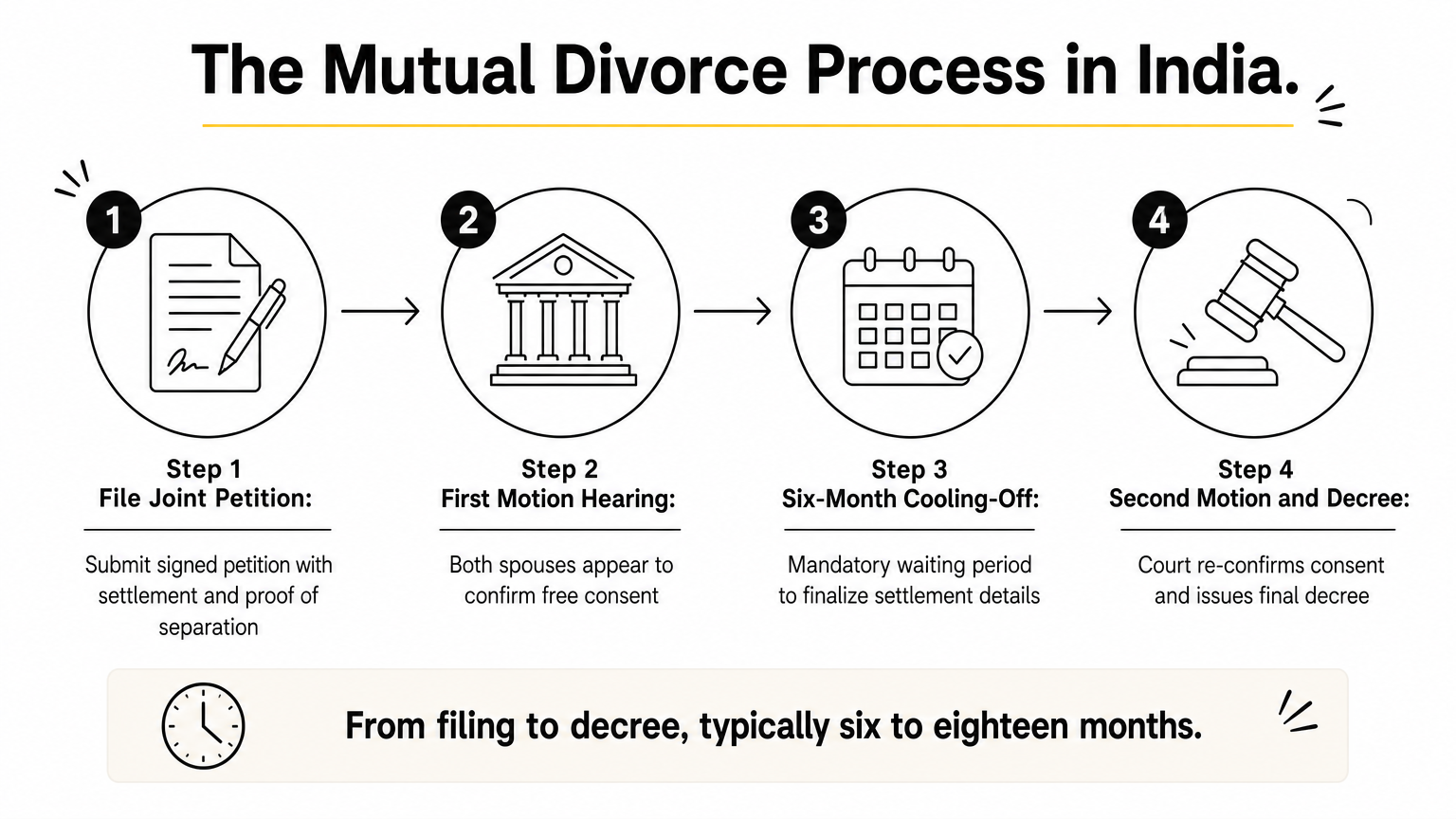
Step 1. File the joint divorce petition
Once you’ve settled the terms, both spouses sign a joint petition and file it in the family court that has jurisdiction, typically where you last lived together, where the marriage was solemnized, or where the wife currently resides. In Chennai, this usually means filing at the Family Court on Fenner Road or the relevant subordinate court depending on your address. Your divorce process mutual consent filing should include the marriage certificate, proof of separation, the signed settlement agreement covering custody, alimony, and property, and identity documents for both parties.
The joint petition is where most delays start, so get every document notarized and cross-checked before you file, not after a judge points out the gaps.
Most lawyers in Chennai handling the mutual divorce india process will draft the petition to include a joint statement affirming that you’ve lived apart for the legally required period and that reconciliation attempts have failed. This document needs to be airtight, since any ambiguity gives the court grounds to send it back for revision, adding weeks to your timeline.
A typical filing checklist looks like this:
- Original marriage certificate or registration proof
- Address proof showing separate residences for both spouses
- Signed settlement agreement (alimony, custody, property)
- Identity proof (Aadhaar, passport, or voter ID) for both parties
- Two passport-sized photographs each
- Filing fee receipt from the family court
Once the court accepts your petition, it schedules the first motion hearing, usually within a few weeks, marking the official start of the cooling-off clock.
Step 2. Appear for the first motion
At the first motion hearing, both spouses must appear in person before the family court, and this is non-negotiable. The judge reads through your joint petition, questions each of you separately, and confirms that neither spouse is signing under pressure from family, financial strain, or someone else’s influence. This is the court’s way of making sure the mutual understanding divorce process you’ve described on paper actually reflects what both of you want.
If either spouse hesitates or contradicts the petition during this hearing, the judge can pause the case entirely, so walk in prepared and aligned.
Expect the hearing to cover a short but specific set of questions:
- Confirmation that you’ve lived separately for the required period
- Verification that reconciliation efforts genuinely failed
- Review of the settlement terms on alimony, custody, and property
- Confirmation that both statements are voluntary, not coerced
Once the judge is satisfied, the court records the statements and formally admits the petition. This step effectively locks in your case and starts the clock on the mandatory waiting period that follows. Some Chennai family courts schedule this hearing within two to three weeks of filing, though it can stretch longer if the court’s docket is busy or if either party’s documentation needs clarification. Lawyers experienced with the mutual consent divorce process in India usually prep clients beforehand with a mock run of likely questions, since nervous or inconsistent answers in court, even from genuinely mutual couples, can trigger unnecessary scrutiny.
Step 3. Complete the six-month cooling-off period
After the first motion, the court imposes a mandatory waiting period, commonly six months, before you can move to the second motion. This gap exists so that couples get one last chance to reconsider before the marriage legally ends. During this stretch, neither spouse needs to appear in court or file anything, but you shouldn’t treat it as dead time. Use it to finalize any loose ends in your settlement, confirm custody logistics if you have children, and make sure alimony payments (if agreed as installments) actually start on schedule.

The six-month wait isn’t a formality to sit through; it’s your last window to fix settlement gaps before the court makes them permanent.
Courts do allow this mutual divorce process time to be waived under Section 13B(2), but only in specific circumstances. The Supreme Court, in Amardeep Singh v. Harveen Kaur (2017), clarified that judges can skip the waiting period if reconciliation is clearly impossible and all settlement terms are already resolved. Chennai family courts grant waivers on a case-by-case basis, and having a lawyer request it explicitly, backed by proof that both parties have moved on independently, improves your odds significantly.
Once six months pass (or a waiver is granted), you don’t automatically get your divorce. Either spouse must file a follow-up motion to proceed, and if that motion isn’t filed within eighteen months of the original petition, the case can lapse entirely. Mark your calendar, because missing this window means restarting the whole mutual consent divorce process from scratch.
Step 4. Attend the second motion and get your decree
Filing for the second motion
Once the waiting period ends, either spouse files a formal application requesting the second motion hearing. This isn’t automatic, so don’t assume the court schedules it for you. Chennai family courts typically list this hearing within a few weeks of the application, provided both parties’ documents are already on file from the first motion.
What happens at the hearing
Both spouses must appear again, and the judge re-confirms that consent hasn’t changed since the first motion. This is a shorter hearing than the first, since the court already reviewed your settlement terms and separation proof earlier. The judge checks that alimony payments, custody arrangements, and property division have proceeded as agreed, and asks directly whether either spouse wants to withdraw consent.
If both spouses still agree at the second motion, the court has no legal reason to delay your decree any further.
Receiving your final decree
When the judge is satisfied, the court passes the final divorce decree on the spot or within a few days, officially dissolving the marriage. This document is what legally ends the union, not the earlier petition or the six-month wait. Ask your lawyer for certified copies immediately, since banks, passport offices, and any future remarriage registration will require the decree as proof. Most Chennai courts issue certified copies within a week of the ruling, closing out the entire process for mutual consent divorce.
Moving forward after your divorce is finalized
Getting through the mutual divorce process takes patience, but it’s still the least painful way to end a marriage legally. Filing the joint petition, surviving the first motion, waiting out the six-month cooling-off period, and finalizing at the second motion isn’t complicated once you know what’s coming at each stage. Most delays happen because couples underestimate the paperwork or walk into hearings unprepared, not because the law itself is slow.
Once your decree is in hand, update your records: banks, passport, property titles, and insurance nominations all need the new documentation. If custody or alimony terms need adjusting later, you can approach the family court again, since a mutual divorce decree doesn’t freeze those arrangements forever.
If you’re still sorting out settlement terms or want someone to review your petition before filing, don’t guess your way through it. Talk to a divorce lawyer in Chennai and book an appointment for a free consultation to get your case moving correctly from day one.