
The total cost of divorce in Chennai is more than your lawyer’s bill. It adds up five things: advocate fees, court fees, documents and notary charges, mediation or counselling, and practical costs such as travel and time off work. For a simple mutual consent divorce, advocate fees of roughly ₹15,000 to ₹75,000 make up most of the total; a contested divorce can cost several lakhs once every hearing and expense is counted.
This guide walks through each cost, line by line, so you can build a realistic budget before your first consultation. All figures are indicative ranges, not fixed rates.
In this guide
- Total cost of divorce at a glance
- Lawyer fees: the largest share
- Court fees and filing costs
- Documents, notary and certified copies
- Mediation and counselling costs
- Other costs people forget
- Mutual consent vs contested: how the total compares
- How to estimate and lower your total cost
- Frequently asked questions
- Plan your divorce budget with an advocate
Total cost of divorce at a glance
Use this table as a checklist. Not every item applies to every case, but each one is worth asking about before you start.
| Cost component | What it covers | How much (indicative) |
|---|---|---|
| Advocate fees | Advice, drafting, court appearances, settlement | ₹15,000 to ₹75,000 (mutual); about ₹50,000 to several lakhs (contested) |
| Court fees | Fee stamps on the petition and applications | Set by law and depends on the relief sought; confirm with your advocate |
| Documents | Notary, affidavits, stamp paper, certified copies, translations | Usually a small part of the total, more in long cases |
| Mediation and counselling | Court-referred sessions or a private mediator | Court-referred sessions cost far less than litigation; private mediators charge their own fees |
| Practical costs | Travel, lost workdays, courier and attestation for NRIs | Varies with the number of hearings |
Maintenance, alimony and child support are not legal costs, but they can be the largest financial item in a divorce. Plan for them separately.
Lawyer fees: the largest share
For most people, the advocate’s fee is the biggest part of the total. It depends on whether the divorce is mutual or contested, the advocate’s experience and how many hearings are needed.
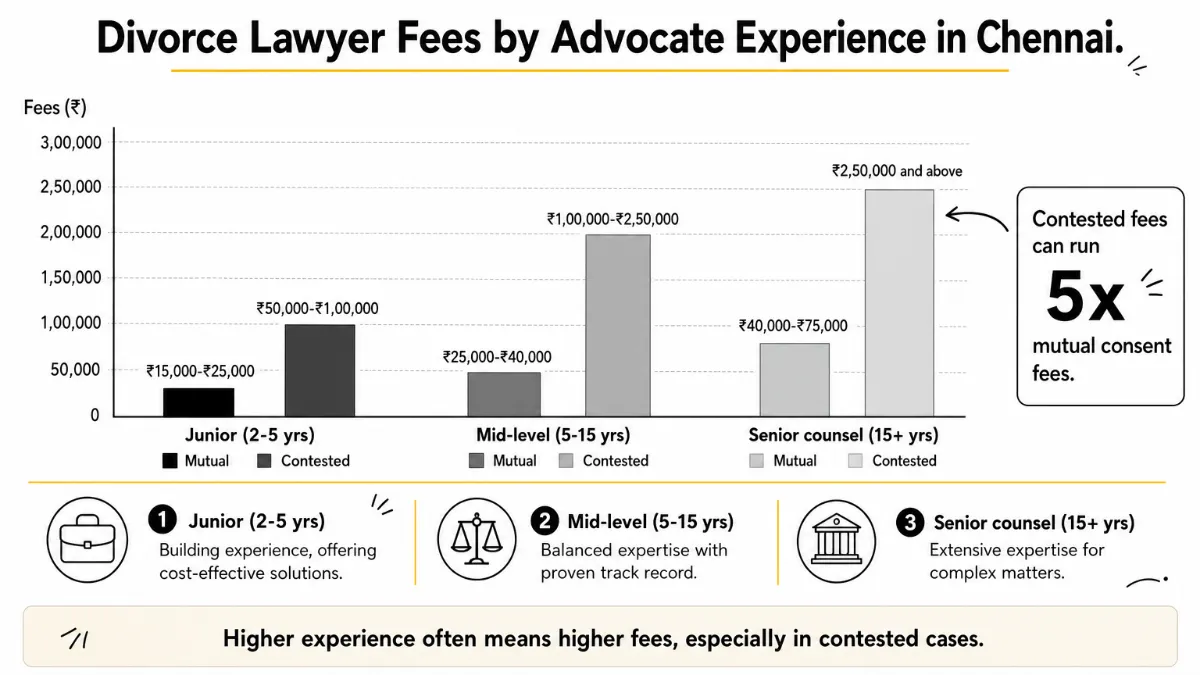
- Mutual consent divorce: typically ₹15,000 to ₹75,000 in total, often as a package fee.
- Contested divorce: typically from about ₹50,000 to ₹2,50,000, and more where custody, maintenance or property is disputed. Often billed per hearing or in stages.
We break these figures down by case type and advocate experience in our guide to divorce lawyer fees in Chennai. If you have seen hourly rates online, our article on divorce lawyer cost per hour explains why Indian advocates rarely bill that way.
If you do not have enough income to pay for the case, you can ask the court to order your spouse to pay litigation expenses and interim maintenance under Section 24 of the Hindu Marriage Act, 1955 (similar provisions exist under the Special Marriage Act). Women and children can also get free legal services under Section 12 of the Legal Services Authorities Act, 1987.
Court fees and filing costs
Every petition and application filed in the Family Court carries a court fee, paid separately from your advocate’s fee. In Tamil Nadu, court fees are governed by state court-fees law, and the amount depends on what you ask the court for.

Expect court-related charges for:
- The main divorce petition (a joint petition in a mutual consent case)
- Interim applications, such as for maintenance, custody or visitation
- Process fees for serving notice on the other party in a contested case
- Applications for certified copies of orders and the decree
Court fees for a divorce petition are generally modest compared with advocate fees. Contested cases cost more because they involve more filings. Ask your advocate for the exact amount for your petition, and whether it is included in their quote.
Documents, notary and certified copies
Divorce cases run on paperwork. Each document has a small cost, and those costs grow over a long case.
- Affidavits and notarisation: petitions and settlement terms are supported by sworn affidavits.
- Stamp paper: may be needed for settlement or other agreements.
- Certified copies: you will need certified copies of the final decree, and often of interim orders.
- Translations: documents not in English or Tamil may need translation.
- Records: marriage certificate, photographs, income proof, bank statements and property papers.
In maintenance disputes, courts follow the Supreme Court’s guidance in Rajnesh v. Neha (2020), which requires both sides to file an affidavit disclosing assets and income. Gathering salary slips, tax returns and bank statements takes time and some expense, so start early.
Mediation and counselling costs
Under the Family Courts Act, 1984, a family court is expected to try to help the parties settle before deciding the case, and couples are often referred to counselling or mediation.
Court-referred counselling or mediation usually costs far less than continuing to litigate, and it can turn a contested case into a mutual one. If you choose a private mediator or counsellor, they charge their own fees, so ask up front.
Settlement is often the single biggest saving available. Once you agree on custody, maintenance and property, the case can move to the shorter mutual consent route.
Other costs people forget
Some of the real cost of a divorce never appears on a lawyer’s invoice.
- Time off work: you may need to attend hearings in person, especially for mutual consent motions and evidence.
- Travel: repeated trips to court and to your advocate’s office.
- NRI costs: courier, notarisation or attestation abroad, and arranging a power of attorney or a video appearance where the court allows it.
- Later applications: changing a maintenance or custody order, or enforcing one, needs a fresh filing and often a fresh fee.
- Setting up a new home: deposits, moving costs and running two households.
Mutual consent vs contested: how the total compares
The route your divorce takes decides most of the total cost.
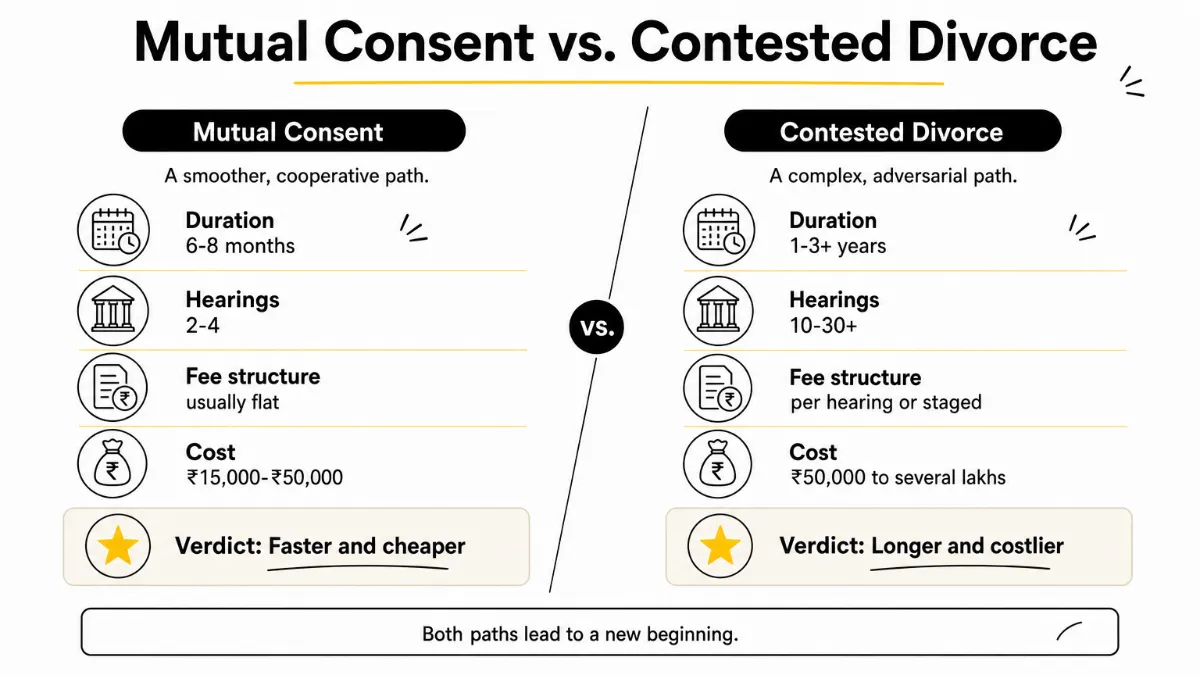
| Factor | Mutual consent | Contested |
|---|---|---|
| Legal basis (Hindu marriages) | Section 13B, Hindu Marriage Act | Section 13 grounds, such as cruelty or desertion |
| Time | Usually at least six months after the first motion, unless the waiting period is waived | No fixed timeline; often a year or more |
| Hearings | A few | Many, with frequent adjournments |
| Advocate fees (indicative) | ₹15,000 to ₹75,000 | About ₹50,000 to several lakhs |
| Other costs | Low | Grow with each hearing and application |
For a mutual consent divorce under Section 13B, the couple must have lived separately for at least a year before filing, and the second motion normally follows at least six months after the first. The Supreme Court held in Amardeep Singh v. Harveen Kaur (2017) that this six-month period can be waived in suitable cases. Our guide to the mutual divorce process explains each step.
How to estimate and lower your total cost
A simple way to build your budget:
- Ask your advocate for a written fee estimate and what stage it covers.
- Ask for the likely court fees for your petition and any interim applications.
- Add documents, copies and translations.
- Add travel and time off work for the hearings you expect.
- Add a buffer of 20 to 30 percent for adjournments and extra applications.
Ways to keep the total down:
- Try mediation before or early in the case.
- Keep documents organised so drafting takes less time.
- Reply to your advocate promptly to avoid needless adjournments.
- Check whether you qualify for free legal aid through the District Legal Services Authority, Chennai.
Under the Family Courts Act, a party is not entitled as of right to be represented by a lawyer, and some people do appear in person. But court fees and documents still have to be paid for, and mistakes in a contested case can cost far more to fix than good advice would have cost at the start.
Frequently asked questions
What is the total cost of a mutual consent divorce in Chennai?
For most couples it is mainly the advocate’s fee, typically ₹15,000 to ₹75,000, plus comparatively small amounts for court fees, notary and certified copies. If each spouse hires a separate advocate, each pays their own fee.
Who pays the cost of divorce in India?
Usually each spouse pays their own costs. A spouse without enough income can ask the court for litigation expenses and interim maintenance under Section 24 of the Hindu Marriage Act.
Why does a contested divorce cost so much more?
Because it involves many more hearings, evidence, cross-examination and interim applications, often over a year or more. Each stage adds advocate fees and expenses.
Can I get a divorce for free?
Women and children are entitled to free legal services under the Legal Services Authorities Act, 1987, as are others who meet the eligibility criteria. Contact the District Legal Services Authority, Chennai, or the Tamil Nadu State Legal Services Authority.
Plan your divorce budget with an advocate
The total cost of divorce depends on your route, your facts and how quickly the case settles. A short consultation can give you a written estimate covering fees, court costs and likely expenses, so there are no surprises later.
To speak to one of the best divorce lawyers in Chennai listed in our directory, call the appointment desk on 9843434510 (available 24/7, first consultation free) or send a request through our contact page.
This article is general information, not legal advice. Speak to an advocate about your specific case.
About this guide: Written by the Divorce Lawyers in Chennai team. Researched from the Acts and court judgments named in this guide and checked against primary sources before publishing. Last reviewed on 23 October 2026. How we research and check our guides.