
The process for mutual divorce in India has four stages: you and your spouse file a joint petition, appear together for the first motion, wait out a six-month period (which the court can sometimes waive), and then appear again for the second motion, when the court passes the divorce decree. Before any of that, you must have lived apart for at least a year and agreed on alimony, custody and property.
It is the quickest and least bitter way to end a marriage legally, but it follows a strict sequence. Most delays happen because couples file with incomplete papers or an unfinished settlement, not because the law itself is slow.
This guide explains each stage of the mutual consent divorce process, who can use it, the documents you need, how long it realistically takes, and what couples in Chennai should prepare before the first hearing.
In this guide
- The mutual divorce process at a glance
- Who can file for mutual consent divorce
- Settle the terms before you file
- Step 1: File the joint petition
- Step 2: Appear for the first motion
- Step 3: The six-month period and when it can be waived
- Step 4: Second motion and final decree
- How long it takes and what it costs
- Filing online or from abroad
- After the decree
- Other divorce routes and court steps
- Frequently asked questions
- Get help with your joint petition
The mutual divorce process at a glance
Every mutual consent divorce in India moves through the same four stages. You file once, appear twice and wait in between.
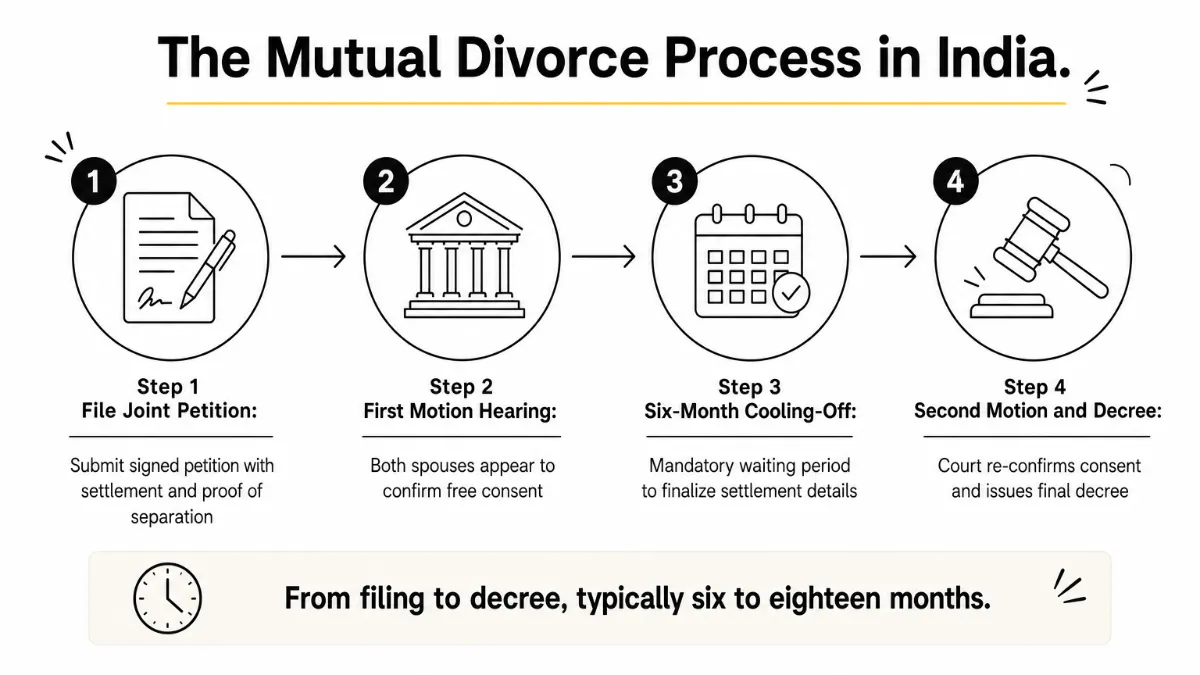
| Stage | What happens | Who must be present |
|---|---|---|
| 1. Joint petition | Both spouses sign and file one petition with the agreed settlement terms | Your advocate files it; both of you sign |
| 2. First motion | The judge records each spouse’s statement and confirms free consent | Both spouses (in person, or by video if the court allows) |
| 3. Waiting period | At least six months from presentation of the petition, unless waived | No appearance needed |
| 4. Second motion and decree | Both confirm consent again; the court passes the divorce decree | Both spouses |
The sections below explain each stage in detail. If your main question is the timeline, see our guide on how many days the mutual divorce process takes.
Who can file for mutual consent divorce
Under Section 13B of the Hindu Marriage Act, 1955, a joint petition needs three things: you have lived separately for one year or more before filing, you have not been able to live together, and you both agree the marriage should be dissolved. Courts take the last point seriously. If a judge suspects one spouse is being pressured, the petition will not go through, however tidy the papers look.
“Living separately” does not always mean different houses. Courts look at whether you have lived as husband and wife, not just at the address. Separate address proof still makes the year far easier to show.
Section 14 of the same Act also bars a divorce petition within the first year of marriage, except in cases of exceptional hardship or depravity, so very new marriages usually have to wait.

The law that applies depends on your religion and how you married. The separation period changes with it.
| Community / marriage | Governing Act | Section | Separation before filing |
|---|---|---|---|
| Hindu, Buddhist, Jain, Sikh | Hindu Marriage Act, 1955 | Section 13B | 1 year |
| Civil or interfaith marriage | Special Marriage Act, 1954 | Section 28 | 1 year |
| Christian | Indian Divorce Act, 1869 | Section 10A | 2 years |
| Parsi | Parsi Marriage and Divorce Act, 1936 | Section 32B | 1 year |
| Muslim | Muslim personal law (mubarat or khula) | Not a statutory joint petition | No fixed statutory period; take advice on how to record it |
This guide uses the Hindu Marriage Act as its baseline because most Chennai filings follow it. Under the other Acts the steps are similar, but the section number and separation period change.
Settle the terms before you file
Mutual consent means you agree on more than ending the marriage. The court expects every practical issue to be settled in writing before it moves forward. Gaps in the settlement are one of the most common reasons a case stalls at the first or second motion.
- Permanent alimony or maintenance: the amount, lump sum or instalments, and the payment dates.
- Child custody and visitation: who keeps the children, a concrete visiting schedule, and holidays.
- Child support: monthly support, school fees and medical costs.
- Streedhan and belongings: an itemised list of what is returned and when.
- Property and loans: who keeps the house, vehicle and savings, and who repays which loan.
- Pending cases: how any maintenance, domestic violence or criminal complaints between you will be withdrawn.
Write a number, a date or a name against each item, not a general promise. Custody terms are not final just because you both agree; the court can still review them for the child’s welfare.
A mutual divorce moves fast only when both spouses have already agreed on money, custody and property before walking into court.
Step 1: File the joint petition
Once the terms are settled, your advocate drafts one joint petition that both of you sign, along with supporting affidavits. It states the date and place of marriage, where you last lived together, details of any children, when your separation began, that you have lived apart for the required period, and the agreed settlement terms.
Under Section 19 of the Hindu Marriage Act, the petition can be filed in the court covering the place where the marriage was solemnised, where you last lived together, or where the respondent lives, and a wife who is a petitioner can also file where she lives. In Chennai, mutual petitions are heard by the Family Court with jurisdiction. Your advocate will confirm the right court, because filing in the wrong one costs weeks.
A typical filing checklist:
- Marriage certificate, or wedding photographs and invitation if the marriage was not registered
- Identity and address proof for both spouses (Aadhaar, passport or voter ID)
- Proof of separate residence, such as rental agreements or utility bills at different addresses
- Income proof if alimony or maintenance is involved, such as salary slips or income tax returns
- Children’s birth certificates, if any
- The signed settlement terms
- Recent passport-size photographs of both spouses
Check that names and dates match across every document. A mismatch between an Aadhaar card and the marriage certificate is a common reason the registry returns a petition. Once the registry accepts it, the court gives a case number and a date for the first motion.
Step 2: Appear for the first motion
At the first motion, both spouses appear before the judge. The judge reads the petition and settlement, records your statements, and checks that neither of you is signing under pressure from family, money worries or anyone else. Some judges question each spouse separately, and many first refer couples to counselling or mediation, as the Family Courts Act expects courts to attempt a settlement.
Expect questions on:
- how long you have lived apart and why;
- whether reconciliation is possible;
- the alimony, custody and property terms;
- whether you are both acting freely.
If either of you hesitates or contradicts the petition, the judge can hold the matter back, so go in prepared and in agreement. Carry original ID and the signed settlement even if copies are already on file. When the judge is satisfied, the court records the first motion and the waiting period runs.
If either spouse hesitates or contradicts the petition at this hearing, the judge can pause the case, so walk in prepared and aligned.
Step 3: The six-month period and when it can be waived
Section 13B(2) says the second motion can be made no earlier than six months and no later than eighteen months after the petition is presented. The gap gives couples a last chance to reconsider. You do not need to attend court during it, but use the time well: pay any instalments due under the settlement and keep receipts, complete handovers of belongings or property, and keep your advocate informed if your address or phone number changes.

When the court can waive the six months
In Amardeep Singh v. Harveen Kaur (2017), the Supreme Court held that the six-month period is directory, not mandatory. The court hearing the case can waive the cooling period if it is satisfied that:
- the one-year separation and the six-month period together (about 18 months) had already passed before the first motion;
- mediation and conciliation efforts have failed and there is no real chance of reunion;
- you have genuinely settled all issues, including alimony and custody;
- waiting longer would only prolong your distress.
The waiver application can be filed one week after the first motion, with reasons. The decision is the judge’s, case by case, so treat a waiver as a possibility, not a plan. Separately, in Shilpa Sailesh v. Varun Sreenivasan (2023), the Supreme Court confirmed that it can itself dissolve a marriage under Article 142 of the Constitution in suitable cases, but that power belongs to the Supreme Court, not the family court.
Step 4: Second motion and final decree
Filing the second motion
The second motion is not automatic. After the waiting period (or once a waiver is granted), your advocate moves the second motion and the court lists it for hearing. Do not let the eighteen-month outer limit in Section 13B(2) slip; a petition that runs past it can face difficulty and may have to be filed afresh.
What happens at the hearing
Both spouses appear again. The judge confirms that consent has not changed, checks that the settlement is being honoured, and may record fresh statements. Bring original ID and proof of any payments already made.
Consent must exist right up to the decree. In Hitesh Bhatnagar v. Deepa Bhatnagar (2011), the Supreme Court confirmed that either spouse may withdraw consent at any time before the decree is passed, and the court cannot then grant a mutual divorce.
Receiving the decree
If the judge is satisfied, the court passes the decree dissolving the marriage, sometimes the same day and sometimes after a short gap. Apply for certified copies straight away; banks, passport offices and any future marriage registration will ask for them.
If both spouses still agree at the second motion and the settlement has been honoured, the decree usually follows without further delay.
How long it takes and what it costs
Because of the six-month period, most mutual divorces take around seven to eight months from filing to decree when the papers are complete. With a waiver it can be much shorter; with missing documents, adjournments or a spouse abroad it can stretch towards the eighteen-month limit. These are typical ranges, not promises, as each court runs its own list. The timeline guide linked above breaks down where the days go.
Costs fall into two groups: modest court fees, stamp paper and notary charges, and advocate fees. As a broad, indicative range, total lawyer fees for a mutual consent divorce in Chennai often fall between ₹15,000 and ₹75,000, depending on the advocate’s experience and how much drafting and negotiation is involved. See our divorce lawyer fees guide for details, and always ask for a written quote that covers both motions and the certified copy.
Filing online or from abroad
A lot of the preparation can now happen online: consultations by phone or video, settlement drafts by email, and e-filing where the court allows it. The decree still comes from a judge after two motions. Our guide to the mutual divorce process online explains what can and cannot be done digitally.
If one spouse lives outside India, ask your advocate early whether the court will permit appearance by video conference; the Supreme Court in Amardeep Singh recognised that courts may use video conferencing in such cases. Our NRI divorce guide covers the extra paperwork.
After the decree
Once you hold the certified decree, update your records. Marital status, nominees and joint accounts do not change automatically.
- Update bank accounts, insurance and provident fund nominations.
- Update your passport and other ID where marital status or name appears.
- Complete any property transfers promised in the settlement.
- Keep several certified copies safely for future property, visa or loan paperwork.
If you plan to remarry, confirm the timing with your advocate. If circumstances change later, child custody and child support arrangements can be taken back to the court, because the child’s welfare always comes first.
Other divorce routes and court steps
Mutual consent is the quickest route, but it only works when both of you agree on everything. If your spouse will not agree, the alternative is a contested divorce: one spouse files on a ground recognised by law, such as cruelty, desertion for at least two years or adultery under Section 13 of the Hindu Marriage Act, and must prove it in court. It usually takes much longer than a joint petition.
Whichever route you take, a few steps are common:
- Legal notice: many people send a legal notice for divorce before filing. It is not compulsory, but it puts your position on record and sometimes opens the door to settlement.
- Documents: marriage proof, address and identity proof, photographs, income details and any settlement terms are needed for both mutual and contested petitions (see the full documents required for divorce checklist).
- Where to file: our guide on how to file for divorce in Chennai covers this in detail. Under Section 19 of the Hindu Marriage Act you can file where the marriage was solemnised, where your spouse lives, where you last lived together, or where the wife lives if she is the petitioner. In Chennai that is usually the Family Court.
- Mediation: the Family Court is required to try to settle matters first, and many contested cases end as mutual consent divorces after mediation.
- After the decree: keep a certified copy of the decree. You will need it to change your name in records, update your passport, or remarry once the appeal period is over.
All guides in this section
- Contested Divorce in India: Meaning, Process and Time
- Documents Required for Divorce in India: Full Checklist
- How to File for Divorce in Chennai: Step-by-Step Guide
- How to File Mutual Divorce Online in India: Full Process
- Legal Notice for Divorce: Format, Process and Reply
- Mutual Divorce Process: How Many Days It Takes in India
- Mutual vs Contested Divorce: Time, Cost and Which to Choose
- Waiver of 6 Month Cooling Period in Mutual Divorce
Frequently asked questions
Is the six-month waiting period compulsory in a mutual divorce?
Not always. The Supreme Court has held it is directory, so the court can waive it when you have already been separated for about 18 months, mediation has failed and all terms are settled. Waiver is at the judge’s discretion.
Can one spouse withdraw consent after the first motion?
Yes. Either spouse can withdraw consent at any time before the decree. If that happens, the court cannot grant a mutual divorce, and the other spouse would need to consider a contested petition on the grounds available under law.
Do both spouses have to attend court?
Yes, both must appear at the first and second motions. Many courts now allow appearance by video conference where there is a genuine reason, such as a spouse living abroad, but you must ask for it in advance.
Can we file for mutual divorce in the first year of marriage?
Generally no. Section 14 of the Hindu Marriage Act bars divorce petitions within one year of marriage, except in cases of exceptional hardship or depravity, and Section 13B itself requires one year of separation.
Get help with your joint petition
The process for mutual divorce is straightforward once you know what comes at each stage: settle the terms, file a complete petition, attend both motions and keep your settlement on track in between. Most problems come from rushed paperwork, so a short review before filing can save months.
Our directory lists some of the top divorce lawyers in Chennai who regularly handle mutual consent petitions. Call the appointment desk on 9843434510 (available 24/7, first consultation free) or send a request through our contact page.
This article is general information, not legal advice. Speak to an advocate about your specific case.
About this guide: Written by the Divorce Lawyers in Chennai team. Researched from the Acts and court judgments named in this guide and checked against primary sources before publishing. Last reviewed on 26 October 2026. How we research and check our guides.