
A legal notice for divorce is a formal letter, usually sent through an advocate, telling your spouse that you intend to seek a divorce and why. In India it is not compulsory before filing a divorce petition, but it is often a useful first step: it puts your position on record and frequently opens the door to a settlement or a mutual consent divorce.
This guide explains when a divorce notice helps, what it should contain, a simple format, how to send it, and what to do if you are the one who receives it.
In this guide
- What is a legal notice for divorce?
- Is a divorce notice compulsory?
- When sending a divorce notice is worth it
- What a divorce notice should contain
- A simple format
- How to send the notice and prove delivery
- What happens after the notice
- If you receive a legal notice for divorce
- Cost of sending a divorce notice
- Frequently asked questions
- Speak to an advocate before you send or reply
What is a legal notice for divorce?
It is a pre-litigation letter. It sets out the basic facts of the marriage, the problems that have led to the breakdown, the legal ground you rely on, and what you want: a divorce by consent, a settlement, or a reply within a fixed time.
A notice is not a court document. It does not end the marriage, and your spouse is not legally bound to reply. Only a decree of the family court dissolves a marriage.
Is a divorce notice compulsory?
No. Under the Hindu Marriage Act, 1955, the Special Marriage Act, 1954 and the Indian Divorce Act, 1869, you can file a divorce petition without first sending a notice. Once the petition is filed, the court issues its own summons to your spouse.
Many people still send one, because a carefully drafted notice can:
- show the court, later, that you tried to resolve matters before litigation;
- record dates and events while they are fresh, such as when your spouse left the matrimonial home;
- test whether your spouse will agree to a mutual consent divorce, which is faster and cheaper;
- prompt a written reply that may itself become useful evidence.
There are cases where a notice is a poor idea. If there is a risk of violence, or your spouse may move or hide assets once warned, speak to an advocate first. Urgent protection under the Protection of Women from Domestic Violence Act, 2005 does not need a prior notice.
When sending a divorce notice is worth it
- To propose mutual consent. The notice invites your spouse to settle alimony, stridhan, custody and property and file a joint petition under Section 13B of the HMA.
- Before a contested petition. It sets out your ground, such as cruelty or desertion, and gives your spouse a final chance to respond.
- Where your spouse has left. A notice asking your spouse to return, or explaining why you are seeking divorce, helps establish the timeline in a desertion case.
- For restitution of conjugal rights. Some spouses first ask the other to resume cohabitation, before considering a petition under Section 9 of the HMA.
Keep in mind that, under Section 14 of the HMA, a divorce petition generally cannot be filed within one year of marriage unless the court permits it for exceptional hardship or depravity. A notice can be sent earlier, but the petition will have to wait.
What a divorce notice should contain
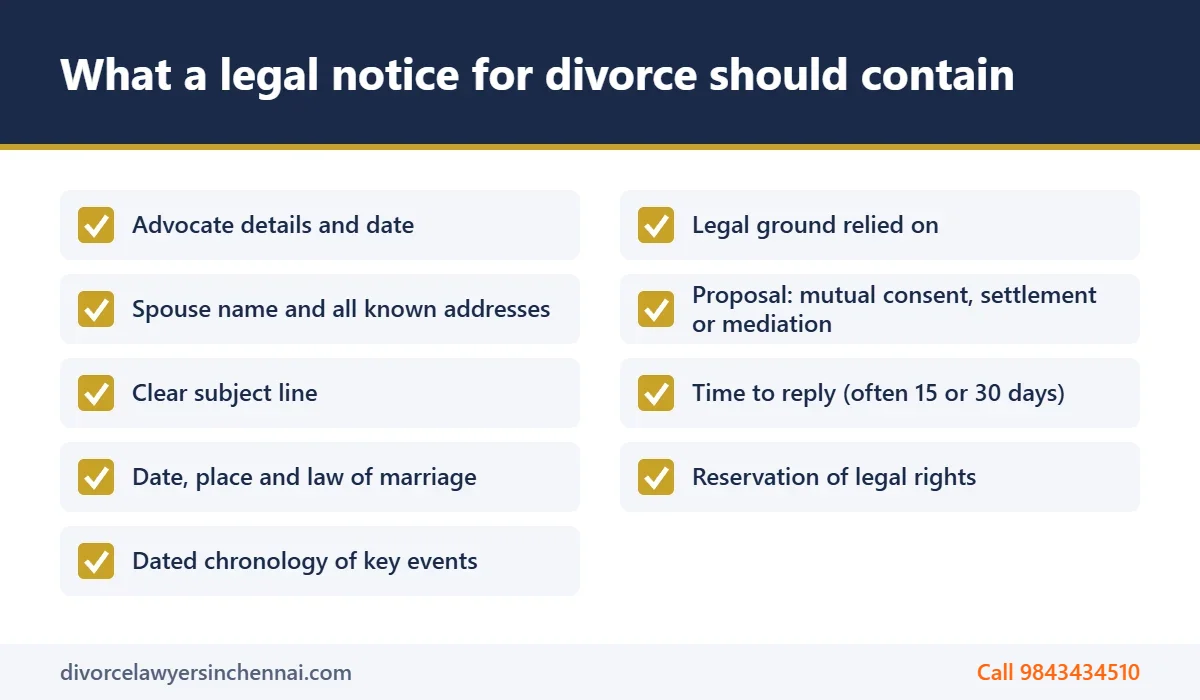
A good notice is factual, calm and specific. Exaggeration or abuse in a notice can be used against you later, because the notice and any reply can be produced in court. Your advocate will usually include:
- Sender and date: the advocate’s name, enrolment details and address, and the date of the notice.
- Recipient: your spouse’s full name and current address, and other known addresses.
- Subject line: for example, “Legal notice on behalf of my client regarding dissolution of marriage”.
- Marriage details: date and place of marriage, the law it was solemnised under, registration details, and children, if any.
- Facts in order: a short, dated chronology of the events behind the breakdown.
- Legal ground: the ground under the applicable law, such as cruelty or desertion under Section 13 of the HMA.
- Demand or proposal: consent to a mutual divorce, terms of settlement, return of articles, or a meeting for mediation.
- Time to reply: commonly 15 or 30 days. This is chosen by the sender; no statute fixes it.
- Reservation of rights: a statement that your client may take legal action if there is no response.
A simple format
Every notice should be drafted to your facts, so treat this outline as a guide to structure, not a template to copy:
- Heading: “Legal Notice”, the mode of service (for example, “By Registered Post with Acknowledgement Due”), and the date.
- To: your spouse’s name and address.
- Opening: “Under instructions from and on behalf of my client, [name], residing at [address], I issue this notice to you as follows.”
- Numbered paragraphs: the marriage, the children, the events, and the reasons the marriage has broken down.
- Legal position: the ground relied on and the relief sought.
- Call to action: “You are called upon to respond within [15/30] days, failing which my client will be constrained to initiate proceedings before the appropriate Family Court.”
- Signature: the advocate’s signature, with a copy retained in the office.
If you are proposing mutual consent, the tone should be conciliatory. A hostile notice makes settlement harder and can push a case that might have taken months into years of litigation.
How to send the notice and prove delivery
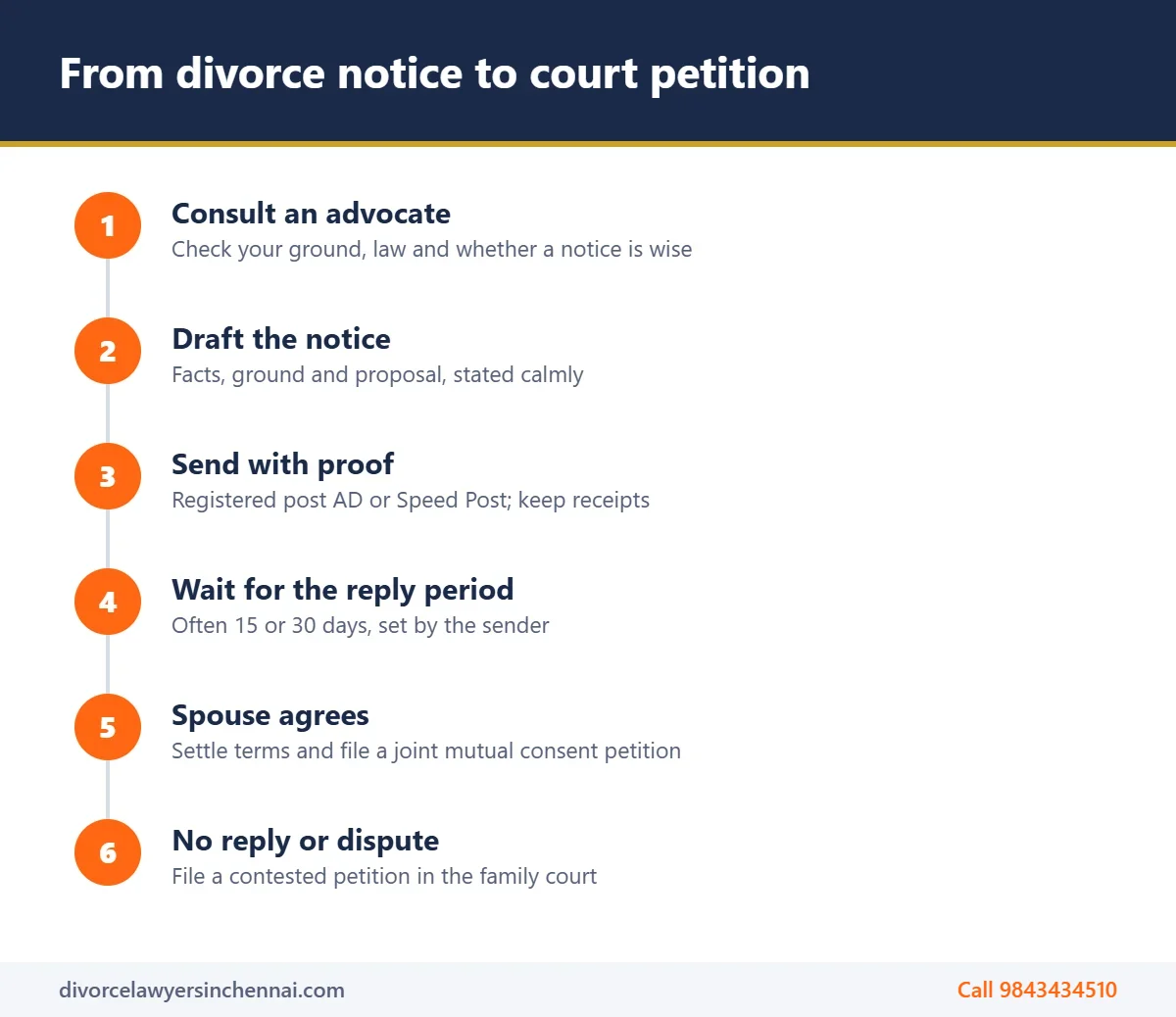
Proof of service matters more than people expect. Use methods that leave a trail:
- Registered post with acknowledgement due, or Speed Post with tracking.
- Email and messaging apps as additional channels, not the only one.
- Copies to every known address if your spouse moves between homes.
Keep the postal receipts, the tracking printout, the returned acknowledgement card and a signed copy of the notice. If the notice is returned “refused” or “unclaimed”, keep the envelope unopened; your advocate may rely on it.
What happens after the notice
There are usually three outcomes:
- Your spouse agrees. The two of you settle terms and file a joint petition. Read our guide to the mutual divorce process and how long a mutual divorce takes.
- Your spouse replies and disputes it. You can try mediation or file a contested petition on your ground.
- Your spouse does not reply. Silence does not grant a divorce, and it is not automatically an admission. You file the petition, and the court serves its own notice.
Either way, the next step is a petition before the family court with jurisdiction. Our step-by-step guide on how to file for divorce in Chennai covers where and how to file, and the list of documents required for divorce helps you prepare.
If you receive a legal notice for divorce
Do not panic, and do not ignore it. A notice from your spouse’s advocate is not a summons, and nothing is decided yet. But how you respond can shape what follows.
- Read it fully. Note the allegations, what is demanded, and the reply deadline.
- Speak to your own advocate. Reply through counsel rather than arguing with your spouse directly.
- Check every fact. Mark wrong dates, exaggerations and anything you deny.
- Preserve evidence. Keep messages, bank records, medical papers and photographs. Do not delete anything.
- Reply in time. A reply is not legally compulsory, but a clear, point-by-point denial avoids any later argument that you accepted the allegations by staying silent.
- Keep the door open. If you are willing to discuss settlement or mediation, say so.
Avoid counter-allegations you cannot support. Like the notice, your reply may be produced in court.
Cost of sending a divorce notice
Advocates charge for drafting and sending a notice according to the complexity of the facts and their experience. Some include it in an overall fee for the divorce case. Ask for the fee in writing before work begins. Our divorce lawyer fees guide explains what affects the total cost of a divorce in Chennai.
Frequently asked questions
Can I send a divorce notice without a lawyer?
There is no rule against it, but a notice drafted by an advocate is taken more seriously and is less likely to contain statements that hurt your case later.
Does the marriage end if my spouse accepts the notice?
No. Even if your spouse agrees in writing, you still need a decree from the family court, either through a joint mutual consent petition or a contested case.
Can a notice be sent by WhatsApp or email?
It can be sent by email or WhatsApp as well, but rely mainly on registered post or Speed Post, which give stronger proof of delivery.
Can a wife send a legal notice for divorce?
Yes. Either spouse can send one. A wife facing harassment may also need urgent protection or maintenance, which can be sought from the court without waiting for a reply.
Speak to an advocate before you send or reply
A legal notice for divorce is short, but what it says can follow your case all the way to the final hearing. Getting the facts, ground and tone right at this stage is worth the effort.
The leading divorce lawyers in Chennai listed in our directory can draft a notice or a reply for you. Call the appointment desk on 9843434510 or book through our contact page.
This article is general information, not legal advice. Speak to an advocate about your specific case.
About this guide: Written by the Divorce Lawyers in Chennai team. Researched from the Acts and court judgments named in this guide and checked against primary sources before publishing. Last reviewed on 15 October 2026. How we research and check our guides.