
Divorce for Christians in India is not granted under the Indian Christian Marriage Act, 1872. That law only covers how a marriage is solemnized and registered. If you are looking up divorce in Christian Marriage Act provisions, the law you need is the Indian Divorce Act, 1869. It sets the grounds, the mutual consent route, and the court procedure for any couple where at least one spouse professes Christianity.
Think of the two laws as a pair. The 1872 Act creates a valid Christian marriage, and the 1869 Act ends it. The 1869 Act is still in force, amended in 2001 and again in 2019, despite what some websites say about its repeal.
This guide explains why the split matters, how to get a mutual consent divorce under Section 10A, which grounds you can use in a contested case, how the court process runs, and what happens to maintenance and custody. The steps below are written with Chennai filings in mind.
In this guide
- Why two Acts decide a Christian divorce in India
- How to get a mutual consent divorce under Section 10A
- Grounds for divorce under the Christian divorce law
- How a contested divorce petition moves through court
- Maintenance, custody, and property after divorce
- Frequently asked questions
- Next steps for your Christian divorce
Why two Acts decide a Christian divorce in India
Two Acts matter because they answer different questions, and mixing them up sends you to the wrong provisions. The Indian Christian Marriage Act, 1872 decides whether your marriage was validly solemnized and registered. The Indian Divorce Act, 1869 decides whether and how that marriage can end. Research that stops at the 1872 law will not find a single ground for divorce.
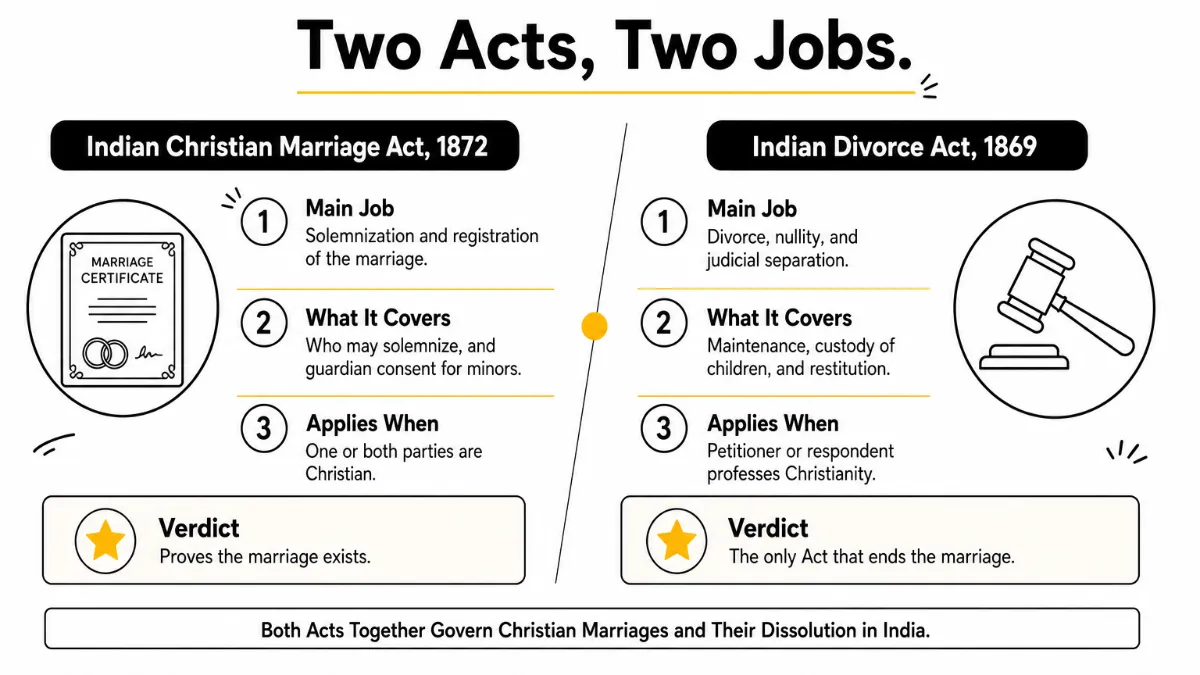
What each Act covers
The table below shows the division of work between the two laws.
| Indian Christian Marriage Act, 1872 | Indian Divorce Act, 1869 | |
|---|---|---|
| Main job | Solemnization and registration of marriage | Divorce, nullity, judicial separation |
| Also deals with | Who may solemnize, licensing of ministers, consent of guardians for minors | Maintenance, custody of children, restitution of conjugal rights |
| Applies when | One or both parties are Christian | Petitioner or respondent professes Christianity |
| Where you use it | Proving the marriage is valid | Filing the petition to end it |
Your church or registrar’s marriage certificate proves the marriage under the 1872 Act. You attach it to your petition, but the petition itself is drafted under the 1869 Act. Section 10 (grounds) and Section 10A (mutual consent) are the provisions most couples need.
The 1872 Act proves your marriage exists, and only the 1869 Act can end it.
Who falls under the Divorce Act
Section 2 allows a petition where the petitioner or the respondent professes the Christian religion. A Christian who married a Hindu under the 1872 Act can therefore still use the 1869 Act. The exception is a couple who married under the Special Marriage Act, 1954. They divorce under that Act, whatever their faith. Check which Act your marriage certificate cites before you do anything else.
Names, the 2019 reference, and where to read the text
Searches for "Christian Marriage and Divorce Act", "Christian Marriage Act 1872 divorce", and "2019 PDF" all point to the same place. There is no single central statute with that combined name. A Jammu and Kashmir law from 1957, since repealed, carried a similar title, which is why it shows up in results. The 2019 reference is the Personal Laws (Amendment) Act, 2019, which removed leprosy as a ground for divorce from several personal laws, including the 1869 Act.
To read the law yourself, search for the Indian Divorce Act, 1869 on India Code, the government’s repository of central Acts. Use the version that shows amendments up to date, not an old scanned copy.
How to get a mutual consent divorce under Section 10A
You get a mutual consent divorce by filing a joint petition under Section 10A of the Indian Divorce Act, 1869 after living apart for the required period, then confirming your consent in court after a waiting period. People often call this a mutual divorce in the Christian Marriage Act, but the provision sits in the Divorce Act. It is usually the fastest and cheapest route when both of you agree.

Eligibility under Section 10A
Section 10A asks you to prove three things:
- You have been living separately for two years or more.
- You have not been able to live together.
- You have mutually agreed that the marriage should be dissolved.
The statute says two years. In Saumya Ann Thomas v. Union of India (2010), the Kerala High Court read this as one year, because the Hindu, Special Marriage, and Parsi laws all use one year. In December 2022, a Division Bench of the Kerala High Court went further and held that even a fixed minimum separation period for filing under Section 10A is unconstitutional. Kerala rulings do not bind courts in Tamil Nadu. They are persuasive only, so ask your advocate how the family court in Chennai treats the separation period before you file.
Steps from petition to decree
The mutual divorce procedure is the same in most courts:
- Settle the terms. Write down what you agree on: maintenance, custody and visiting, and who keeps which property.
- Gather documents. You need the marriage certificate, ID and address proofs, wedding photographs, proof of separate residence, and income details.
- File the joint petition in the family court or district court with jurisdiction over your case.
- Record statements. Both spouses appear, and the court may try to counsel you.
- Make the second motion after the waiting period, confirming you still consent.
- Receive the decree once the court is satisfied that the conditions are met and the consent is genuine.
The waiting period and how it can be waived
Section 10A(2) lets you make the second motion no earlier than six months after the petition and no later than eighteen months. In Tomy Joseph v. Smitha Tomy (2018), the Kerala High Court waived the six-month gap for a Christian couple. The Supreme Court had held in Amardeep Singh v. Harveen Kaur (2017) that the equivalent wait under the Hindu Marriage Act is not mandatory.
Waiver is possible, but you have to ask for it and show the court that reconciliation has no chance.
Courts look for a signed settlement, long separation, and no pending cases between you. If there are criminal complaints or disputes over children, expect the court to insist on the full period.
Grounds for divorce under the Christian divorce law
If you do not agree on divorce, you must prove a ground listed in Section 10 of the Indian Divorce Act, 1869. Since the 2001 amendment, husbands and wives have the same grounds, and a wife has one more. The grounds for divorce under the Christian Marriage Act system are therefore a single list in the Divorce Act. For the other personal laws, see our overview of grounds for divorce in India.
Grounds open to both spouses
Either spouse can petition on any of these grounds:
- Adultery.
- Conversion to another religion.
- Incurable unsound mind for at least two years immediately before the petition.
- Venereal disease in a communicable form for at least two years.
- Not being heard of as alive for seven years by those who would naturally have heard.
- Willful refusal to consummate the marriage, so that it has not been consummated.
- Failure to obey a decree for restitution of conjugal rights for two years or more.
- Desertion for at least two years.
- Cruelty that makes it harmful or dangerous to live with the other spouse.
Leprosy used to appear on this list. The 2019 amendment removed it. Adultery was decriminalized by the Supreme Court in 2018 in Joseph Shine v. Union of India, but it remains a valid civil ground for divorce. Cruelty covers mental as well as physical harm, and courts judge it from a pattern of conduct, not one quarrel.
The additional ground for a wife
Section 10(2) lets a wife petition if her husband has been guilty of rape, sodomy, or bestiality after the marriage. No similar ground exists for a husband. You need evidence, and the court will weigh criminal records, medical reports, and witness testimony.
Nullity and judicial separation
Divorce is not your only option. Under Section 19, a court can declare a marriage null and void. Grounds include impotence at the time of marriage and of the petition, relationships within prohibited degrees, unsound mind at the time of marriage, a living former spouse, and consent obtained by force or fraud. Under Section 22, you can ask for judicial separation on grounds of adultery, cruelty, or two years of desertion. The marriage then continues, and neither of you can remarry. This route suits people who object to divorce on religious grounds but cannot live together.
Pick the ground you can prove with documents and witnesses, not the one that feels most accurate.
How a contested divorce petition moves through court
A contested petition under Section 10 follows ordinary civil trial steps, so expect it to take much longer than a mutual consent case. You file in the district court or family court covering the place where you married, or where you and your spouse last lived together. Families in Chennai usually file before the family court. The timeline depends on the court’s workload and on how hard your spouse contests.

Filing and trial
The process runs roughly like this:
- Your advocate drafts a petition stating the facts, the ground, and the relief you seek.
- The court issues notice to your spouse, who files a written reply.
- The court may refer you to mediation or counseling.
- Both sides lead evidence, which means affidavits, documents, and cross-examination.
- Final arguments are heard and the judgment is delivered.
If your spouse lives abroad, jurisdiction and domicile can complicate the case. Speak to an advocate before you file if either of you lives outside India.
Decree, appeal, and remarriage
The court can refuse a decree even when a ground is proved. It may do so where the petitioner colluded with the other side, delayed unreasonably, or is guilty of conduct such as cruelty. Older articles say a High Court must confirm every district court decree. That requirement was removed by the 2001 amendment, so a district court decree no longer needs High Court confirmation. Either side can still appeal to the High Court. Under Section 57, you may remarry only after the appeal period ends without an appeal, or after any appeal is dismissed.
Maintenance, custody, and property after divorce
Maintenance, custody, and property are decided alongside the divorce, and the Divorce Act gives courts power to order each. Under the Act, a wife can claim interim maintenance while the case is pending (Section 36) and permanent maintenance after the decree (Section 37). Interim alimony under Section 36 cannot exceed one-fifth of the husband’s average net income over the previous three years.
Maintenance
The court looks at the wife’s own assets, the husband’s income and ability to pay, and the way the couple lived. In maintenance proceedings, the Supreme Court’s 2020 guidelines in Rajnesh v. Neha require both sides to file affidavits disclosing assets and income. A claim for maintenance can also be made under Section 144 of the Bharatiya Nagarik Suraksha Sanhita, which replaced Section 125 of the old Code of Criminal Procedure. In a mutual consent case, there is no fixed formula, so you can agree on a lump sum or monthly payments.
Custody and property
On custody, the court puts the child’s welfare first. It does not prefer a parent by gender or religion. Orders can cover interim custody during the case, custody after the decree, and visiting rights. The Guardians and Wards Act, 1890 may apply as well. The Divorce Act has no formula for dividing property. Ownership usually follows whose name is on the title, and gifts and jewelry given to the wife are treated separately. In a mutual consent case, write the property terms into the settlement so the court can record them in its decree.
Put every settlement term in writing before you file, because the court can only enforce what the decree records.
Frequently asked questions
Can Christians get a mutual consent divorce in India?
Yes. Section 10A of the Indian Divorce Act, 1869 allows a joint petition when both spouses agree and have lived separately. The court grants the decree after the second motion, once it is satisfied that the consent is genuine.
How long does a Christian divorce take?
There is no fixed timeline. A mutual consent case needs at least the six-month gap between the petition and the second motion unless the court waives it. A contested case usually takes much longer, depending on evidence and the court’s workload.
Is the six-month waiting period compulsory?
Not always. The Kerala High Court waived it for a Christian couple in Tomy Joseph v. Smitha Tomy (2018), following the Supreme Court’s approach in Amardeep Singh v. Harveen Kaur (2017). You must apply for the waiver and show that reconciliation is not possible.
When can I remarry after a Christian divorce?
Under Section 57, after the time for appeal has expired without an appeal, or after any appeal has been dismissed. Remarrying earlier can create serious legal problems.
Next steps for your Christian divorce
Divorce for Christians in India runs through the Indian Divorce Act, 1869, while the Indian Christian Marriage Act, 1872 only proves that you were married. If you both agree, Section 10A offers a joint petition with a waiting period. If you do not, Section 10 requires you to prove a ground such as adultery, cruelty, desertion, or conversion.
Before you file, collect your marriage certificate, decide whether you want divorce, nullity, or judicial separation, and write down your position on maintenance and custody. The right advocate can tell you how your court handles separation periods and waivers. If your marriage was under Muslim law instead, see our guide to Muslim divorce lawyers in Chennai.
The advocates in our directory handle divorce, maintenance and custody petitions. None of their profiles lists a separate Christian-law specialism, so tell our appointment desk that your marriage falls under the Christian law and they will match you with a suitable advocate from our list of top divorce lawyers in Chennai. Call 9843434510, available 24/7, for a free first consultation, or write to us through our contact page.
This article is general information, not legal advice. Speak to an advocate about your specific case.
About this guide: Written by the Divorce Lawyers in Chennai team. Researched from the Acts and court judgments named in this guide and checked against primary sources before publishing. Last reviewed on 26 October 2026. How we research and check our guides.