
Child custody laws in India decide who a child lives with, who makes decisions for the child, and how the other parent stays in the child’s life after separation or divorce. There is no single custody code. Instead, courts apply a few related laws, and every one of them is guided by the same rule: the welfare of the child comes first.
This guide explains which laws apply, the kinds of custody a court can order, what judges look at, and how a custody case usually moves through the Family Court in Chennai. It is written for parents who want a clear picture before they speak to an advocate.
In this guide
- Which child custody laws in India apply to your family
- Types of custody a court can order
- What judges look at when deciding custody
- How a custody case moves in Chennai
- Documents that help in a custody matter
- Child support and education costs
- Common mistakes parents make
- Maintenance and alimony: the money side
- Frequently asked questions
- Speak to a family lawyer about custody
Which child custody laws in India apply to your family
The law that applies depends mainly on your religion and the law under which you married. In practice, the welfare test runs through all of them, so outcomes depend far more on facts than on labels.
Guardians and Wards Act, 1890
This is the general, secular law on guardianship and custody. It applies to children of every religion. A parent can apply under it to be appointed or declared guardian, or for an order about who keeps the child.
The petition is ordinarily filed in the court where the child ordinarily resides. Section 17 lists what the court must consider, including the child’s age, sex and religion and the character and capacity of the proposed guardian, and it allows the court to consider the child’s own preference if the child is old enough to form an intelligent preference.
Hindu Minority and Guardianship Act, 1956
This law covers Hindus, Buddhists, Jains and Sikhs. Section 6 names the father, and after him the mother, as natural guardian. It also says custody of a child below five years of age shall ordinarily be with the mother.
In Githa Hariharan v. Reserve Bank of India (1999), the Supreme Court read “after” to mean “in the absence of”, so a mother can act as natural guardian where the father is absent from the child’s affairs. Section 13 states plainly that the welfare of the minor is the paramount consideration.
Hindu Marriage Act, 1955 (Section 26)
When a divorce, judicial separation or other matrimonial case is pending under the HMA, Section 26 lets the same court pass interim orders on custody, maintenance and education of minor children. It can also include custody terms in the final decree and change them later if circumstances change.
This is useful because you do not need a separate case. The custody question is decided alongside the divorce.
Special Marriage Act, Indian Divorce Act and Muslim law
- Special Marriage Act, 1954: Section 38 gives the court similar powers on custody, maintenance and education of children during and after proceedings.
- Indian Divorce Act, 1869 (Christians): Sections 41 to 44 allow custody orders in separation and divorce suits and after the decree.
- Muslim personal law: traditional rules of hizanat give the mother custody of young children, but guardianship and custody disputes are decided under the Guardians and Wards Act, where the child’s welfare overrides fixed age rules.
Protection of Women from Domestic Violence Act, 2005
Section 21 of the PWDVA allows a Magistrate hearing a domestic violence application to grant temporary custody of a child to the aggrieved woman, and to arrange visits for the other parent if that is safe. This is often the quickest route when a mother needs urgent protection along with custody.
Types of custody a court can order
Parents often say “custody” when they mean several different things. The table below sets out the main forms courts use.
| Type | What it means | When it is common |
|---|---|---|
| Physical custody | The child lives with one parent day to day. | Most contested cases; the other parent gets visitation. |
| Legal custody | The right to make major decisions such as schooling, health and religion. | Can be shared even if the child lives with one parent. |
| Joint custody | Both parents share time and decisions, by an agreed schedule. | Parents who live reasonably close and can cooperate. |
| Sole custody | One parent has both physical and legal custody. | Where the other parent is unfit, absent or unsafe. |
| Third-party custody | A grandparent or relative is given custody. | Rare; only when neither parent is suitable. |
The parent without physical custody is normally given visitation rights. These may be weekend visits, holiday time, or video calls. In Yashita Sahu v. State of Rajasthan (2020), the Supreme Court noted that a child has a right to the love and affection of both parents, and that contact through video calls can supplement physical visits.
What judges look at when deciding custody
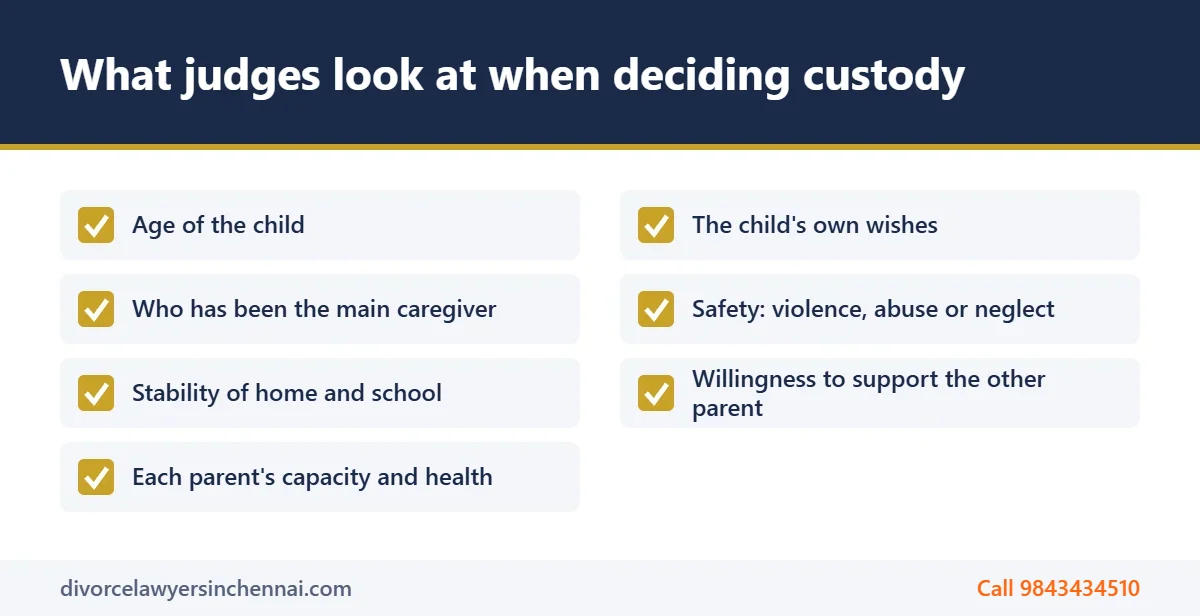
Under Indian custody law, no parent has an automatic right to custody. The court asks one question: what arrangement is best for this child? To answer it, judges commonly consider the following.
- Age of the child: very young children usually stay with the mother unless there are strong reasons otherwise.
- Who has been the main caregiver: who handled school, meals, illness and daily routine.
- Stability: continuity of home, school and friends matters a lot.
- Each parent’s capacity: health, working hours, support from family, and conduct towards the child.
- The child’s wishes: older children are often spoken to by the judge, usually in chambers.
- Safety: any history of violence, abuse, addiction or neglect weighs heavily.
- Willingness to support the other relationship: a parent who tries to cut the child off from the other parent does not help their own case.
A higher income alone does not win custody. If money is the issue, the court can order the other parent to pay maintenance for the child instead.
How a custody case moves in Chennai
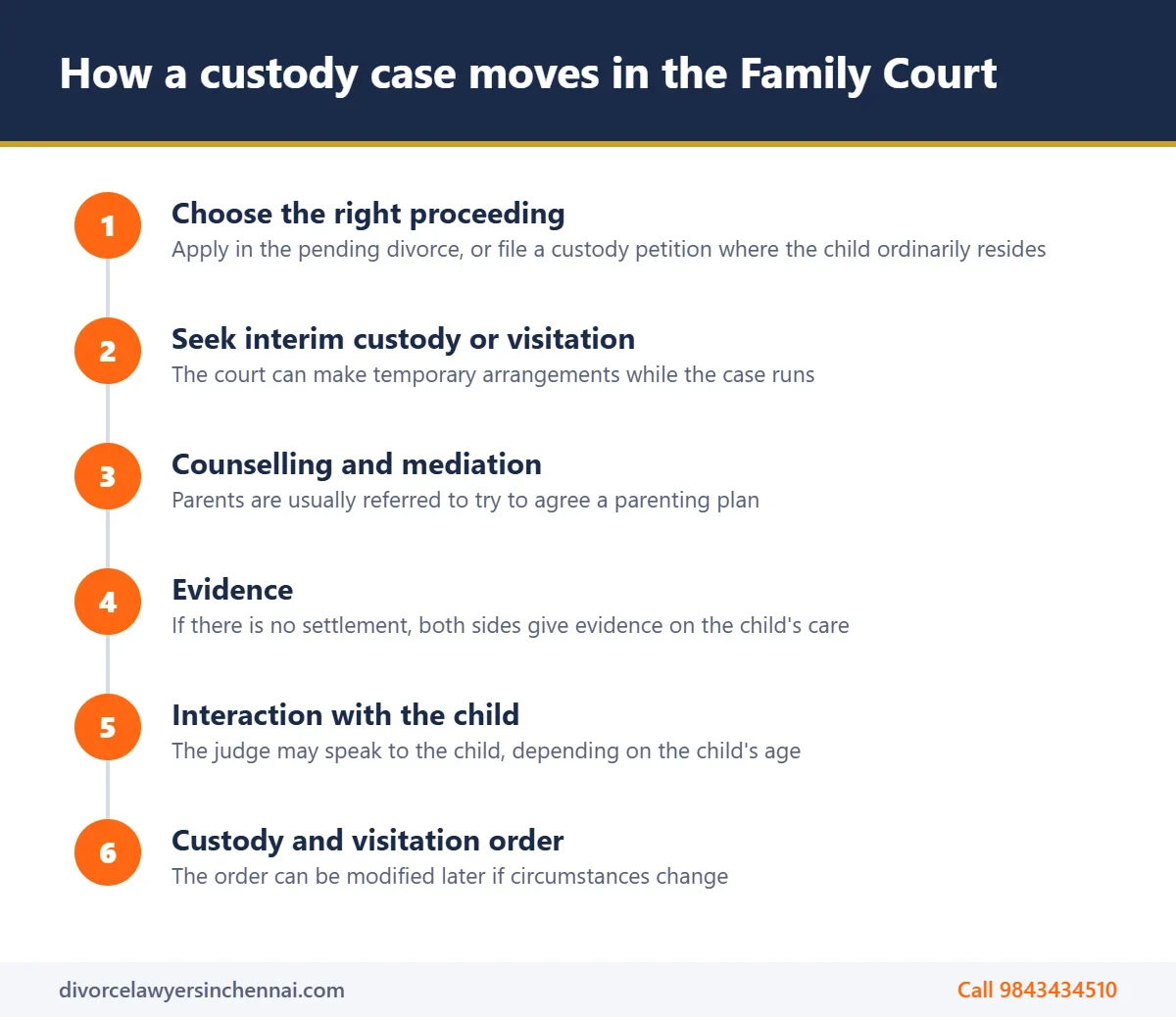
Exact timelines vary from case to case. The broad steps are usually these.
- Choose the right proceeding. If a divorce is already pending, apply for custody in that case. If not, file a guardianship or custody petition before the family court with jurisdiction where the child ordinarily resides.
- Apply for interim custody or visitation. The court can make temporary arrangements while the main case runs.
- Counselling and mediation. Family courts generally refer parents to counselling or mediation to try to agree on a parenting plan.
- Evidence. If there is no settlement, both sides file documents and give evidence about the child’s care and needs.
- Interaction with the child. The judge may talk to the child directly, depending on the child’s age.
- Order. The court passes a custody and visitation order. It can be modified later if circumstances change.
If both parents agree, custody terms can simply be written into the joint petition in a mutual consent divorce. Our guide to the mutual divorce process explains how that petition is filed.
Documents that help in a custody matter
Bring what shows the child’s life and your role in it. Typical papers include:
- The child’s birth certificate and your marriage certificate
- School records, fee receipts and report cards
- Medical records and vaccination cards
- Proof of your income, residence and working hours
- Messages, emails or complaints relevant to safety or neglect
- Any police complaint or domestic violence order, if applicable
Child support and education costs
Custody and maintenance go together. Under Section 26 of the HMA and similar provisions, the court can direct a parent to contribute to the child’s maintenance and education.
A child can also claim maintenance under Section 144 of the Bharatiya Nagarik Suraksha Sanhita, 2023 (formerly Section 125 CrPC). In Rajnesh v. Neha (2020), the Supreme Court required both parties to file an affidavit of assets and income, which makes it harder to hide earnings.
Common mistakes parents make
- Taking the child away and cutting off contact without a court order.
- Speaking badly about the other parent in front of the child.
- Ignoring interim visitation orders, which damages credibility.
- Assuming the mother always wins or the father always loses. Courts decide on facts.
- Agreeing to vague verbal arrangements instead of a written, court-recorded plan.
Maintenance and alimony: the money side
Custody decides where a child lives; maintenance decides how the child and a dependent spouse are supported. The two usually run side by side in the same case, so it helps to know the main routes:
- Interim maintenance while the case is pending: Section 24 of the Hindu Marriage Act lets either spouse with no sufficient independent income ask for monthly support and litigation costs until the case ends.
- Permanent alimony: Section 25 of the Hindu Marriage Act lets the court order a lump sum or periodic payments at the time of the decree or later. Our guide explains how alimony is calculated in India.
- Maintenance under Section 144 BNSS (formerly Section 125 CrPC): a wife, children and parents who cannot maintain themselves can claim monthly maintenance from a person with sufficient means who neglects or refuses to support them.
- Disclosure: since Rajnesh v. Neha (2020), both sides file an affidavit of assets, income and liabilities, so the court can fix a fair amount.
How much is ordered depends on both incomes, the standard of living during the marriage, the children’s needs and other obligations. A working wife may still receive maintenance if her income is not enough to keep up a similar standard of living, and a husband can also seek maintenance under Sections 24 and 25 of the Hindu Marriage Act in suitable cases.
All guides in this section
- Child Custody Lawyer in Chennai: When and How to Hire One
- How Alimony Is Calculated in India: Factors and Formula
Frequently asked questions
At what age can a child choose which parent to live with?
There is no fixed age. The court considers the child’s preference once the child is mature enough to form an intelligent view, but the final decision still rests on the child’s welfare.
Can a father get custody of a young child?
Yes, if the facts show it serves the child’s welfare. The mother is ordinarily preferred for children under five, but that is a starting point, not an absolute rule.
Can custody orders be changed later?
Yes. Custody orders are never truly final. Either parent can apply to modify them if circumstances change, such as relocation, remarriage or the child’s changing needs.
Is joint custody allowed in India?
Yes. Courts increasingly approve joint or shared parenting where both parents are fit and able to cooperate, often with a detailed schedule.
Speak to a family lawyer about custody
Child custody laws in India give judges wide discretion, so custody cases turn on details: the child’s routine, school, health and the history between the parents. A short consultation helps you choose the right proceeding and prepare your evidence early. Our guide on when to hire a child custody lawyer in Chennai explains what to look for.
Our directory lists some of the best divorce lawyers in Chennai, including advocates who regularly handle custody and guardianship matters. Call the appointment desk on 9843434510 or send a request through our contact page.
This article is general information, not legal advice. Speak to an advocate about your specific case.
About this guide: Written by the Divorce Lawyers in Chennai team. Researched from the Acts and court judgments named in this guide and checked against primary sources before publishing. Last reviewed on 26 October 2026. How we research and check our guides.