

There is no fixed formula for how alimony is calculated in India. Courts look at both spouses’ income, assets, needs, liabilities and the standard of living during the marriage, and then fix an amount that is fair to both sides. As a rough benchmark, the Supreme Court has treated about 25% of the husband’s net salary as a reasonable monthly figure in one case, but that is a guide, not a rule.
This guide explains which laws allow alimony, the factors judges weigh, how monthly and lump-sum amounts are worked out, and what you should prepare before you ask for or contest a claim in Chennai.
In this guide
- Alimony and maintenance: what the terms mean
- Which laws allow alimony in India
- How alimony is calculated in India: the factors courts use
- Working out a monthly figure
- Working out a lump-sum (one-time) settlement
- The affidavit of assets and liabilities
- Documents to prepare
- When alimony can be refused, changed or stopped
- Frequently asked questions
- Get advice on your alimony claim
Alimony and maintenance: what the terms mean
People use the two words loosely, but the law separates them by stage.
- Interim maintenance (maintenance pendente lite): money paid while the case is going on, to cover living costs and litigation expenses.
- Permanent alimony: the amount fixed at or after the divorce decree. It can be a monthly or periodic payment, or a one-time lump sum.
- Child maintenance: a separate amount for the children’s living and education costs, payable to whoever has custody.
The calculation logic is similar at each stage. What changes is how much evidence the court has and how final the order is.
Which laws allow alimony in India
The law that applies depends on your religion and the law under which you married. Some remedies, like the criminal-court maintenance remedy, are open to everyone.
| Law | Interim maintenance | Permanent alimony |
|---|---|---|
| Hindu Marriage Act, 1955 | Section 24 | Section 25 |
| Special Marriage Act, 1954 | Section 36 | Section 37 |
| Indian Divorce Act, 1869 (Christians) | Section 36 | Section 37 |
| Bharatiya Nagarik Suraksha Sanhita, 2023 | Section 144 (formerly Section 125 CrPC): monthly maintenance for a wife, children and parents | |
| Protection of Women from Domestic Violence Act, 2005 | Section 20: monetary relief for expenses and losses | |
Under Sections 24 and 25 of the Hindu Marriage Act, either spouse can apply. So a husband with no independent income can also ask for maintenance from an earning wife, though such claims are less common.
For Muslim women, the Muslim Women (Protection of Rights on Divorce) Act, 1986 provides for a fair and reasonable provision. In Mohd. Abdul Samad v. State of Telangana (2024), the Supreme Court held that a divorced Muslim woman can also claim maintenance under Section 125 CrPC, now Section 144 BNSS.
How alimony is calculated in India: the factors courts use
In Rajnesh v. Neha (2020), the Supreme Court said there is no straitjacket formula and set out the factors courts should consider. In Parvin Kumar Jain v. Anju Jain (2024), it summarised the key factors for permanent alimony. Taken together, these are the points that drive the amount.
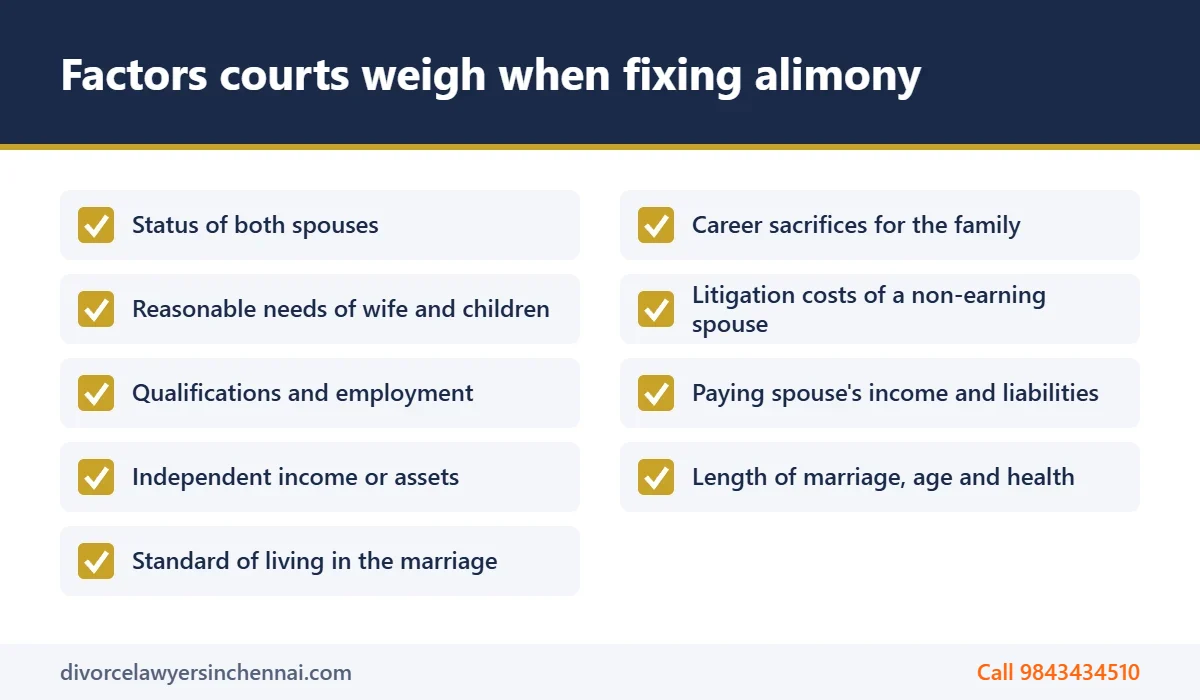
- Status of the parties: their social and financial position.
- Reasonable needs: of the wife and of any dependent children.
- Qualifications and employment: what each spouse earns now and can realistically earn.
- Independent income or assets: of the person asking for alimony.
- Standard of living: the lifestyle the wife enjoyed in the matrimonial home.
- Career sacrifices: whether she gave up work to look after the home or children.
- Litigation costs: reasonable legal expenses for a spouse who is not working.
- Paying spouse’s capacity: income, other maintenance obligations and genuine liabilities.
- Duration of the marriage, age and health: including any illness or disability needing care.
The court’s aim is balance. The amount should let the dependent spouse live with reasonable dignity, close to the matrimonial standard, without being so high that it punishes the paying spouse or is impossible to pay.
Working out a monthly figure
For periodic maintenance, the court first tries to find the paying spouse’s real income. It then weighs that against the claimant’s own income and needs.
Step 1: Find the net income
Courts start from salary slips, income tax returns, bank statements and business records. Statutory deductions such as income tax and provident fund are usually subtracted. Voluntary expenses, like optional loan repayments or investments, are not automatically deducted, though genuine liabilities are considered.
Step 2: Apply a reasonable share
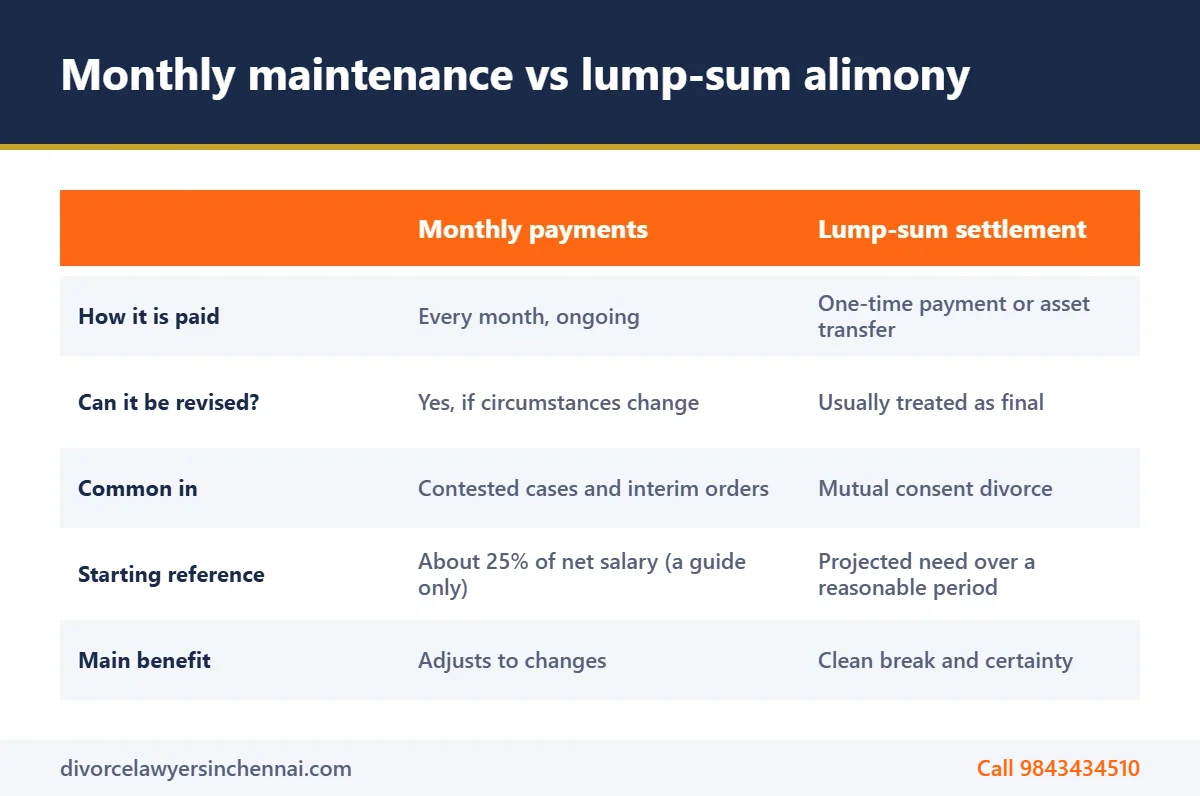
In Kalyan Dey Chowdhury v. Rita Dey Chowdhury (2017), the Supreme Court said 25% of the husband’s net salary would be just and proper as maintenance in that case. Many courts use this as a starting reference. It can go up or down depending on the number of dependants, the claimant’s own income and the other factors above.
Step 3: Adjust for the claimant’s income and children
A working wife is not automatically shut out. If her income is not enough to maintain the standard she had during the marriage, the court can award the shortfall. Child maintenance is usually considered separately, covering school fees, health and daily needs.
Here is a simple illustration. If a husband’s net take-home pay is ₹80,000 a month and the wife has no income, a court might treat about ₹20,000 as a reasonable starting point for her. That figure could rise if a child lives with her, or fall if she has her own income. This is only an illustration, not a prediction of any order.
Working out a lump-sum (one-time) settlement
Many couples prefer a one-time payment so that the financial link ends with the divorce. Courts and parties usually consider:
- the monthly figure the court would otherwise award, projected over a reasonable period;
- the age of the receiving spouse and how long she would need support;
- assets that can be transferred instead of cash, such as a flat, land or deposits;
- the children’s future needs, including education and, where relevant, marriage expenses;
- the paying spouse’s ability to pay without selling essential assets.
In a mutual consent divorce, the lump sum is agreed between the spouses and written into the joint petition and the settlement terms. Our guide to the mutual divorce process explains how those terms are recorded before the court.
The affidavit of assets and liabilities
Rajnesh v. Neha also made financial disclosure compulsory. In maintenance proceedings, both spouses must file an affidavit of disclosure of assets and liabilities in the format the Supreme Court prescribed. If a party does not file it despite chances, the court can decide on the other side’s affidavit.
The judgment also settled other practical points:
- Maintenance is payable from the date of the application, not just from the date of the order.
- If maintenance is claimed under more than one law, the amount already awarded in one case is adjusted or set off in the other. You must disclose earlier orders.
- Unpaid maintenance can be enforced like a money decree, including by attachment of property.
Documents to prepare
Whether you are asking for alimony or responding to a claim, the outcome depends heavily on evidence. Gather these early.
- Salary slips for the last 6 to 12 months and Form 16
- Income tax returns for the last few years
- Bank statements and fixed deposit details
- Property documents, vehicle papers and investment statements
- Loan statements and proof of genuine liabilities
- Children’s school fee receipts and medical bills
- Proof of monthly household expenses and rent
- Educational certificates and employment history of both spouses
When alimony can be refused, changed or stopped
An alimony order is not frozen forever. Under Section 25 of the Hindu Marriage Act, the court can vary, modify or cancel the order if circumstances change, for example if the receiving spouse remarries.
Under Section 144 BNSS, a wife may not be entitled to maintenance if she is living in adultery, refuses to live with her husband without sufficient reason, or they live separately by mutual consent. A big change in either spouse’s income can also justify a fresh look at the amount.
A lump-sum settlement accepted in a mutual consent divorce is usually treated as final, which is why it is worth getting the figure right the first time.
Frequently asked questions
Is there a fixed percentage of salary for alimony in India?
No. About 25% of the husband’s net salary is often used as a reference point after Kalyan Dey Chowdhury, but courts can award more or less depending on needs, dependants and the other factors.
Can a working wife get alimony?
Yes, if her income is not enough to maintain the standard of living she had in the marriage. The court compares both incomes and can award the difference.
Can a husband claim alimony from his wife?
Under Sections 24 and 25 of the Hindu Marriage Act, either spouse can apply. The husband has to show he has no sufficient independent income, and the court applies the same factors.
Is lump-sum alimony better than monthly payments?
It depends. A lump sum gives certainty and a clean break, while monthly payments can be revised if circumstances change. Discuss your situation with an advocate and, for tax questions, a tax adviser.
Get advice on your alimony claim
Because there is no fixed formula for how alimony is calculated in India, the way your income, expenses and needs are presented often decides the amount. An early consultation helps you collect the right documents and set realistic expectations, whether you are asking for alimony or paying it. If children are involved, read our overview of child custody laws in India, since custody and child maintenance are usually decided together. If custody is also disputed, a child custody lawyer in Chennai can handle both claims together.
You can speak to experienced divorce case lawyers in Chennai listed in our directory. Call the appointment desk on 9843434510 or send a request through our contact page.
This article is general information, not legal advice. Speak to an advocate about your specific case.
About this guide: Written by the Divorce Lawyers in Chennai team. Researched from the Acts and court judgments named in this guide and checked against primary sources before publishing. Last reviewed on 26 October 2026. How we research and check our guides.