
A contested divorce in India is a divorce that one spouse asks for without the other’s consent. You file a petition in the Family Court and must prove a ground recognised by law, such as cruelty or desertion. Your spouse’s refusal cannot stop the case, but you need evidence, and a contested divorce usually takes much longer than a mutual consent divorce.
People often call this a “one sided divorce”. It means the same thing. This guide explains what contested divorce means, the grounds, the step-by-step procedure in the Family Court in Chennai, what the petition contains, what happens if your spouse does not appear, and how long it realistically takes.
In this guide
- Contested divorce meaning
- Grounds for a contested divorce
- Contested divorce procedure in the Family Court, Chennai
- What a contested divorce petition contains
- What if your spouse does not appear?
- Minimum time for a contested divorce
- Documents and evidence to prepare
- Cost and practical tips
- Frequently asked questions
- Talk to an advocate about your case
Contested divorce meaning
The law does not use the phrases “contested divorce” or “one sided divorce”. They are everyday terms for a divorce sought by one spouse alone. Legally it is a petition on a fault or other statutory ground, for example under Section 13 of the Hindu Marriage Act, 1955 (HMA), Section 27 of the Special Marriage Act, 1954, or Section 10 of the Indian Divorce Act, 1869.
The key difference from mutual consent is the burden of proof. In a mutual divorce, both spouses simply confirm they agree. In a contested case, the court must be satisfied that a legal ground exists. Section 23 of the HMA requires this even when the other side does not contest. For a side-by-side comparison of the two routes, see our guide to mutual vs contested divorce.
| Contested (one sided) divorce | Mutual consent divorce | |
|---|---|---|
| Who files | One spouse | Both spouses jointly |
| Spouse’s agreement needed | No | Yes, until the decree |
| Must prove a ground | Yes | No |
| Evidence and cross-examination | Yes | No |
| Typical duration | Often several years | Usually months |
Grounds for a contested divorce
Under Section 13(1) of the HMA, either spouse can seek divorce if the other:
- has had voluntary sexual intercourse with another person after marriage (adultery);
- has treated the petitioner with cruelty, physical or mental;
- has deserted the petitioner for a continuous period of at least two years before the petition;
- has converted to another religion and ceased to be a Hindu;
- has been incurably of unsound mind, or suffers from a mental disorder of a kind and degree that the petitioner cannot reasonably be expected to live with;
- has a venereal disease in a communicable form;
- has renounced the world by entering a religious order;
- has not been heard of as alive for seven years or more.
Section 13(1A) adds a ground for either spouse: there has been no resumption of cohabitation for one year or more after a decree of judicial separation, or no restitution of conjugal rights for one year or more after a decree for restitution.
A wife has some additional grounds under Section 13(2). These include cases where a maintenance order was passed in her favour (for example under Section 144 BNSS, formerly Section 125 CrPC) and the couple have not lived together for one year or more since, and where she was married before 15 and repudiated the marriage after 15 but before 18.
In practice, many contested petitions rely on cruelty or desertion. Mental cruelty is broad: in Samar Ghosh v. Jaya Ghosh (2007), the Supreme Court gave illustrations of conduct that can amount to it.
What about “irretrievable breakdown”?
Irretrievable breakdown of marriage is not a ground a family court can grant divorce on under the HMA. In Shilpa Sailesh v. Varun Sreenivasan (2023), the Supreme Court held that it can dissolve a marriage on this basis using its special power under Article 142 of the Constitution. That power belongs to the Supreme Court, so ordinary petitions must still rely on a statutory ground.
Contested divorce procedure in the Family Court, Chennai
In Chennai, a contested divorce is heard by the Family Court. Under Section 19 of the HMA, you can file where the marriage took place, where your spouse lives, where you last lived together, or, if you are the wife, where you live now. Section 22 of the HMA requires every proceeding under the Act to be held in camera, so the hearings are not open to the public.
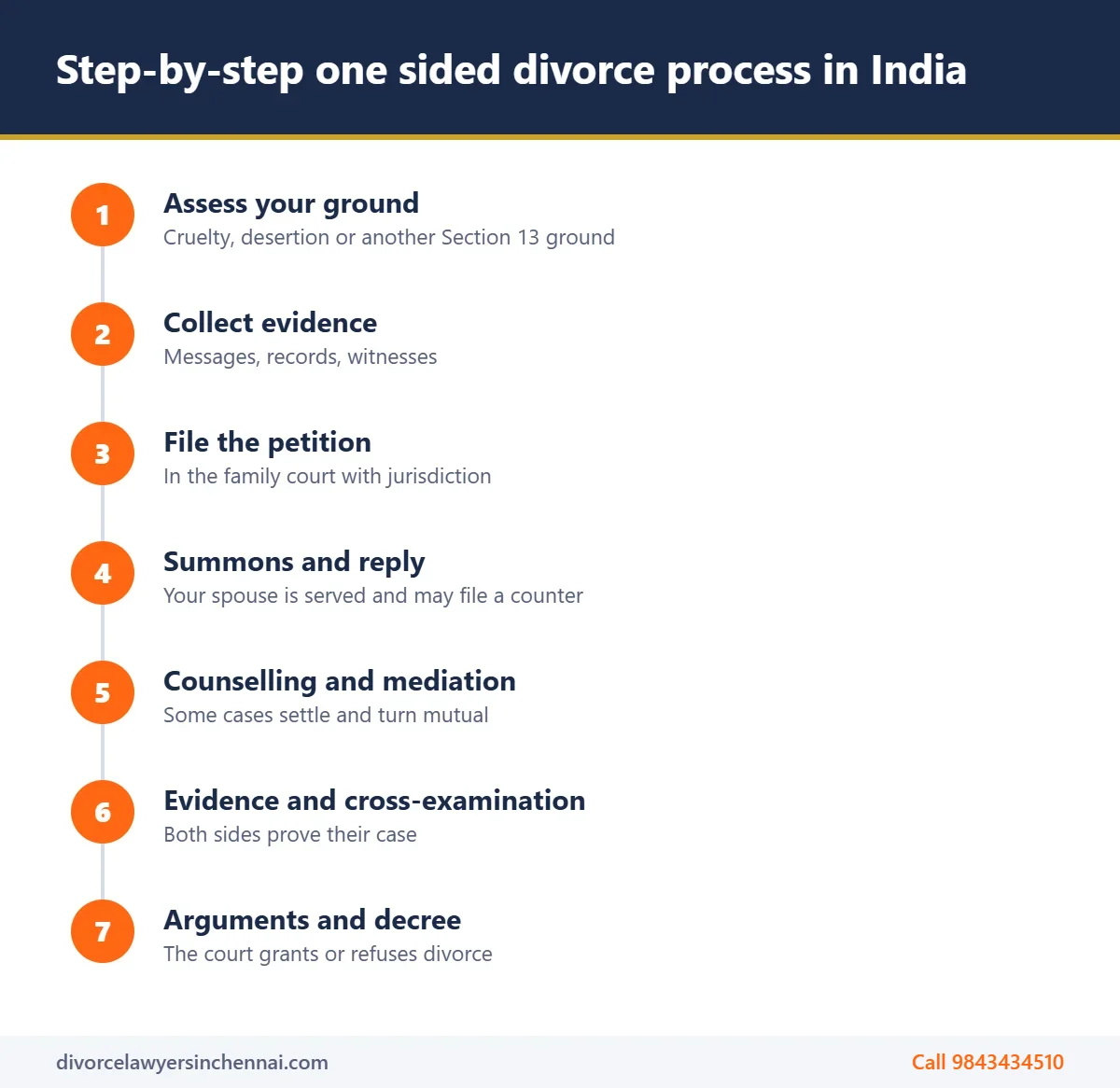
- Consult an advocate and assess your ground. Match your facts to a legal ground and check that at least one year has passed since the marriage. Section 14 of the HMA bars a divorce petition within the first year unless the court allows it for exceptional hardship or depravity.
- Optional legal notice. A legal notice for divorce is not compulsory, but it can record your position and test whether your spouse will settle.
- Collect evidence. Messages, emails, medical records, police complaints, photographs, and names of witnesses who saw what happened.
- File the petition. It goes to the family court with jurisdiction, with a vakalatnama and supporting documents. Our guide on how to file for divorce in Chennai explains which court can hear your case.
- Summons to your spouse. The court issues notice. Your spouse can file a written statement (counter) denying the allegations.
- Counselling and mediation. Section 9 of the Family Courts Act, 1984 requires the Family Court to first try to help the parties settle, so couples are usually referred for counselling or mediation. Some contested cases end here as a settlement and convert to mutual consent.
- Interim applications. Either side can apply for interim maintenance and litigation costs under Section 24 of the HMA, and for interim custody or visitation under Section 26.
- Evidence. You file your proof affidavit and documents, and you and your witnesses are cross-examined. Your spouse then leads evidence.
- Arguments and judgment. The court hears both sides and grants or refuses the decree.
- Appeal. Under Section 19 of the Family Courts Act, an appeal from a Family Court judgment lies to the High Court and the Act sets a period of 30 days, so get advice quickly after the judgment.
What a contested divorce petition contains
There is no single official form to copy, and a petition should be drafted around your own facts. Section 20 of the HMA requires a petition to state the facts on which relief is claimed as clearly as the case allows, to state that it is not filed in collusion with the other spouse, and to be verified like a plaint in a civil suit. A typical contested divorce petition covers:
- Court and parties: the Family Court it is filed in, and the name, age, occupation and address of the petitioner and respondent.
- Marriage details: date and place of marriage, the ceremony or registration, and the law that applies (for example the HMA).
- Children: names and ages of any children and where they live now.
- Residence and jurisdiction: where the couple last lived together and why this court can hear the case.
- Grounds with facts: the legal ground relied on and the specific incidents, with dates, that support it. Vague allegations weaken a case.
- Other proceedings: any earlier or pending cases between the spouses, such as maintenance or domestic violence cases.
- No collusion and no condonation: statements that the petition is not collusive and that the petitioner has not condoned the conduct complained of.
- Reliefs (prayer): a decree of divorce and any other orders sought, such as custody, maintenance or return of property.
- Verification: the petitioner’s signed verification, with the supporting affidavit and documents filed alongside.
Your advocate will draft the petition in the format the court accepts. A petition built from an online template rarely fits your facts.
What if your spouse does not appear?
This is one of the most common questions. A spouse who ignores the case cannot block it.
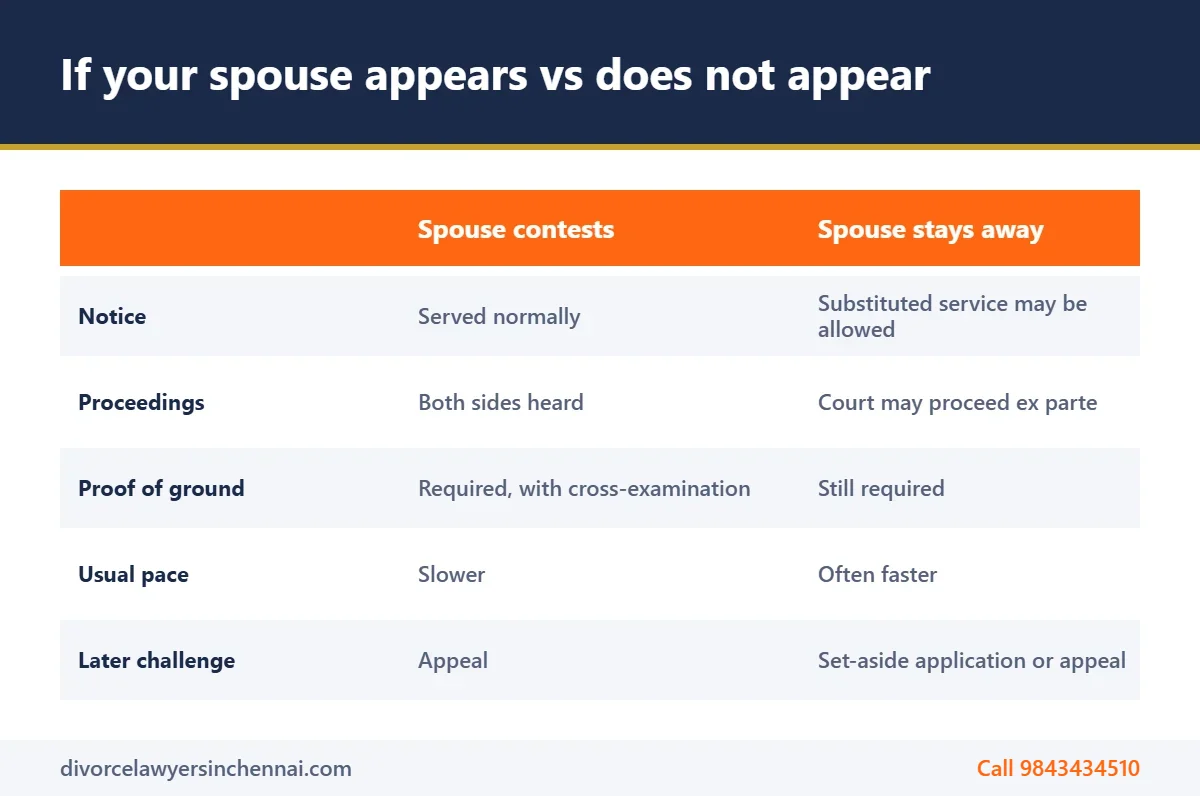
- Service of notice. The court first tries to serve notice at the known address. If your spouse avoids it or cannot be traced, the court can allow substituted service, such as newspaper publication, under Order V Rule 20 of the Code of Civil Procedure.
- Ex parte proceedings. If your spouse is duly served and still does not appear, the court can proceed ex parte, meaning without them.
- You still prove your case. Even ex parte, you must file evidence supporting your ground. The decree is not automatic.
- Risk of being set aside. Your spouse can apply under Order IX Rule 13 CPC to set aside an ex parte decree by showing that summons were not duly served or that they had sufficient cause for not appearing. The usual limitation period for this is 30 days, though courts can condone delay.
Because an ex parte decree can be challenged, it is wise not to remarry until the time for appeal and any set-aside application has clearly passed. Keep a careful record of every address and attempt to serve notice.
Minimum time for a contested divorce
There is no fixed minimum or maximum time. Two time rules apply before and during the case:
- You generally cannot file within one year of the marriage (Section 14 of the HMA), and a desertion petition needs at least two years of desertion before filing.
- Unlike mutual consent, there is no statutory waiting period between filing and the decree. Section 21B of the HMA asks courts to try to conclude the trial within six months of serving notice on the respondent, but this is a target, not a guarantee.
In practice, a contested divorce often takes several years in a busy family court, depending on how strongly your spouse contests, the number of witnesses, interim applications and adjournments. Cases tend to move faster when the respondent does not appear, when evidence is well organised from the start, or when the parties settle during mediation and switch to a mutual petition. Even after the decree, Section 15 of the HMA allows remarriage only once the time for appeal has passed without an appeal, or an appeal has been dismissed.
Documents and evidence to prepare
- Marriage certificate or proof of marriage, such as invitation and photographs.
- Identity and address proof of both spouses.
- Evidence of your ground: messages, emails, medical or police records.
- Proof of separation date for desertion cases.
- Income and asset details, especially where maintenance is claimed. In Rajnesh v. Neha (2020), the Supreme Court required both parties to file affidavits of assets and income in maintenance proceedings.
Our checklist of documents required for divorce covers the full list.
Cost and practical tips
A contested divorce usually costs more than a mutual one because it runs longer and involves evidence and cross-examination. Ask your advocate to explain the fee structure in writing at the start. Our divorce lawyer fees guide explains the main cost factors.
- Choose the ground your evidence actually supports, not the one that sounds strongest.
- Attend every hearing, or make sure your advocate does. Absence can lead to dismissal.
- Stay open to settlement. If your spouse later agrees, converting to a mutual divorce process can save years.
Frequently asked questions
What is the meaning of contested divorce?
A contested divorce is one where only one spouse wants the divorce, or the spouses cannot agree on it, so the court decides after the petitioner proves a legal ground such as cruelty or desertion. It is also called a one sided divorce.
What is the minimum time for a contested divorce in India?
The law sets no fixed minimum. You usually cannot file within the first year of marriage, and the HMA asks courts to try to finish within six months of notice, but most contested cases take much longer, often several years, depending on the evidence and how hard the case is fought.
Can I get a divorce if my spouse refuses?
Yes. A contested divorce does not need your spouse’s consent. You need to prove a legal ground such as cruelty or desertion.
Can a contested divorce become mutual?
Yes. If both spouses reach a settlement during the case, they can file a joint petition for divorce by mutual consent, which is usually much quicker.
Talk to an advocate about your case
A contested divorce succeeds or fails on evidence and procedure. Getting the ground, jurisdiction and paperwork right at the start makes the biggest difference.
To discuss your situation with one of the divorce specialist lawyers in Chennai in our directory, call the appointment desk on 9843434510 or book through our contact page.
This article is general information, not legal advice. Speak to an advocate about your specific case.
About this guide: Written by the Divorce Lawyers in Chennai team. Researched from the Acts and court judgments named in this guide and checked against primary sources before publishing. Last reviewed on 15 October 2026. How we research and check our guides.