
The difference in mutual vs contested divorce comes down to consent. In a mutual consent divorce, both spouses agree to end the marriage and settle terms such as alimony and custody between themselves, so the court does not need to find anyone at fault. In a contested divorce, one spouse files alone and must prove a legal ground like cruelty or desertion, which usually means evidence, cross-examination and a much longer case.
A mutual consent divorce is also called an uncontested (or “not contested”) divorce, because neither spouse opposes it. This guide compares the two side by side on time, cost, grounds, money and children, explains when each route makes sense, and shows how a contested case can be converted into a mutual one.
In this guide
- Mutual vs contested divorce at a glance
- How a mutual consent divorce works
- How a contested divorce works
- Time, cost and stress compared
- Alimony, maintenance and custody in each route
- When to choose which route
- Converting a contested divorce into a mutual one
- Frequently asked questions
- Get advice on the right route
Mutual vs contested divorce at a glance
Here is how the two routes compare under the Hindu Marriage Act, 1955 (HMA), which applies to Hindus, Buddhists, Jains and Sikhs. Other personal laws follow a broadly similar pattern.
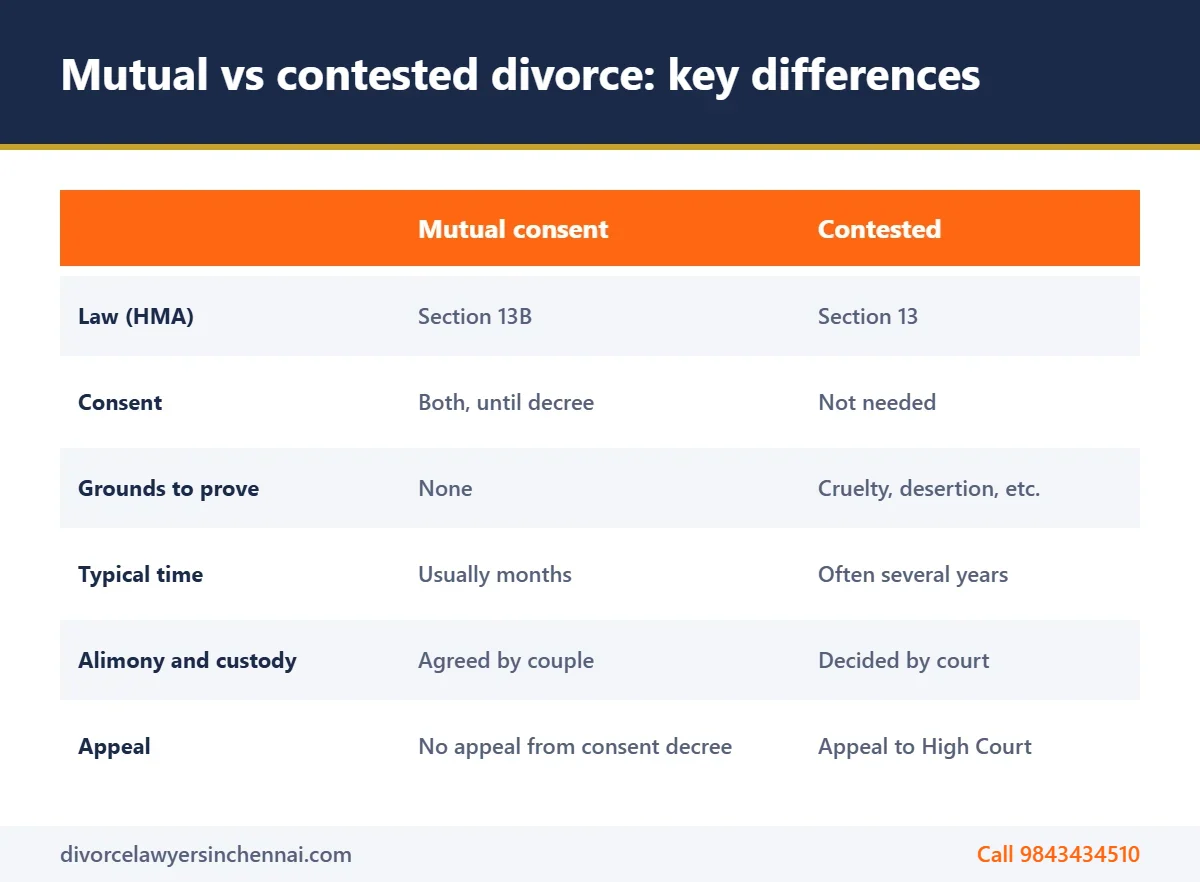
| Factor | Mutual consent divorce | Contested divorce |
|---|---|---|
| Law (HMA) | Section 13B | Section 13 |
| Consent | Both spouses, until the decree | Not needed from the other spouse |
| Grounds to prove | None | Cruelty, desertion, adultery, etc. |
| Pre-condition | Living separately for one year or more | One year from marriage (Section 14), unless leave is granted |
| Evidence and cross-examination | No | Yes |
| Typical time | Usually months | Often several years |
| Typical lawyer fees | Roughly ₹15,000 to ₹75,000 in total (indicative) | Higher, as the case runs longer |
| Alimony and custody | Agreed by the couple, approved by court | Decided by the court |
| Appeal | No appeal from a consent decree | Appeal to the High Court possible |
How a mutual consent divorce works
Under Section 13B of the HMA, both spouses file a joint petition in the family court stating that:
- they have been living separately for one year or more;
- they have not been able to live together; and
- they have mutually agreed that the marriage should be dissolved.
After the first motion, the law provides a gap of at least six months before the second motion, which must be made within eighteen months of filing. On the second motion, if both still consent, the court grants the decree. In Amardeep Singh v. Harveen Kaur (2017), the Supreme Court held that the six-month gap is not mandatory and can be waived in suitable cases. Our guide to how many days a mutual divorce takes explains the timeline.
The key point is that consent must continue to the end. In Sureshta Devi v. Om Prakash (1991), the Supreme Court held that either spouse can withdraw consent at any time before the decree is passed. If that happens, the court cannot grant a mutual divorce.
For the full procedure, see our mutual divorce process guide.
How a contested divorce works
A contested divorce is filed by one spouse under Section 13 of the HMA (or the equivalent section of another personal law). The petitioner must prove a ground such as cruelty, desertion for at least two years, adultery, conversion, or serious mental disorder.
The usual stages are filing, summons, counter statement, counselling or mediation, interim applications for maintenance and custody, evidence and cross-examination, and final arguments. Section 23 of the HMA requires the court to be satisfied that the ground is proved, even if the other spouse does not contest.
Contested cases take longer because each stage depends on both sides, witnesses and the court’s calendar. If you are weighing your options, our guide to filing a mutual divorce shows how much simpler the agreed route can be.
Time, cost and stress compared
Time
A mutual divorce is shaped by the statutory gap between the motions, so it usually finishes in a matter of months, and sooner if the waiting period is waived. There is no fixed timeline for a contested divorce. It often takes several years, depending on how strongly it is defended, the number of witnesses, interim applications and adjournments.
Cost
For a straightforward mutual divorce in Chennai, total advocate fees typically fall somewhere between about ₹15,000 and ₹75,000, with court fees and paperwork adding comparatively little. A contested case costs more because it involves many more hearings, evidence and drafting. Our divorce lawyer fees guide breaks down the cost factors.
Privacy and stress
A mutual petition avoids allegations being pleaded and proved in court. A contested case requires you to set out what went wrong in the marriage and to be cross-examined on it, which many people find draining. Under section 22 of the Hindu Marriage Act, every proceeding under that Act is held in camera, so the hearings are private, but the process is still more adversarial.
Alimony, maintenance and custody in each route
- In a mutual divorce, you and your spouse agree on permanent alimony (often a lump sum), return of stridhan and other property, and custody and visitation. These terms are recorded in the petition or a settlement and placed before the court.
- In a contested divorce, the court decides these issues. Either spouse can apply for interim maintenance and litigation costs under Section 24 of the HMA, and the court can order permanent alimony under Section 25 and make custody orders under Section 26.
- Children’s welfare comes first in both. Even in a mutual divorce, the court can look at whether the custody arrangement is in the child’s interest.
A settlement gives you control and certainty. A court decision gives you a binding ruling where you cannot agree, but the result is less predictable.
When to choose which route
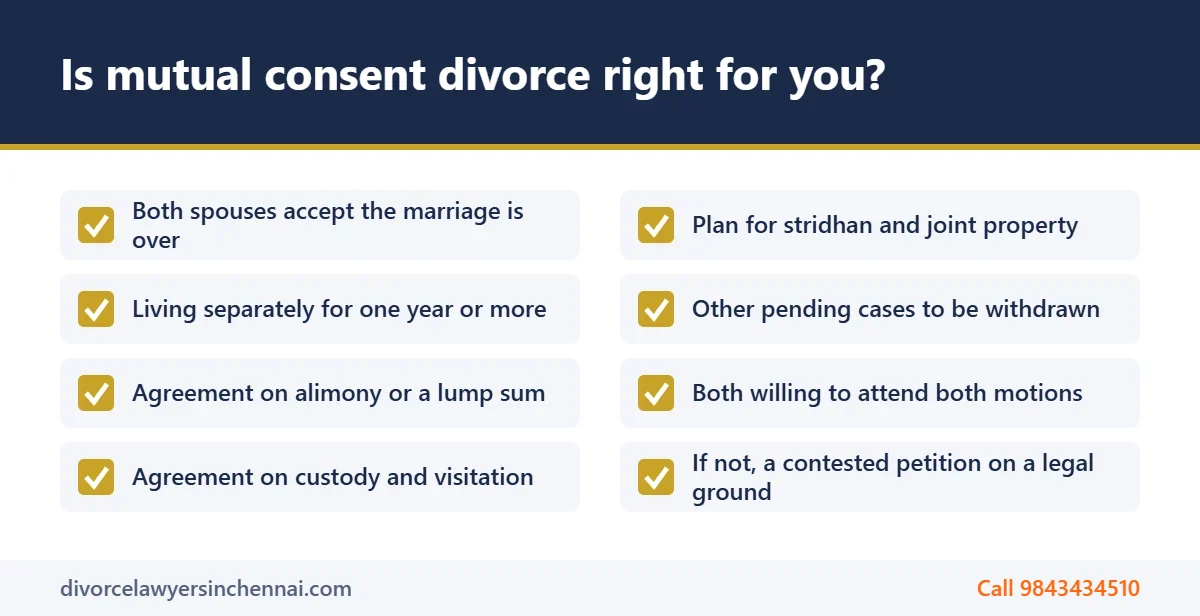
Mutual consent usually makes sense when:
- both of you accept that the marriage is over;
- you can agree, perhaps with help, on money, property and children;
- you have already lived separately for a year or more; and
- you want a faster, more private result.
A contested petition may be necessary when:
- your spouse refuses to agree to a divorce at all;
- your spouse cannot be traced or will not engage;
- the demands being made for consent are unreasonable; or
- there is serious cruelty or abuse and you need the court’s protection and orders.
If there is domestic violence, speak to an advocate about urgent protection under the Domestic Violence Act, which is separate from the divorce itself.
Converting a contested divorce into a mutual one
Many contested cases end by mutual consent. Family courts are required by Section 9 of the Family Courts Act, 1984 to try to bring about a settlement, and couples are often referred to counselling or mediation during the case.
If you reach a settlement:
- Record the terms (alimony, property, custody, withdrawal of other cases) in a written settlement.
- File a joint petition for mutual consent divorce under Section 13B, or seek the court’s permission to proceed on the basis of the settlement, as your advocate advises.
- Withdraw the contested petition and any connected cases as agreed.
- Where the conditions are met, ask for waiver of the six-month gap so the decree is not delayed.
The opposite can happen too. If a spouse withdraws consent before the second motion, the mutual petition fails, and the other spouse may have to file a contested case on a legal ground.
Frequently asked questions
Which is better, mutual or contested divorce?
Where both spouses can agree, mutual consent is usually quicker, cheaper and less stressful. A contested divorce is the route when your spouse will not agree or when you need the court to decide money or custody.
Can a contested divorce be converted to mutual consent?
Yes. If you settle during the case, you can file a joint petition under Section 13B and withdraw the contested case as part of the settlement.
Can my spouse withdraw consent in a mutual divorce?
Yes. Following Sureshta Devi v. Om Prakash (1991), consent can be withdrawn at any time before the decree. That is why the settlement terms should be clear and complete before you file.
Is evidence needed in a mutual consent divorce?
No ground has to be proved. The court records both spouses’ statements and checks that consent is genuine, that the separation condition is met, and that the terms are lawful.
Is an uncontested divorce the same as a mutual consent divorce?
In everyday use, yes. Indian divorce laws do not use the word “uncontested”; people use it to mean a joint petition for divorce by mutual consent, such as under Section 13B of the HMA. A contested petition in which the other spouse simply does not appear is different: the court still decides it on a legal ground, ex parte, so it is not a mutual consent divorce.
Get advice on the right route
Choosing between mutual vs contested divorce is a practical decision about consent, evidence, money and children. An advocate can tell you whether settlement is realistic and how to protect yourself if it is not.
To discuss your options with one of the divorce case lawyers in Chennai in our directory, call the appointment desk on 9843434510 or book through our contact page. The first consultation is free.
This article is general information, not legal advice. Speak to an advocate about your specific case.
About this guide: Written by the Divorce Lawyers in Chennai team. Researched from the Acts and court judgments named in this guide and checked against primary sources before publishing. Last reviewed on 26 October 2026. How we research and check our guides.