
Yes, the six-month waiting period in a mutual consent divorce can be waived. In Amardeep Singh v. Harveen Kaur (2017), the Supreme Court held that this period under Section 13B(2) of the Hindu Marriage Act is directory, not mandatory, so the family court can waive it when certain conditions are met. A waiver of 6 month cooling period lets the court take up the second motion early and grant the decree in weeks rather than months.
This guide explains what the cooling period is, the conditions courts look for, when and how to apply, and what to do if the application is refused.
In this guide
- What is the six-month cooling period?
- What the Supreme Court decided in Amardeep Singh
- Who can grant the waiver?
- How to apply for waiver of 6 month cooling period
- Documents to support the application
- When courts may refuse
- Tips to strengthen your application
- Waiting out the period vs seeking a waiver
- How much time a waiver can save
- Frequently asked questions
- Get advice on your waiver application
What is the six-month cooling period?
A mutual consent divorce under Section 13B of the Hindu Marriage Act, 1955 (HMA) has two stages:
- First motion: both spouses file a joint petition stating they have lived separately for one year or more, cannot live together, and agree the marriage should be dissolved.
- Second motion: both spouses confirm their consent again. Under Section 13B(2), this can be moved not earlier than six months and not later than eighteen months after the petition was presented.
The six-month gap is the “cooling-off” period. It exists to give the couple time to reconsider, so that a marriage is not ended in a moment of anger. In many cases, though, the couple have already been apart for years, every issue is settled, and the wait only extends the stress.
For the full two-motion procedure, read our guide to the mutual divorce process.
What the Supreme Court decided in Amardeep Singh
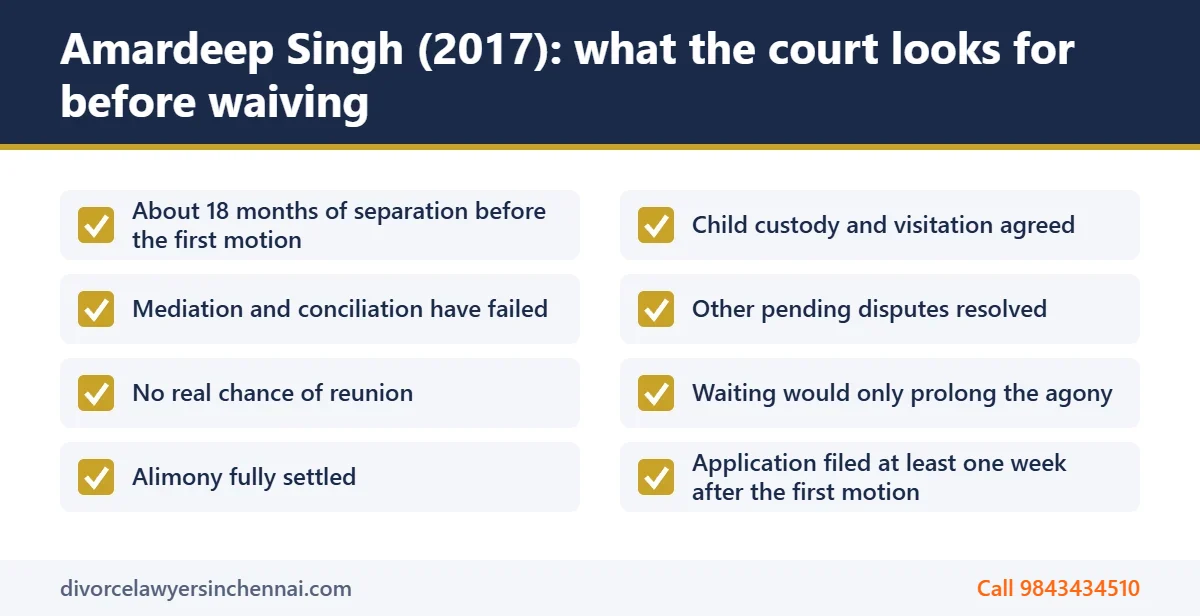
In Amardeep Singh v. Harveen Kaur (2017), the Supreme Court held that the six-month period is not mandatory. The court hearing the case may waive it after considering the facts. The Court said the court should be satisfied that:
- the six-month period under Section 13B(2), in addition to the one-year separation under Section 13B(1), is already over before the first motion, meaning the couple have been living apart for at least eighteen months;
- all efforts at mediation and conciliation to reunite the couple have failed, and there is no likelihood of success;
- the parties have genuinely settled their differences, including alimony, custody of children and any other pending issues;
- the waiting period will only prolong their agony.
The Court also said the waiver application can be filed one week after the first motion, giving reasons. Later decisions have treated these conditions as guidance for the court’s discretion rather than a rigid checklist, so the overall facts of your case matter.
Who can grant the waiver?
The waiver is decided by the court hearing the mutual consent petition, which in Chennai is the family court with jurisdiction. You do not need to go to the High Court or Supreme Court for it.
The Supreme Court has a separate power. In Shilpa Sailesh v. Varun Sreenivasan (2023), a Constitution Bench held that the Supreme Court can, under Article 142 of the Constitution, dispense with the waiting period and grant divorce by mutual consent, and can also dissolve a marriage for irretrievable breakdown. That power is the Supreme Court’s alone; a family court applies the Amardeep Singh approach.
Amardeep Singh concerned the HMA. Whether a similar waiver is available in a mutual petition under the Special Marriage Act or the Indian Divorce Act depends on the facts and the court, so ask your advocate before you file.
How to apply for waiver of 6 month cooling period
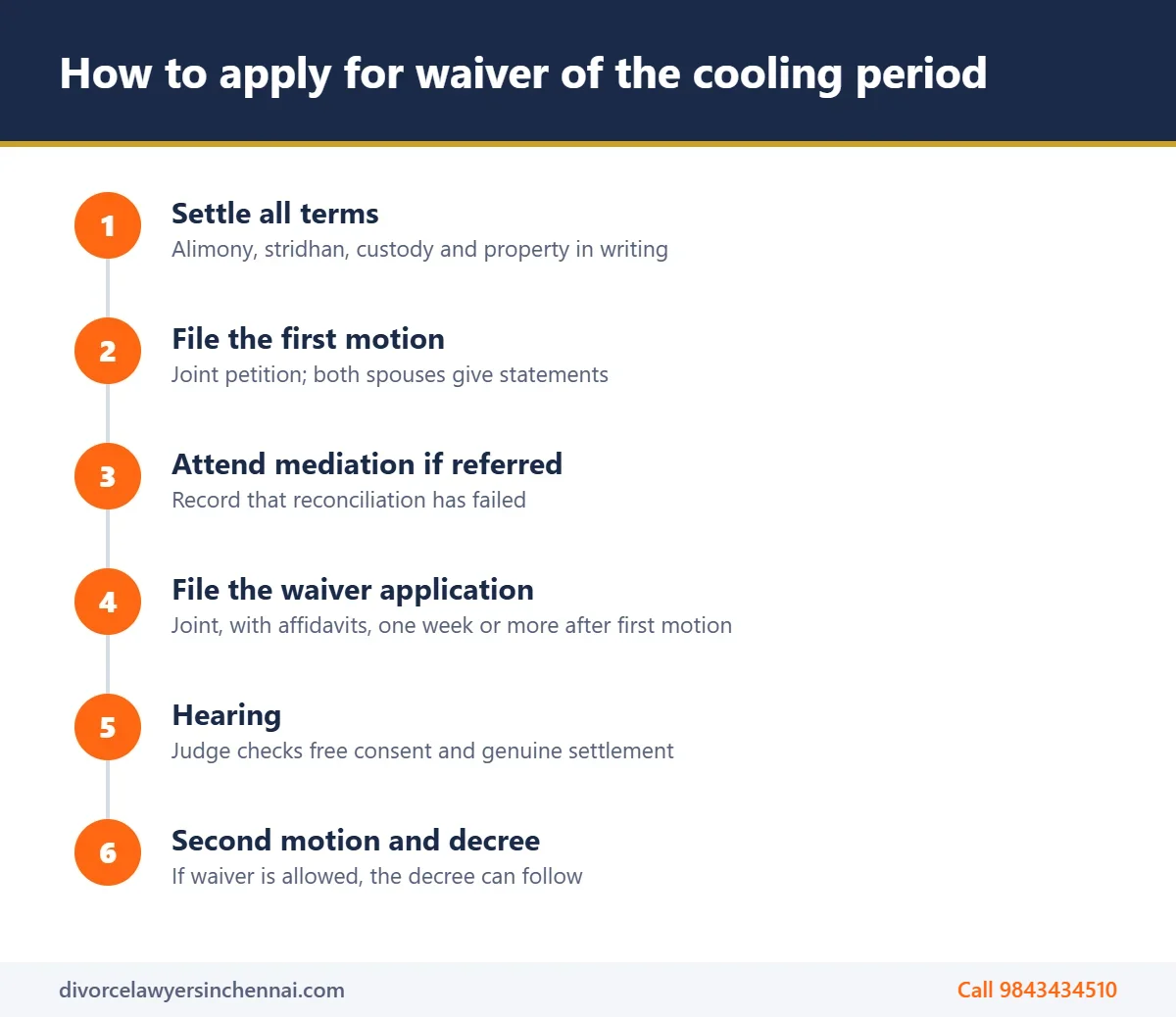
- Settle everything first. Put alimony or a one-time settlement, stridhan and jewellery, child custody and visitation, and property into a written agreement.
- File the joint petition (first motion). Both spouses appear, and their statements are recorded.
- Attend mediation or counselling if referred. A recorded failure of reconciliation efforts supports the waiver.
- File the waiver application. A joint application, supported by affidavits from both spouses, can be filed one week or more after the first motion. It should state the date you separated, the settlement terms, and why waiting serves no purpose.
- Hearing. The judge may question both spouses to make sure the consent is free and the settlement is genuine.
- Second motion and decree. If the waiver is allowed, the second motion is taken up and the court can pass the decree.
Documents to support the application
- The first motion petition and the order recording statements.
- Proof of the separation date, such as rental agreements, separate address proof or correspondence.
- The signed settlement agreement or memorandum of understanding.
- Mediation or counselling reports, if any.
- Affidavits of both spouses explaining why the waiting period should be waived.
- Proof of payment of any amount already paid under the settlement, if applicable.
The standard papers for the petition itself are listed in our guide to documents required for divorce.
When courts may refuse
A waiver is a discretion, not a right. It may be refused if:
- the couple have been separated for a short time;
- alimony, custody or property terms are vague or still disputed;
- one spouse seems hesitant, or there is a suggestion of pressure;
- there has been no real attempt at reconciliation or mediation.
If the application is refused, the petition does not fail. You simply wait out the six months and move the second motion as usual. Remember that the second motion must be moved within eighteen months of filing, or the petition may lapse.
Tips to strengthen your application
- Be precise about dates. State the exact date you began living apart and support it with documents. Vague dates invite doubt about the eighteen-month condition.
- Make the settlement complete. Cover every item: the amount and mode of payment, the timeline for instalments, return of jewellery and household articles, and custody and visitation arrangements.
- Deal with pending cases. If either spouse has filed other cases, such as a maintenance or domestic violence case, the settlement should say how they will be withdrawn or closed.
- Explain the hardship. A job offer abroad, a planned remarriage, or the strain on children are the kind of reasons courts consider, if they are genuine.
- Attend in person if you can. Being present to answer the judge’s questions helps the court satisfy itself that consent is free.
Waiting out the period vs seeking a waiver
| Waiting six months | Seeking a waiver | |
|---|---|---|
| Legal basis | Section 13B(2) HMA | Amardeep Singh v. Harveen Kaur (2017) |
| Extra application | Not needed | Joint application with affidavits |
| Separation required | One year before filing | Courts look for about eighteen months before the first motion |
| Court’s role | Hears the second motion after six months | Decides, on the facts, whether waiting serves any purpose |
| Time to decree | Longer | Can be much shorter if allowed |
How much time a waiver can save
Without a waiver, a mutual divorce under the HMA usually takes at least six months after the first motion, plus the time courts need for listing and hearings. With a waiver, the decree can come much sooner after the first motion. Actual timing depends on the court’s calendar, so treat any estimate as indicative. Our post on how many days a mutual divorce takes explains the typical timeline.
If one spouse lives abroad or in another city, the court may permit appearance by video conferencing, as recognised in Santhini v. Vijaya Venketesh (2017). See how the mutual divorce process online works.
The cost of a waiver application is usually part of the overall lawyer fee for a mutual divorce. Our divorce lawyer fees guide covers typical ranges.
Frequently asked questions
Can the one-year separation period also be waived?
Amardeep Singh dealt with the six-month period, not the one-year separation under Section 13B(1). Separately, Section 14 of the HMA allows a petition within one year of marriage only with the court’s leave for exceptional hardship or depravity.
Can one spouse withdraw consent after the waiver application?
Yes. Consent must continue until the decree. If either spouse withdraws before the decree, the court cannot grant a mutual consent divorce.
Is waiver of 6 month cooling period automatic if we meet the conditions?
No. It is the court’s discretion. Meeting the Amardeep Singh conditions makes a strong case, but the judge decides on the facts.
Do both spouses have to appear for the waiver hearing?
Generally yes. Where personal appearance is genuinely difficult, courts can allow appearance through video conferencing.
Get advice on your waiver application
A well-prepared settlement and a clearly reasoned application are what make a waiver of 6 month cooling period likely. Most refusals come from loose ends that could have been fixed before filing.
To have your petition and waiver application reviewed by one of the famous divorce lawyers in Chennai listed in our directory, call the appointment desk on 9843434510 or book through our contact page.
This article is general information, not legal advice. Speak to an advocate about your specific case.
About this guide: Written by the Divorce Lawyers in Chennai team. Researched from the Acts and court judgments named in this guide and checked against primary sources before publishing. Last reviewed on 15 October 2026. How we research and check our guides.