

NRI divorce lawyers in Chennai help Indians living abroad end a marriage under Indian law without moving back for the case. They advise on which court can hear the case, file mutual consent or contested petitions, arrange a power of attorney and video-conference appearances, and check whether a foreign divorce will be recognised in India. If you live in Dubai, Singapore or the US and married in Tamil Nadu, this guide explains how an NRI divorce works, what it typically costs and how to start.
The basics of Indian divorce law do not change because you live overseas. What changes is the practical side: proving jurisdiction, getting papers to a spouse in another country, signing documents abroad and appearing without flying back for every hearing. Getting those steps right at the start saves months.
In this guide
- What NRI divorce lawyers in Chennai handle
- Where an NRI can file for divorce
- Mutual consent divorce from abroad
- Contested divorce when a spouse lives overseas
- Is a foreign divorce valid in India?
- Power of attorney and video conference hearings
- Custody, maintenance and property across borders
- What an NRI divorce costs
- Documents to prepare before your first call
- Frequently asked questions
- Book a consultation from abroad
What NRI divorce lawyers in Chennai handle
An NRI divorce is still decided by a family court in India under your personal law, such as the Hindu Marriage Act, 1955, the Special Marriage Act, 1954 or the Indian Divorce Act, 1869. The advocate’s job is to run that case while you are in another time zone. Typical work includes:
- Advising on the correct court and the right type of petition
- Drafting and filing mutual consent or contested divorce petitions
- Preparing a power of attorney and affidavits you can sign abroad
- Arranging service of notice on a spouse who lives overseas
- Requesting video-conference appearances where the court allows them
- Assessing whether a foreign divorce decree will be recognised in India
- Handling connected claims: maintenance, child custody, stridhan and property
An NRI case is an Indian case run from a distance, so paperwork and timing matter more than usual.
Where an NRI can file for divorce
Jurisdiction is the first question, because a petition filed in the wrong court can be challenged and delayed. For marriages under the Hindu Marriage Act, Section 19 allows the petition to be filed in the district court (in Chennai, the Family Court) where:
- the marriage was solemnised;
- the respondent lives when the petition is filed;
- the couple last lived together;
- the wife lives on the date of filing, if she is the petitioner; or
- the petitioner lives, if the respondent lives outside the territories to which the Act extends.
So a wife living in Chennai can usually file here even if her husband is abroad, and a couple who married in Chennai can file here even if both now live overseas. The Special Marriage Act and the Indian Divorce Act have their own jurisdiction rules, so check them with your advocate before filing.
Mutual consent divorce from abroad
When both spouses agree, a mutual consent divorce is usually the fastest route. Under Section 13B of the Hindu Marriage Act, the couple must have lived separately for at least one year, file a joint petition, and confirm consent again in a second motion, ordinarily after six months. In Amardeep Singh v. Harveen Kaur (2017), the Supreme Court held that this six-month period is not mandatory and can be waived in suitable cases.
For NRIs, the practical points are signing the petition and affidavits abroad, agreeing on alimony, custody and return of stridhan in writing, and asking the court whether appearance by video conference will be allowed. Our guide to the process for mutual divorce explains each stage in detail.
Contested divorce when a spouse lives overseas
If your spouse does not agree, you file a contested petition on a ground recognised by your personal law, such as cruelty or desertion for at least two years under Section 13 of the Hindu Marriage Act. You will need evidence, and you should expect several hearings.
The hardest step is often serving notice on a spouse abroad. Courts can use post, courier, email or official channels depending on the country and the court’s directions. Proper service matters: if the other side later shows they were never properly served, an order can be set aside and the case reopened.
A contested NRI case moves only as fast as the service of notice on the spouse abroad.
Is a foreign divorce valid in India?
Not automatically. Indian courts test a foreign judgment under Section 13 of the Code of Civil Procedure. In Y. Narasimha Rao v. Y. Venkata Lakshmi (1991), the Supreme Court held that a foreign divorce is generally recognised only if the foreign court granted it on a ground available under the law the couple married under, and the court had jurisdiction recognised by that law. Recognition is more likely where the other spouse voluntarily took part and contested the case, or where both consented to the divorce.

This matters for remarriage, inheritance and property. A decree obtained abroad on a ground unknown to Indian law, without the other spouse taking part, can leave you divorced in one country but still married in India. Take advice before you remarry or rely on a foreign decree in an Indian court.
Power of attorney and video conference hearings
Most NRIs do not need to attend every hearing. You can sign a power of attorney abroad, usually before a notary with apostille or at an Indian embassy or consulate, so a trusted person can file papers and handle routine steps. A power of attorney holder cannot give evidence about facts only you know, so your own testimony may still be needed.
Courts can also allow appearance and recording of evidence by video conference in suitable cases. Whether this is allowed, and at which stage, is for the court to decide, so your advocate should ask for it early. Plan for at least one trip to Chennai in case the court wants to see you in person.
Custody, maintenance and property across borders
Indian courts decide custody on the welfare of the child, which is the paramount consideration. When one parent lives abroad, courts look at schooling, stability and each parent’s ability to care for the child. Enforcing a custody or maintenance order in another country depends on that country’s law, so plan for enforcement before you settle.
Maintenance can be claimed under your personal law, for example Sections 24 and 25 of the Hindu Marriage Act, or under Section 144 of the Bharatiya Nagarik Suraksha Sanhita, 2023 (formerly Section 125 CrPC). For flats, deposits and gold in two countries, see our guide on divorce and division of property.
NRI cases also often involve domestic violence applications under the Protection of Women from Domestic Violence Act, 2005, or complaints of cruelty by a husband or his relatives under Section 85 of the Bharatiya Nyaya Sanhita, 2023 (formerly Section 498A IPC). Muslim and Christian marriages follow their own personal law on grounds and procedure, including talaq and khula.
What an NRI divorce costs
Cost depends mostly on whether the case is mutual or contested. As a broad, indicative guide, total lawyer fees for a mutual consent divorce in Chennai typically fall in the range of about ₹15,000 to ₹75,000. Contested cases cost more because of the number of hearings, evidence and cross-examination. These are not quotes.
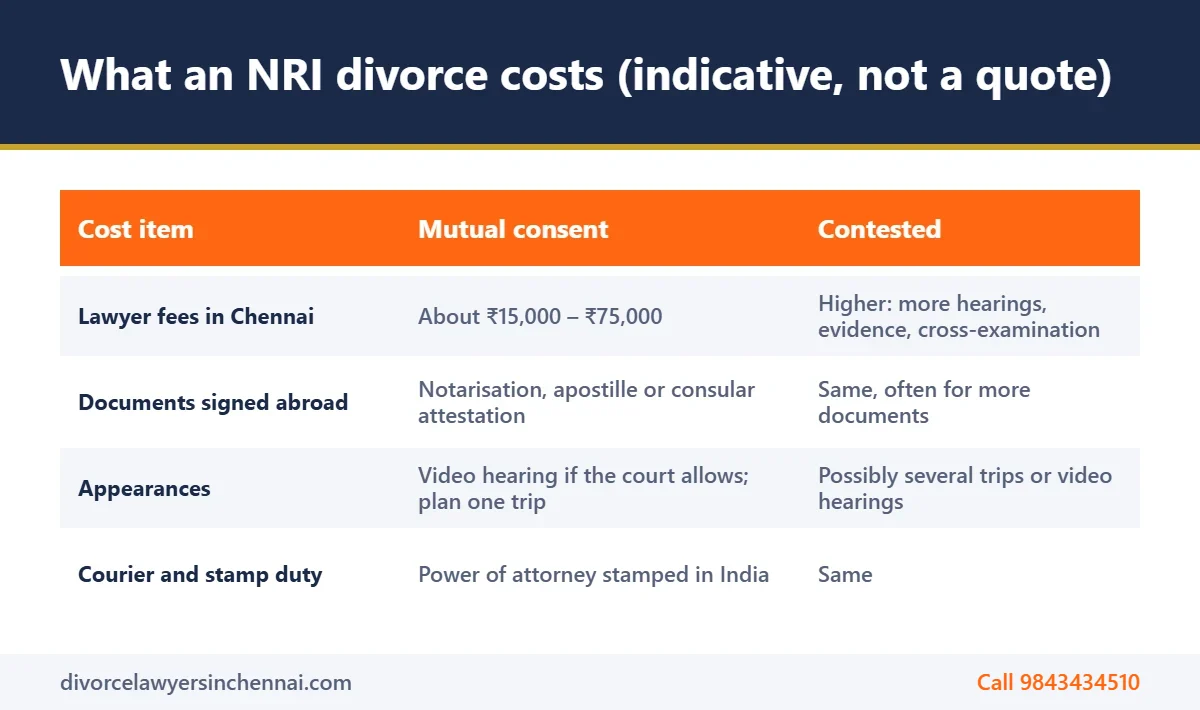
NRI cases usually add costs that a local case does not have:
- Notarisation, apostille or consular attestation of documents signed abroad
- Courier of original documents to Chennai
- Translation of foreign court orders or records
- Extra steps for serving notice on a spouse overseas
- Travel, if the court needs you in person
Ask for a written fee breakdown before you engage anyone. For more on how fees are set, see our page on divorce lawyer fees in Chennai.
Documents to prepare before your first call
Gather these before you speak to an advocate, so the first call moves your case forward:
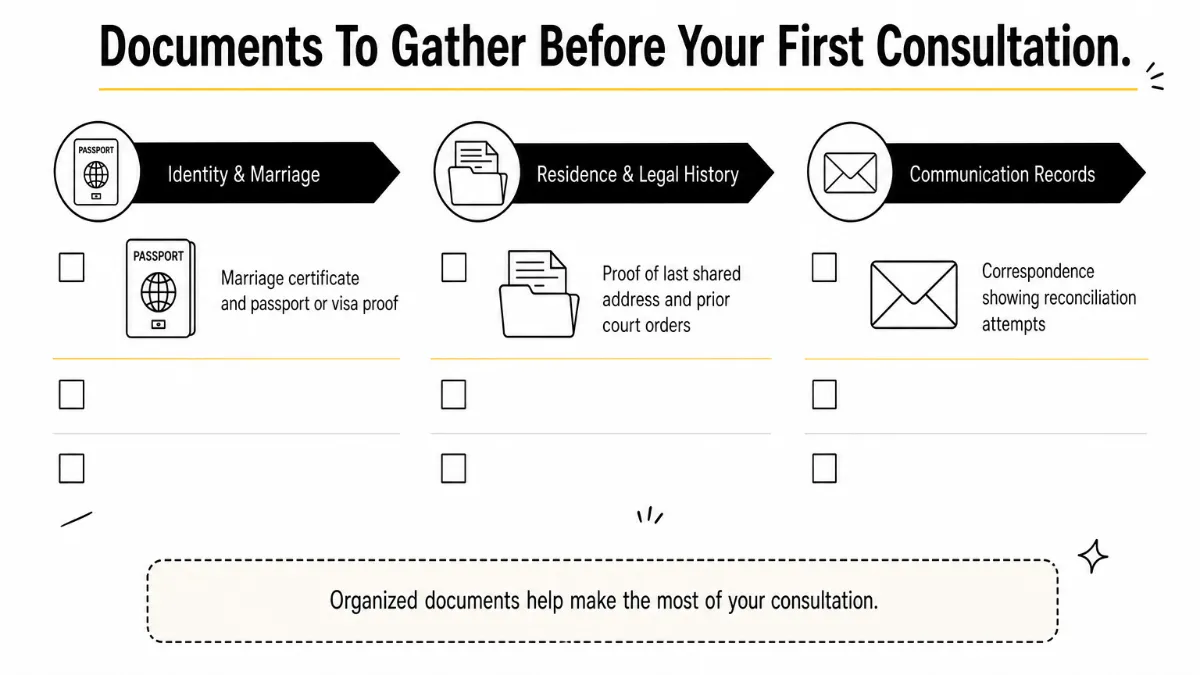
- Marriage certificate, or wedding invitation and photos if the marriage was not registered
- Passports, visas or residence permits of both spouses
- Proof of the last address where you lived together in India
- Any foreign court filings, orders or separation agreements
- Details of children, income, assets and stridhan
- Messages or emails relevant to the separation
When choosing an advocate, ask how they will keep you updated across time zones, how documents will be signed and sent, and whether they will request video-conference appearances.
Frequently asked questions
Can an NRI file for divorce in India while living abroad?
Yes, if an Indian court has jurisdiction, for example because the marriage took place in Chennai or the couple last lived together here. The petition can be signed abroad, and a representative can handle many routine steps.
Is my physical presence required in a mutual consent divorce?
Courts need to be satisfied that both spouses consent freely. Many courts allow this by video conference in suitable cases, but it is the court’s decision, so keep the option of travelling for at least one hearing.
Can I divorce my spouse who lives abroad without their cooperation?
Yes, by filing a contested petition on a legal ground. The court must be satisfied that notice was properly served. If your spouse does not appear after valid service, the court can proceed in their absence.
Will a divorce I got abroad be accepted in India?
Only if it meets the tests under Section 13 of the Code of Civil Procedure as explained in Y. Narasimha Rao. A mutual divorce abroad, or one your spouse contested on a ground available under Indian law, stands a better chance than a one-sided decree.
Book a consultation from abroad
An NRI divorce is manageable when the court, the paperwork and the hearings are planned from the start. Our appointment desk can connect you with a top divorce lawyer in Chennai from the directory for a first consultation by phone or video call, so you can understand your options before you decide anything.
Call 9843434510 (open 24/7, first consultation free; use +919843434510 from abroad) or write to us through the contact page.
This article is general information, not legal advice. Speak to an advocate about your specific case.
About this guide: Written by the Divorce Lawyers in Chennai team. Researched from the Acts and court judgments named in this guide and checked against primary sources before publishing. Last reviewed on 15 October 2026. How we research and check our guides.