
You can get a divorce on grounds of cruelty in India if your spouse’s conduct, physical or mental, has made it unsafe or unreasonable for you to keep living with them. Cruelty is a ground under every major marriage law, and either the husband or the wife can rely on it. What matters is not a single quarrel but serious conduct that you can prove with evidence.
This guide explains what courts treat as cruelty, how the law differs by religion, what evidence helps, and how a cruelty petition moves through the Family Court in Chennai.
In this guide
What the law says about cruelty
Under the Hindu Marriage Act, 1955, Section 13(1)(ia) allows either spouse to seek divorce if the other has, after the marriage, treated them with cruelty. Cruelty became a ground for divorce through the Marriage Laws (Amendment) Act, 1976. Before that, it only allowed judicial separation.
The Act does not define cruelty. Courts have filled the gap over decades, and the test today is simple to state: was the conduct so grave that the petitioner cannot reasonably be expected to live with the other spouse?
Cruelty is also a ground under the other personal laws:
| Law | Who it covers | Cruelty provision |
|---|---|---|
| Hindu Marriage Act, 1955 | Hindus, Buddhists, Jains, Sikhs | Section 13(1)(ia) |
| Special Marriage Act, 1954 | Civil and inter-faith marriages registered under the Act | Section 27(1)(d) |
| Indian Divorce Act, 1869 | Christian marriages | Section 10(1)(x) – cruelty causing a reasonable apprehension that living together is harmful or injurious |
| Dissolution of Muslim Marriages Act, 1939 | Muslim wife seeking divorce through court | Section 2(viii) – including habitual assault and making her life miserable |
If your marriage is Christian or Muslim, read our guides on divorce under the Christian marriage law and Muslim divorce in Chennai for the procedure that applies to you.
Physical cruelty and mental cruelty
Physical cruelty
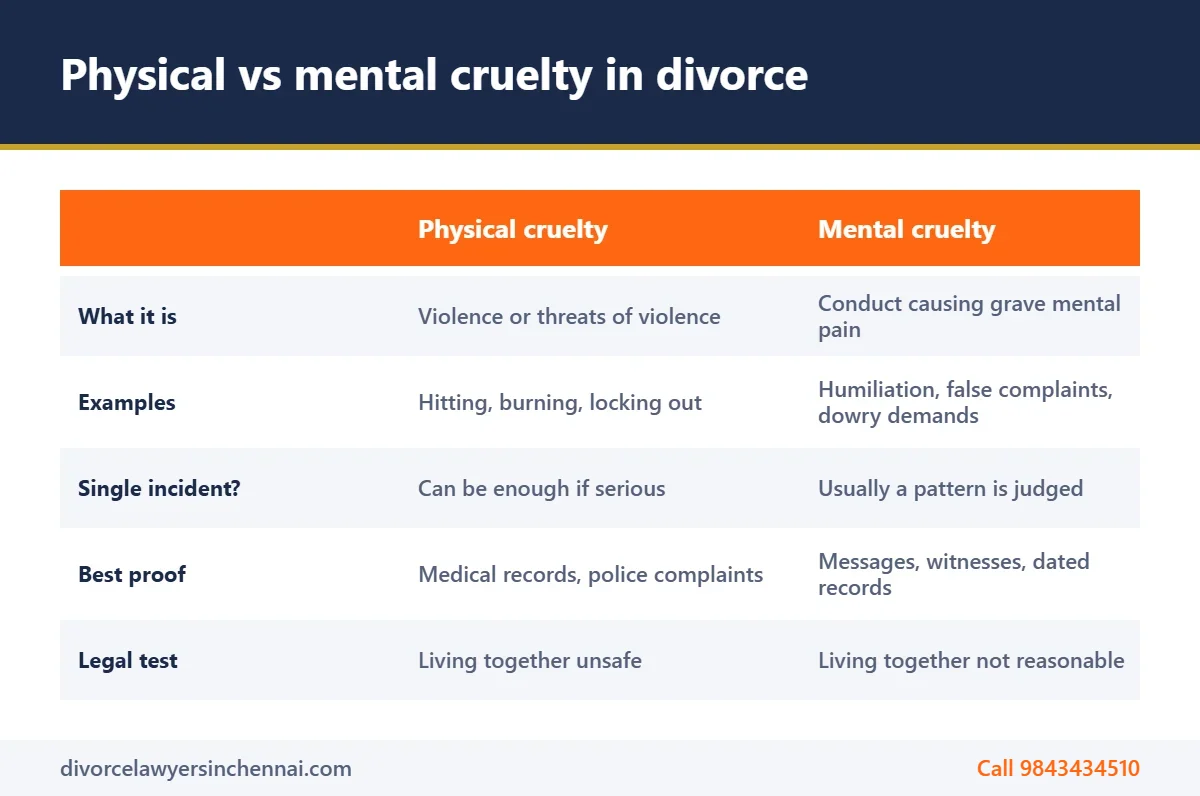
Physical cruelty is the easier kind to recognise: hitting, pushing, burning, locking a spouse in or out, or threatening violence. Even one serious incident can be enough if it is grave. Medical records and police complaints made at the time are usually the strongest proof.
Mental cruelty
Most cruelty petitions today rely on mental cruelty. In V. Bhagat v. D. Bhagat (1994), the Supreme Court described it as conduct that causes such mental pain and suffering that living together becomes impossible.
In Samar Ghosh v. Jaya Ghosh (2007), the Court gave an illustrative, non-exhaustive list of conduct that may amount to mental cruelty. Examples include:
- sustained abusive and humiliating treatment that makes life miserable;
- a long, unilateral refusal of sexual relations without a good reason;
- a unilateral decision not to have a child after marriage;
- persistent neglect, indifference and coldness that shows the relationship has turned hostile;
- a long separation that shows the marriage has become a fiction.
The Court also stressed that cruelty is judged by the cumulative effect of the conduct, and by the background, status and sensitivity of the people involved.
What courts have treated as cruelty
Each case turns on its facts, but some patterns appear again and again in Supreme Court rulings:
- Dowry demands. In Shobha Rani v. Madhukar Reddi (1988), persistent demands for dowry were held to be cruelty, even without proof of an intention to harm.
- False criminal complaints. In K. Srinivas Rao v. D.A. Deepa (2013), making false and defamatory complaints against a spouse and their family was held to be mental cruelty.
- Unfounded allegations. Accusing a spouse of insanity, immorality or an affair without basis, especially in pleadings or in public, has been treated as cruelty.
- Public humiliation. Insulting a spouse in front of colleagues or in published notices.
- Threats of suicide. In Narendra v. K. Meena (2016), repeated suicide threats and an attempt, along with pressure on the husband to leave his parents without a justifiable reason, were held to be cruelty in the facts of that case.
What usually does not count
Courts repeatedly say that ordinary wear and tear of married life is not cruelty. Occasional arguments, differences over money, or a spouse being moody or difficult will not, on their own, support a divorce. In A. Jayachandra v. Aneel Kaur (2005), the Supreme Court said the conduct must be grave and weighty, not trivial irritations.
How to prove cruelty
A divorce case is civil, so you do not have to prove cruelty beyond reasonable doubt. In N.G. Dastane v. S. Dastane (1975), the Supreme Court held that the standard is a preponderance of probabilities: your version must be more likely true than not.
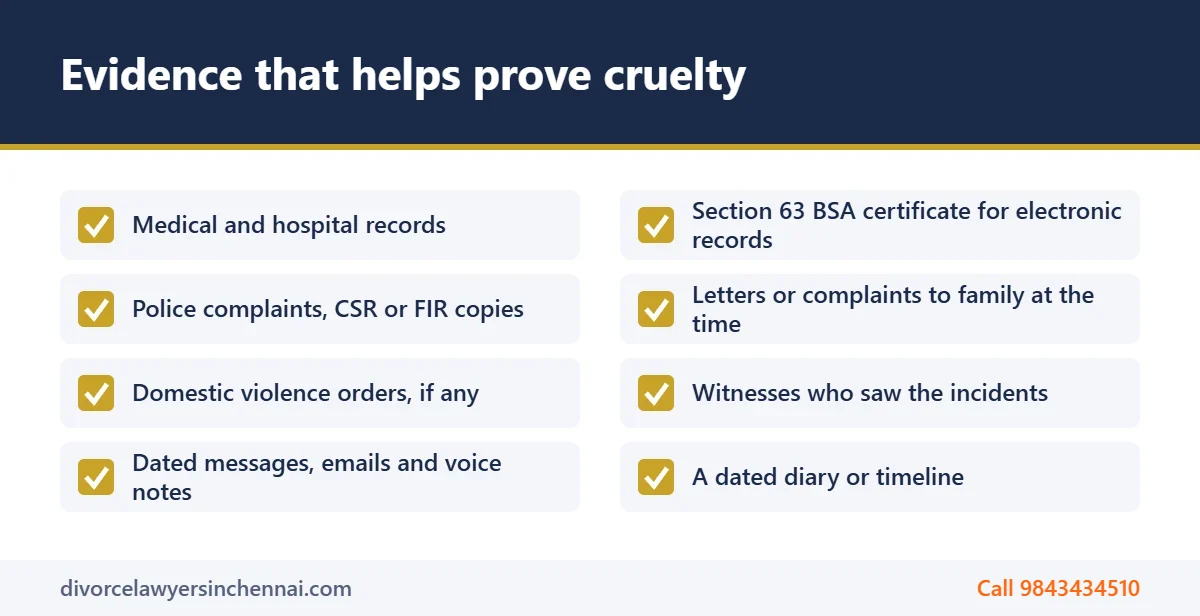
Even so, a cruelty petition succeeds or fails on evidence. Useful material includes:
- medical and hospital records of injuries or treatment, including counselling or psychiatric care;
- police complaints, Community Service Register entries or FIRs, and any orders under the domestic violence law;
- messages, emails, voice notes and social media posts, kept with their dates;
- letters or complaints made to family members, employers or elders at the time;
- witnesses such as neighbours, relatives or friends who saw the incidents;
- a dated diary or timeline you kept while the events were happening.
Electronic records such as WhatsApp chats now need a certificate under Section 63 of the Bharatiya Sakshya Adhiniyam, 2023 (which replaced Section 65B of the Indian Evidence Act). The Family Courts Act, 1984 also gives family courts some flexibility in receiving evidence, but you should not rely on that. Preserve the original phone or device and talk to your advocate early about how to produce it.
The process for divorce on grounds of cruelty
- Consultation and assessment. Your advocate checks whether the facts amount to cruelty in law, and whether other grounds such as desertion also apply.
- Petition. A petition is drafted setting out specific incidents with dates, places and details. Vague claims of “harassment” without particulars tend to fail.
- Filing in the right court. The petition is filed in the Family Court with jurisdiction, usually where the marriage took place, where the spouses last lived together, where the respondent lives, or where the wife lives if she is filing under the HMA.
- Notice and reply. Your spouse is served and files a counter, often denying the allegations.
- Counselling and mediation. The court will usually refer you to counselling or mediation. Some cases settle at this stage and convert to mutual consent.
- Interim applications. Maintenance and litigation expenses under Section 24 of the HMA, and interim custody of children, can be sought while the case is pending.
- Evidence and cross-examination. You give evidence, produce documents and are cross-examined. Your witnesses are examined too.
- Judgment. If the court finds cruelty proved, it grants a decree of divorce. The other side can appeal to the High Court.
Contested cases often take a long time, and there is no fixed timeline. Note also that under Section 14 of the HMA, a divorce petition generally cannot be filed within one year of marriage unless the court permits it for exceptional hardship.
Defences your spouse may raise
- Denial. The most common response is that the incidents never happened or are exaggerated. This is why contemporaneous records matter.
- Condonation. Under Section 23(1)(b) of the HMA, the court will not grant divorce if the cruelty was forgiven. Resuming normal married life after an incident can be argued as condonation, although later cruelty can revive the earlier conduct.
- Taking advantage of your own wrong. The court will not let a petitioner benefit from their own misconduct.
Cruelty in divorce and in criminal law
Cruelty for divorce is a civil ground. It is separate from the criminal offence of cruelty by a husband or his relatives under Section 85 of the Bharatiya Nyaya Sanhita, 2023 (formerly Section 498A IPC). A wife may pursue a criminal complaint, a divorce, or both, and she can also seek protection and residence orders under the Protection of Women from Domestic Violence Act, 2005.
If you are facing violence now, safety comes first. Our guide to the domestic violence case process explains how to get urgent protection.
Frequently asked questions
Can a husband file for divorce on grounds of cruelty?
Yes. The ground is available to either spouse. Several leading Supreme Court cases on mental cruelty were filed by husbands.
Is one incident enough for a cruelty divorce?
Sometimes. A single serious act of violence can be enough, but for mental cruelty courts usually look at a pattern of conduct and its overall effect.
Can I file for cruelty and desertion together?
Yes. A petition can plead more than one ground if the facts support each one. Your advocate will advise which grounds are strongest.
What if my spouse later agrees to a divorce?
A contested cruelty case can be converted into a mutual consent divorce if both of you agree on terms. This is often faster and less stressful.
Speak to an advocate about your case
A divorce on grounds of cruelty depends on how well your facts are pleaded and proved. Getting advice before you file helps you collect the right evidence and avoid allegations you cannot support.
To speak with one of the best lawyers for divorce in Chennai listed in our directory, call the appointment desk on 9843434510 or book through our contact page.
This article is general information, not legal advice. Speak to an advocate about your specific case.
About this guide: Written by the Divorce Lawyers in Chennai team. Researched from the Acts and court judgments named in this guide and checked against primary sources before publishing. Last reviewed on 2 November 2026. How we research and check our guides.