
If your marriage was solemnised or registered under the Special Marriage Act, 1954, your divorce is also governed by that Act, whatever your religion. You can seek divorce by mutual consent under Section 28, or on your own on a legal ground such as cruelty or desertion under Section 27. This guide explains how divorce under Special Marriage Act works, step by step.
It covers who the Act applies to, the grounds for divorce, the mutual consent procedure, which court in Chennai to approach, and how alimony and custody are handled.
In this guide
- Who the Special Marriage Act applies to
- Two ways to get divorce under Special Marriage Act
- Grounds for divorce under Section 27
- Mutual consent divorce under Section 28
- Which court to file in
- The one-year bar on early petitions
- Alimony, maintenance and custody
- Remarriage and appeals
- Frequently asked questions
- Get advice before you file
Who the Special Marriage Act applies to
The Special Marriage Act is a secular law. It lets any two people marry by civil registration, regardless of religion. Your divorce falls under this Act if:
- you married before a Marriage Officer under the Special Marriage Act, which is common for inter-faith couples; or
- you married under religious rites but later registered the marriage under Section 15 of the Act. Section 18 then treats it as a marriage solemnised under the Act.
A frequent mix-up: registering a Hindu marriage under the Tamil Nadu Registration of Marriages Act, 2009 does not turn it into a Special Marriage Act marriage. That is only a record of a marriage that remains governed by its own personal law, usually the Hindu Marriage Act. Check your marriage certificate to see which Act it was issued under.
If either spouse is Christian and you married in church, see our guide on divorce under the Christian marriage law. For a nikah, see Muslim divorce in Chennai.
Two ways to get divorce under Special Marriage Act
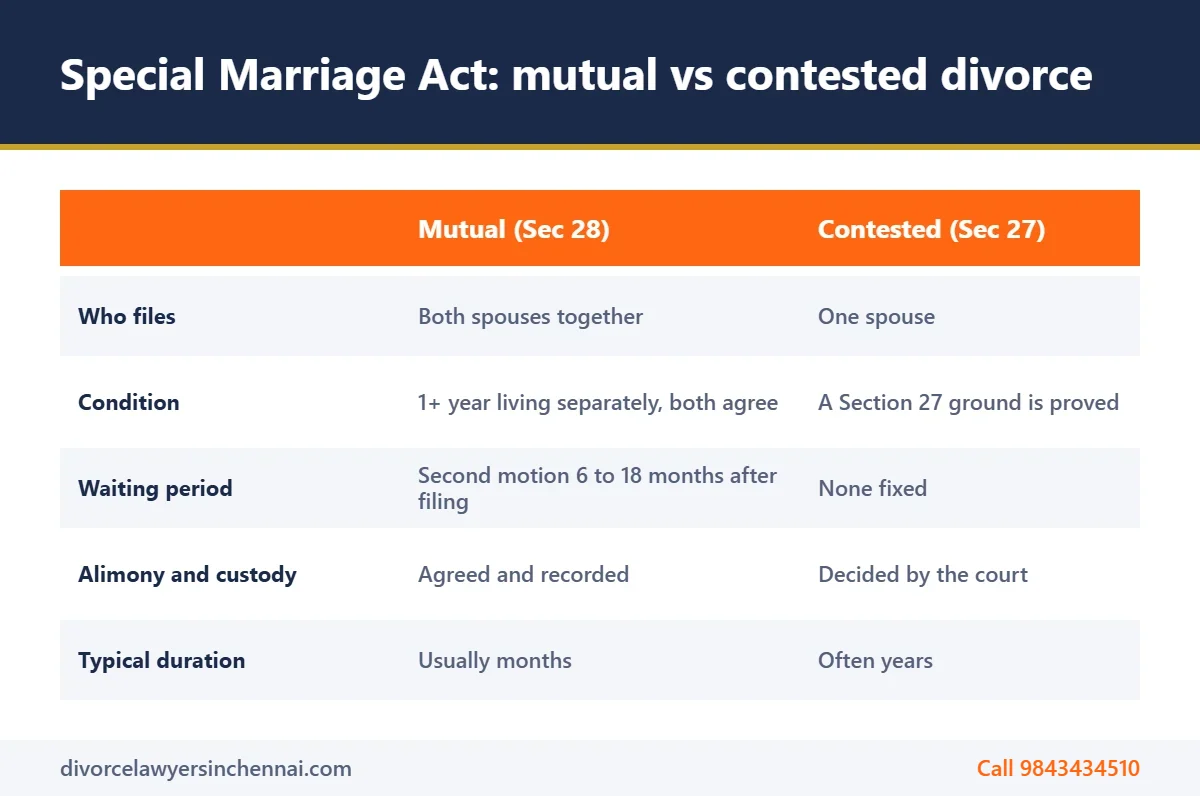
| Mutual consent (Section 28) | Contested (Section 27) | |
|---|---|---|
| Who files | Both spouses together | One spouse |
| Condition | Living separately for one year or more and both agree | A ground listed in Section 27 must be proved |
| Waiting period | Second motion not earlier than 6 months and not later than 18 months after filing | None fixed; depends on the trial |
| Alimony, custody, property | Agreed between you and recorded | Decided by the court if not settled |
| Typical duration | Usually months | Often years |
Grounds for divorce under Section 27
Under Section 27(1), either spouse can seek divorce if the other:
- has had voluntary sexual intercourse with someone other than the spouse after the marriage (adultery);
- has deserted the petitioner for a continuous period of at least two years immediately before the petition;
- is undergoing a sentence of imprisonment of seven years or more for an offence under the Indian Penal Code (now the Bharatiya Nyaya Sanhita);
- has treated the petitioner with cruelty since the marriage;
- has been incurably of unsound mind, or suffers from a mental disorder of a kind and extent that the petitioner cannot reasonably be expected to live with them;
- is suffering from a venereal disease in a communicable form; or
- has not been heard of as alive for seven years or more by those who would naturally have heard of them.
Leprosy was earlier a ground but was removed by an amendment in 2019.
Additional grounds for the wife
Section 27(1A) gives a wife two more grounds: if the husband has, since the marriage, been guilty of rape, sodomy or bestiality; or if a maintenance order was passed in her favour against the husband and the couple have not lived together for one year or more since that order.
Grounds after earlier court orders
Under Section 27(2), either spouse can seek divorce if they have not resumed living together for one year or more after a decree of judicial separation, or if there has been no restitution of conjugal rights for one year or more after a decree for restitution.
Cruelty is the ground most often pleaded in practice. Read our detailed guide on divorce on grounds of cruelty to see what courts accept and how it is proved.
Mutual consent divorce under Section 28
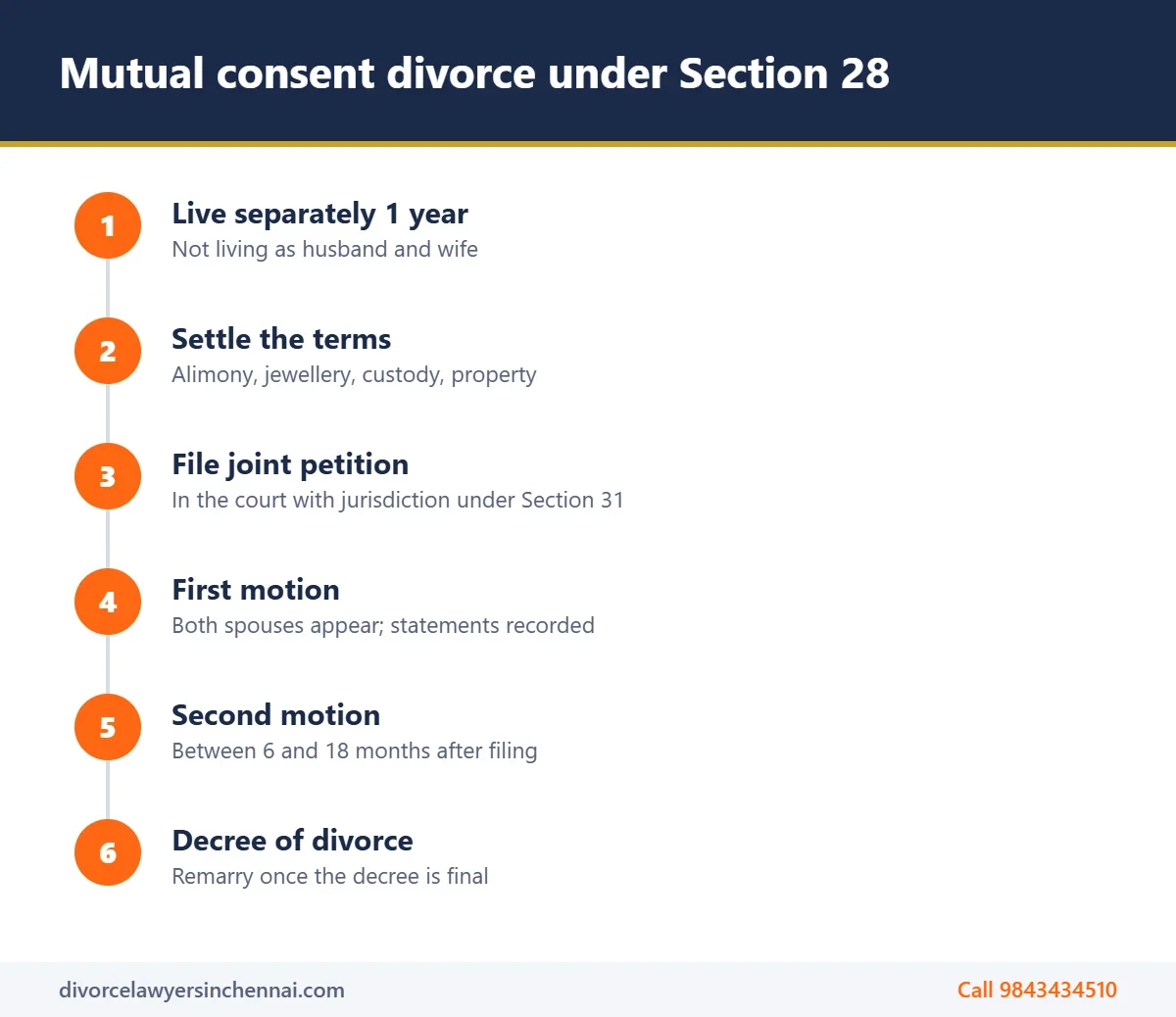
- Live separately for at least one year. Living separately means not living as husband and wife. It can sometimes be under the same roof, but you should be able to show it.
- Settle the terms. Agree on alimony or a one-time settlement, return of jewellery and belongings, custody and visitation of children, and any jointly owned property.
- File a joint petition. Both spouses sign and file the petition, stating that you have lived separately for a year, cannot live together, and have mutually agreed to dissolve the marriage.
- First motion. Both of you appear in court and your statements are recorded.
- Wait for the second motion. The second motion can be moved no earlier than six months and no later than eighteen months after the petition was presented. Either spouse can withdraw consent before the decree.
- Decree. After hearing you and making any inquiry it thinks fit, the court passes a decree of divorce from the date of the decree.
In Amardeep Singh v. Harveen Kaur (2017), the Supreme Court held that the six-month waiting period under the Hindu Marriage Act is not mandatory and can be waived in suitable cases. Courts have applied similar reasoning to Special Marriage Act petitions, but whether a waiver is possible depends on the facts and the court. For the step-by-step mutual consent procedure, see our mutual divorce process guide.
Which court to file in
Under Section 31, a petition can be presented in the court within whose limits:
- the marriage was solemnised;
- the respondent lives when the petition is filed;
- the couple last lived together;
- the wife lives on the date of filing, if she is the petitioner; or
- the petitioner lives, if the respondent lives outside India or has not been heard of as alive for seven years.
In Chennai, matrimonial cases are heard by the Family Court, which takes over the jurisdiction the Act gives the district court.
The one-year bar on early petitions
Under Section 29, you generally cannot file for divorce within one year from the date the marriage was entered in the Marriage Certificate Book. The court may allow an earlier petition only in cases of exceptional hardship to the petitioner or exceptional depravity by the respondent, and will consider the interests of any children and the chance of reconciliation.
Alimony, maintenance and custody
- Interim maintenance (Section 36). While the case is pending, the wife can ask the court to order the husband to pay her maintenance and the expenses of the case. Unlike Section 24 of the Hindu Marriage Act, this provision is framed for the wife only.
- Permanent alimony (Section 37). At the time of the decree or later, the court can order the husband to pay the wife a lump sum or periodic amount, considering both incomes, property and conduct.
- Children (Section 38). The court can make interim and final orders on custody, maintenance and education of minor children, keeping the child’s welfare first.
In maintenance disputes, courts follow Rajnesh v. Neha (2020), which requires both sides to file an affidavit disclosing assets and income. A wife can also claim maintenance under Section 144 of the Bharatiya Nagarik Suraksha Sanhita, 2023, which applies regardless of religion.
Remarriage and appeals
Under Section 30, either party can remarry once the decree is final: when the time for appeal has passed with no appeal filed, or an appeal has been dismissed. Remarrying while an appeal is pending can create serious legal problems, so wait for your advocate to confirm.
Frequently asked questions
Can a Hindu couple file under the Special Marriage Act?
Only if the marriage was solemnised or registered under that Act. A Hindu marriage performed with rites and registered under the state registration law is dissolved under the Hindu Marriage Act.
How long does a mutual consent divorce under the Act take?
The law sets a minimum six-month gap between filing and the second motion, unless waived. The total time depends on the court’s calendar and whether both spouses attend on time.
Is religion relevant in a Special Marriage Act divorce?
No. The grounds and procedure are the same for every couple, whatever their faiths.
Can we appear by video if one of us is abroad?
Courts can permit video conferencing in suitable matrimonial cases, as recognised in Santhini v. Vijaya Venketesh (2017). Permission depends on the court.
Get advice before you file
Choosing the right Act, the right ground and the right court is what keeps a divorce under Special Marriage Act moving without delay. A short consultation can confirm all three.
To speak with one of the experienced divorce lawyers in Chennai listed in our directory, call the appointment desk on 9843434510 or book through our contact page.
This article is general information, not legal advice. Speak to an advocate about your specific case.
About this guide: Written by the Divorce Lawyers in Chennai team. Researched from the Acts and court judgments named in this guide and checked against primary sources before publishing. Last reviewed on 2 November 2026. How we research and check our guides.