
The grounds for divorce in India depend on the law your marriage falls under. For Hindus, Buddhists, Jains and Sikhs, the Hindu Marriage Act, 1955 applies, and its main grounds are cruelty, desertion for two years, adultery, conversion, serious mental disorder, communicable venereal disease, renunciation of the world and being missing for seven years. Christians, Muslims and couples married under the Special Marriage Act have their own, similar lists.
If both spouses agree, you do not need to prove any ground at all: you can file for divorce by mutual consent. This guide sets out every ground, law by law, explains the extra grounds available only to a wife, and helps you see which route fits your situation.
In this guide
- Which law applies to your marriage?
- Grounds for divorce under the Hindu Marriage Act
- Grounds under the Special Marriage Act
- Grounds under the Divorce Act for Christians
- Grounds for a Muslim wife under the DMMA, 1939
- Grounds compared: quick reference table
- Mutual consent: divorce without proving a ground
- Is irretrievable breakdown a ground?
- How to choose and prove the right ground
- Frequently asked questions
- Get advice on your grounds
Which law applies to your marriage?
India has no single divorce law. The grounds you can rely on come from the personal law or special law that governs your marriage:
- Hindu Marriage Act, 1955 (HMA) applies to Hindus, Buddhists, Jains and Sikhs.
- Special Marriage Act, 1954 (SMA) applies to couples who married under it, which includes most inter-faith couples who registered their marriage under that Act.
- Divorce Act, 1869 (often called the Indian Divorce Act) applies where either spouse is Christian.
- Muslim personal law and the Dissolution of Muslim Marriages Act, 1939 (DMMA) apply to Muslim marriages.
- Parsi marriages have their own statute, the Parsi Marriage and Divorce Act, 1936.
Whichever law applies, a divorce is either contested (one spouse files and must prove a ground) or by mutual consent (both agree and no ground is needed).
Grounds for divorce under the Hindu Marriage Act
Section 13(1) of the HMA lets either the husband or the wife seek divorce if the other spouse, after the marriage:
- Adultery: had voluntary sexual intercourse with someone other than their spouse.
- Cruelty: treated the petitioner with cruelty, physical or mental.
- Desertion: deserted the petitioner for a continuous period of at least two years immediately before the petition.
- Conversion: ceased to be a Hindu by converting to another religion.
- Mental disorder: is incurably of unsound mind, or has a mental disorder of such a kind and degree that the petitioner cannot reasonably be expected to live with them.
- Venereal disease: is suffering from venereal disease in a communicable form.
- Renunciation: has renounced the world by entering a religious order.
- Presumed death: has not been heard of as being alive for seven years or more by people who would naturally have heard of them.
Leprosy was once a ground; it was removed from the personal laws by an amendment in 2019, so you will still see it in older articles.
Section 13(1A): after a court decree
Either spouse can also seek divorce if, for one year or more after a decree of judicial separation, the couple have not resumed living together, or if, for one year or more after a decree for restitution of conjugal rights, the decree has not been obeyed.
Section 13(2): the wife’s additional grounds
A wife has four further grounds:
- For marriages before the HMA came into force, the husband had another wife living at that time.
- The husband has, since the marriage, been guilty of rape, sodomy or bestiality.
- A maintenance order or decree has been passed in her favour and the couple have not lived together for one year or more since.
- She was married before she turned 15 and repudiated the marriage after 15 but before 18.
Of all the grounds for divorce in India, cruelty and desertion are among the most commonly pleaded in contested cases. Our detailed guides explain how to prove divorce on grounds of cruelty and desertion as a ground for divorce.
Grounds under the Special Marriage Act
Section 27 of the Special Marriage Act, 1954 gives either spouse grounds very close to the HMA: adultery, desertion for at least two years, cruelty, incurable unsound mind or serious mental disorder, communicable venereal disease, and not being heard of as alive for seven years. It adds one ground the HMA does not have: the respondent is undergoing a sentence of imprisonment of seven years or more.
Like the HMA, Section 27 allows divorce where a judicial separation or restitution decree has not been followed for one year or more, and gives a wife extra grounds (rape, sodomy or bestiality, and non-cohabitation for a year after a maintenance order). See our guide to divorce under the Special Marriage Act for the procedure.
Grounds under the Divorce Act for Christians
After its 2001 amendment, Section 10(1) of the Divorce Act, 1869 gives husband and wife the same grounds. Either spouse can seek dissolution if the other, since the marriage:
- has committed adultery;
- has ceased to be a Christian by conversion;
- has been incurably of unsound mind for at least two years before the petition;
- has suffered from communicable venereal disease for at least two years before the petition;
- has not been heard of as alive for seven years or more;
- has wilfully refused to consummate the marriage;
- has failed to comply with a decree for restitution of conjugal rights for two years or more;
- has deserted the petitioner for at least two years before the petition;
- has treated the petitioner with such cruelty that it is harmful or injurious to live together.
Under Section 10(2), a wife can also seek divorce if her husband has been guilty of rape, sodomy or bestiality since the marriage. Read more on divorce for Christians.
Grounds for a Muslim wife under the DMMA, 1939
A Muslim husband can end the marriage by talaq in the manner permitted by personal law, but instant triple talaq is void and an offence under the Muslim Women (Protection of Rights on Marriage) Act, 2019. A Muslim wife can approach the court under Section 2 of the DMMA, 1939 on any of these grounds:
- the husband’s whereabouts have not been known for four years;
- he has neglected or failed to maintain her for two years;
- he has been sentenced to imprisonment for seven years or more;
- he has failed, without reasonable cause, to perform his marital obligations for three years;
- he was impotent at the time of marriage and continues to be so;
- he has been insane for two years, or suffers from a virulent venereal disease;
- she was married off by her father or guardian before 15, repudiated the marriage before 18, and it was not consummated;
- cruelty, which the Act defines broadly, including habitual assault, cruel conduct that makes her life miserable, interfering with her property or her religious practice, and unequal treatment where he has more than one wife;
- any other ground recognised as valid under Muslim law.
Muslim law also recognises divorce initiated by the wife (khula) and by agreement (mubarat). An advocate can advise which route suits your circumstances.
Grounds compared: quick reference table
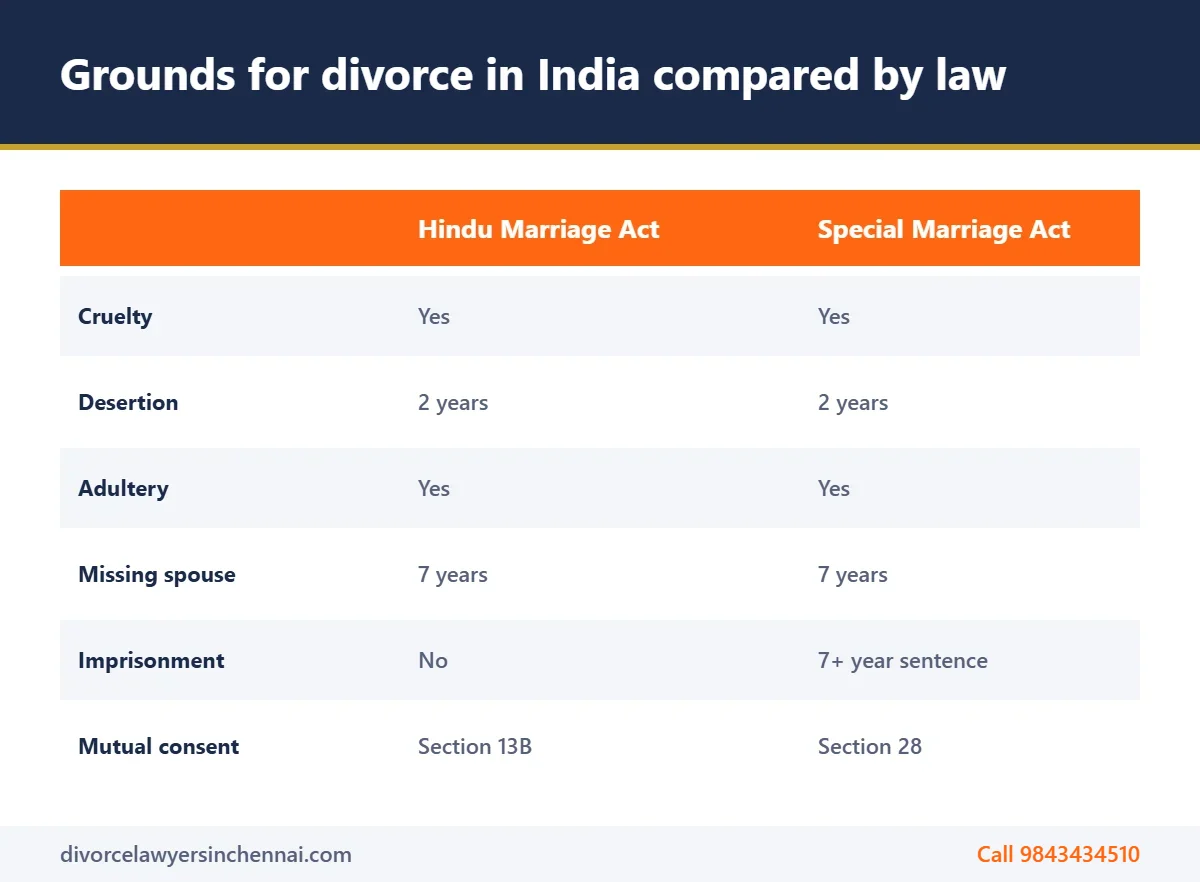
| Ground | Hindu Marriage Act | Special Marriage Act | Divorce Act (Christian) | DMMA (Muslim wife) |
|---|---|---|---|---|
| Cruelty | Yes | Yes | Yes | Yes (defined in the Act) |
| Desertion | 2 years | 2 years | 2 years | Failure of marital obligations, 3 years |
| Adultery | Yes | Yes | Yes | Not listed separately |
| Conversion | Yes | No | Yes | No |
| Mental disorder | Yes | Yes | 2 years | Insanity, 2 years |
| Missing spouse | 7 years | 7 years | 7 years | 4 years |
| Imprisonment | No | 7+ years sentence | No | 7+ years sentence |
| Mutual consent | Section 13B | Section 28 | Section 10A | Mubarat |
Mutual consent: divorce without proving a ground
If you and your spouse both want to end the marriage, you can skip the grounds altogether:
- HMA Section 13B and SMA Section 28: the couple must have lived separately for one year or more and agree that they cannot live together. The second motion is made between six and eighteen months after filing, and the six-month gap can be waived in suitable cases following Amardeep Singh v. Harveen Kaur (2017).
- Divorce Act Section 10A: the text requires separation for two years or more. In Saumya Ann Thomas v. Union of India (2010), the Kerala High Court read this down to one year, and in 2022 the same court struck down the minimum separation period as unconstitutional, so ask your advocate how it is currently applied in Tamil Nadu.
Mutual consent is usually far quicker and less expensive than a contested case. Our mutual divorce process guide walks through each step.
Is irretrievable breakdown a ground?
Not in the family court. Irretrievable breakdown of marriage is not listed in the HMA, SMA or Divorce Act. In Shilpa Sailesh v. Varun Sreenivasan (2023), a Constitution Bench of the Supreme Court held that it may dissolve a marriage on this basis using its special power under Article 142 of the Constitution. That power belongs only to the Supreme Court, so a petition in Chennai must still rely on a statutory ground or on mutual consent.
How to choose and prove the right ground
Choosing between the grounds for divorce in India is a strategic decision, not a formality. A few practical points:
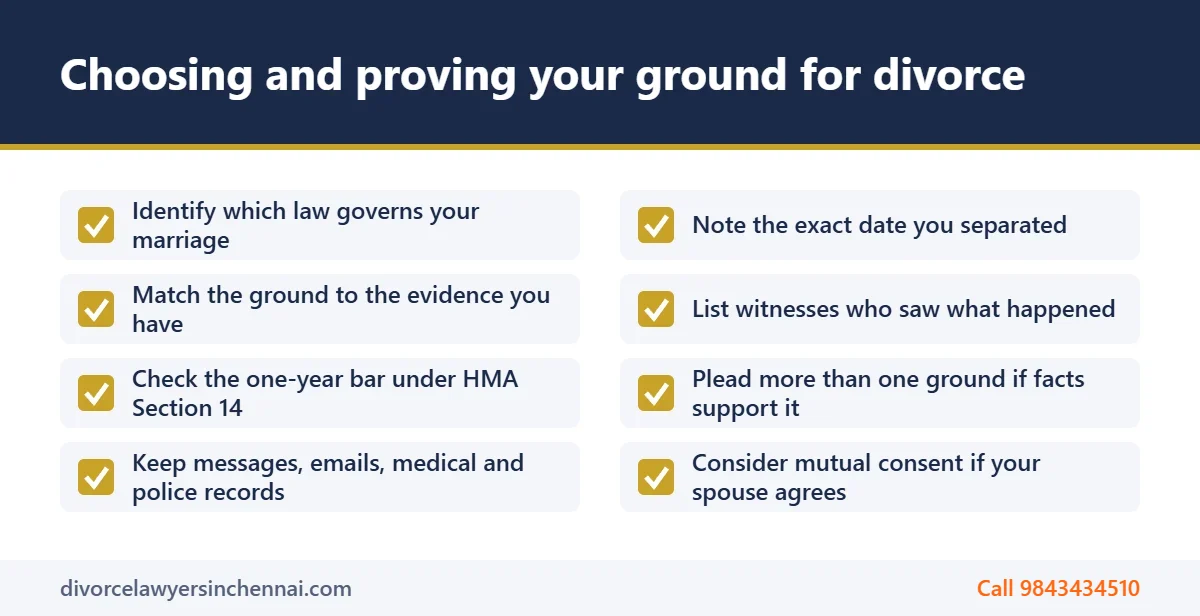
- Match the ground to your evidence. A ground you cannot prove can lead to dismissal, even if the marriage has clearly failed.
- Check the time bar. Under Section 14 of the HMA, a divorce petition generally cannot be filed within one year of marriage unless the court allows it for exceptional hardship or depravity.
- Proof is required even if your spouse does not appear. Section 23 of the HMA requires the court to be satisfied that the ground is made out.
- Collect documents early: messages, emails, medical and police records, proof of the date of separation, and names of witnesses.
- Combine grounds where the facts support it. Many petitions plead cruelty and desertion together.
- Stay open to settlement. A contested case can be converted into a mutual consent petition if you both agree later.
All guides in this section
- Divorce in Christian Marriage Act: Grounds and Process
- Muslim Divorce Lawyers in Chennai: Talaq, Khula and Mehr
Frequently asked questions
Can I get a divorce in India without giving any reason?
Yes, if your spouse agrees. A mutual consent divorce needs no ground, only the required period of separation and genuine consent from both of you at the final stage.
Can a husband file for divorce on the same grounds as the wife?
Yes. The grounds in Section 13(1) of the HMA, Section 27(1) of the SMA and Section 10(1) of the Divorce Act are available to both spouses. Only the additional grounds in HMA Section 13(2), SMA Section 27(1A) and Divorce Act Section 10(2) are limited to the wife.
What is the most common ground for divorce?
Cruelty, especially mental cruelty, is one of the most commonly pleaded grounds in contested cases, often together with desertion. Whether it succeeds depends entirely on the evidence.
Can I file for divorce within one year of marriage?
Under the HMA, generally not, unless the court grants leave for exceptional hardship or exceptional depravity. A mutual consent petition also needs one year of separation, so it cannot be filed immediately after marriage either.
Get advice on your grounds
Knowing the grounds for divorce in India is the first step; applying them to your facts and evidence is where an advocate helps most. The right choice of ground, court and paperwork at the start can save months of litigation.
To discuss your case with one of the best divorce lawyers in Chennai in our directory, call the appointment desk on 9843434510 or book through our contact page. The first consultation is free.
This article is general information, not legal advice. Speak to an advocate about your specific case.
About this guide: Written by the Divorce Lawyers in Chennai team. Researched from the Acts and court judgments named in this guide and checked against primary sources before publishing. Last reviewed on 15 October 2026. How we research and check our guides.