
How can a wife file for divorce in India? She can file either jointly with her husband by mutual consent, or on her own by filing a contested petition on legal grounds such as cruelty or desertion. She does not need her husband’s permission to file, and under the Hindu Marriage Act she can file in the court where she is living on the date of filing, even if that is her parents’ home.
This guide explains how a wife can file for divorce in India step by step: which law applies, the grounds available only to wives, where to file, what to claim alongside the divorce, and how to get free legal help in Chennai if money is a concern.
In this guide
- First, decide between mutual consent and contested divorce
- Which law applies to you
- Grounds a wife can use in a contested divorce
- Where a wife can file
- How a wife can file for divorce in India: step by step
- What you can claim along with the divorce
- If you are facing violence or harassment
- Free legal help if you cannot afford a lawyer
- Frequently asked questions
- Talk to an advocate before you file
First, decide between mutual consent and contested divorce
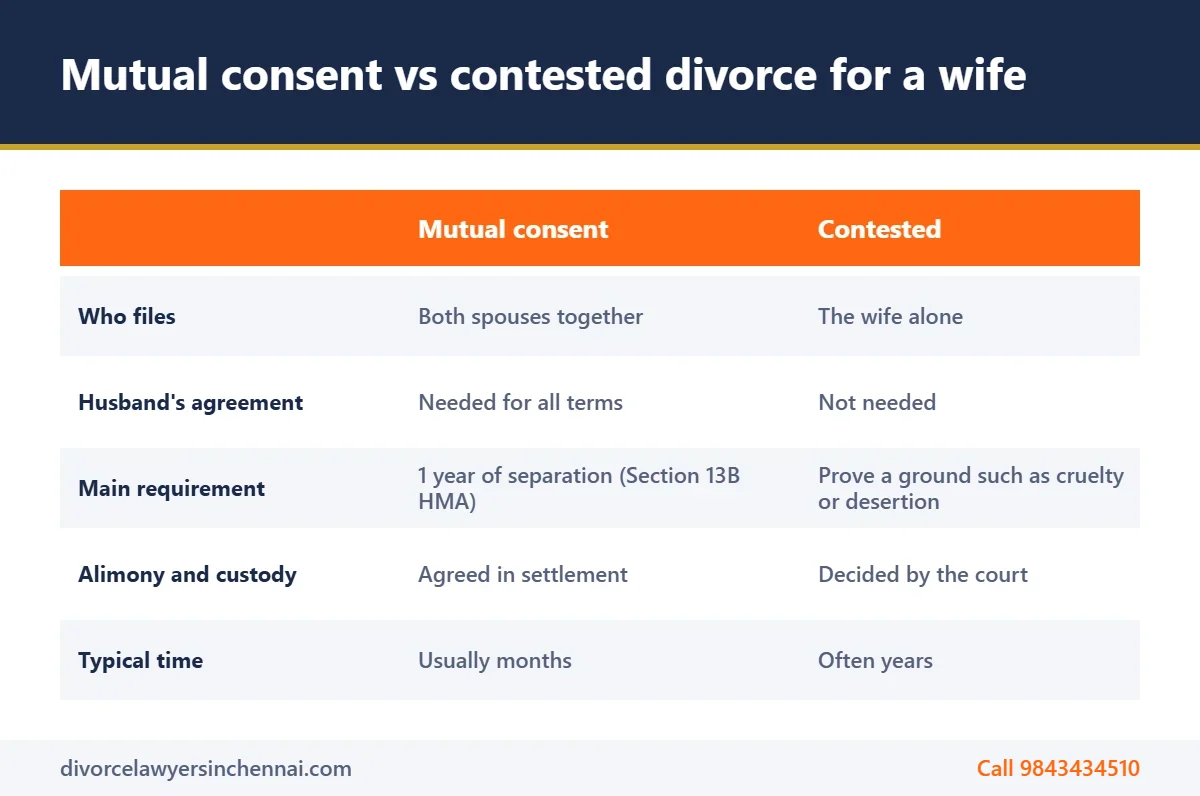
The route you choose shapes everything else, from cost to time to stress.
| Mutual consent divorce | Contested divorce | |
|---|---|---|
| Who files | Both spouses together | The wife alone |
| Husband’s agreement | Needed for all terms | Not needed |
| Main requirement | Living separately for at least one year (Hindus, Section 13B HMA) | Proving a legal ground, such as cruelty or desertion |
| Alimony and custody | Agreed in the settlement | Decided by the court on evidence |
| Typical time | Usually months | Often years |
If your husband is willing to settle on fair terms, mutual consent is usually faster and less draining. Our guide to the mutual divorce process explains the two motions and the waiting period. If he refuses or the terms are unfair, a contested petition is your route.
Which law applies to you
Your religion and the way you married decide which law governs your divorce.
- Hindus, Buddhists, Jains and Sikhs: Hindu Marriage Act, 1955. Section 13 lists the grounds, and Section 13B covers mutual consent.
- Registered civil or inter-faith marriages: Special Marriage Act, 1954. Section 27 lists the grounds and Section 28 covers mutual consent.
- Christians: Indian Divorce Act, 1869. Section 10 lists the grounds and Section 10A covers mutual consent, though courts have relaxed the two-year separation period the Act originally set.
- Muslim women: the Dissolution of Muslim Marriages Act, 1939, along with khula and mubarat under personal law. Triple talaq is void and an offence under the Muslim Women (Protection of Rights on Marriage) Act, 2019.
Grounds a wife can use in a contested divorce
Under Section 13(1) of the Hindu Marriage Act, either spouse can seek divorce on grounds including:
- Cruelty, physical or mental. In Samar Ghosh v. Jaya Ghosh (2007), the Supreme Court gave examples of mental cruelty, such as sustained humiliation and conduct that makes living together impossible.
- Desertion for a continuous period of at least two years before filing.
- Adultery after marriage.
- Conversion to another religion.
- Unsound mind or serious mental disorder of a kind that makes living together unreasonable.
- Renunciation of the world, or the spouse not being heard of as alive for seven years.
Grounds available only to the wife
Section 13(2) of the Hindu Marriage Act gives a wife extra grounds:
- The husband has been guilty of rape, sodomy or bestiality since the marriage.
- A maintenance order was passed in her favour (under Section 18 of the Hindu Adoptions and Maintenance Act or Section 125 CrPC), and the couple have not lived together for one year or more since that order.
- She was married before the age of 15 and repudiated the marriage after turning 15 but before turning 18.
- For marriages before 1955, the husband had another living wife.
Muslim women can seek dissolution under Section 2 of the 1939 Act on grounds such as the husband’s whereabouts being unknown for four years, failure to provide maintenance for two years, failure to perform marital obligations for three years, imprisonment for seven years or more, and cruelty.
Where a wife can file
Section 19 of the Hindu Marriage Act lets a petition be filed where the marriage was solemnised, where the husband lives, or where the couple last lived together. Importantly, clause (iiia) also lets a wife file where she is residing on the date of filing.
So if you have moved back to your parents’ home in Chennai, you can usually file before the family court with jurisdiction over that area. In Chennai, divorce cases are heard by the Family Court, which also handles custody and maintenance.
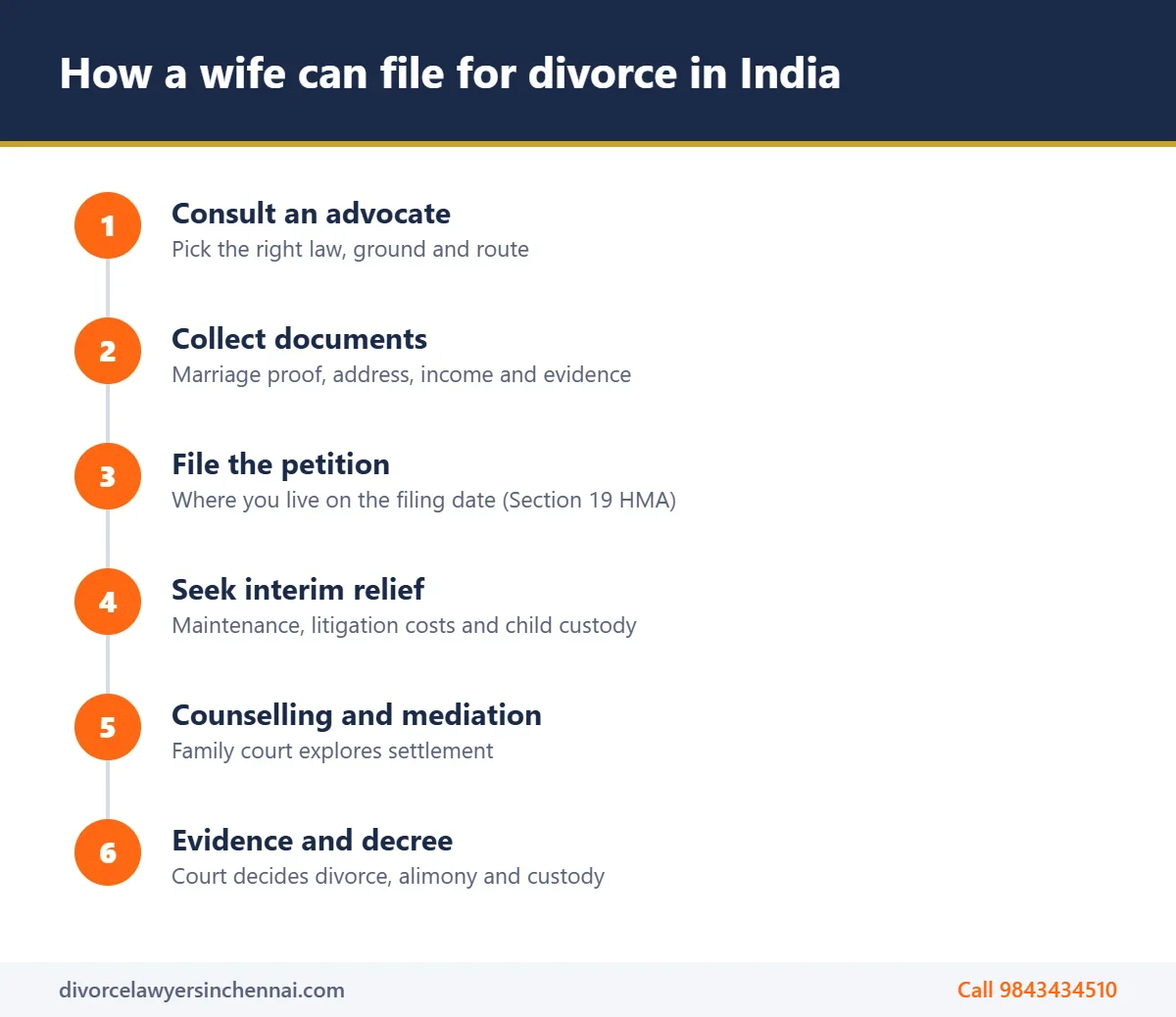
How a wife can file for divorce in India: step by step
- Consult an advocate. Discuss your facts, the right law and ground, and whether mutual consent is realistic.
- Collect documents. Marriage certificate, wedding photos, address proof, proof of separation, income details of both spouses, and any evidence of cruelty such as messages, medical records or police complaints.
- Consider a legal notice. It is not legally required before filing, but it can open talks on settlement.
- Draft and file the petition. Your advocate prepares the petition with the ground, facts and reliefs, and files it with the supporting affidavit and court fee.
- File interim applications. These can include interim maintenance and litigation costs under Section 24, and interim custody of children.
- Counselling and mediation. The family court usually refers both parties to counselling to explore reconciliation or settlement.
- Evidence and arguments. If there is no settlement, both sides give evidence and are cross-examined.
- Decree. The court grants or refuses divorce and decides alimony and custody.
Since Santhini v. Vijaya Venketesh (2017), courts can also allow parts of matrimonial proceedings by video conference in suitable cases, which helps if you have moved away.
What you can claim along with the divorce
Filing for divorce is only part of the picture. A wife can also ask for financial and personal protection.
- Interim maintenance and litigation expenses under Section 24 of the HMA while the case runs.
- Permanent alimony under Section 25 of the HMA at the time of the decree.
- Maintenance under Section 144 of the Bharatiya Nagarik Suraksha Sanhita, 2023 (formerly Section 125 CrPC), for herself and the children.
- Custody of children under Section 26 of the HMA.
- Return of stridhan, the jewellery and gifts that belong to her.
- Protection and residence orders under the Protection of Women from Domestic Violence Act, 2005, if there is abuse.
In Rajnesh v. Neha (2020), the Supreme Court required both spouses to file an affidavit of their assets and income in maintenance cases, which makes it harder for a husband to hide his earnings.
If you are facing violence or harassment
Your safety comes first. If you are in immediate danger, call 100 or 112. The women’s helpline 181 can also guide you.
You do not need to wait for the divorce to get protection. A Magistrate can pass protection, residence and monetary relief orders under the domestic violence law, and cruelty by a husband or his relatives is an offence under Section 85 of the Bharatiya Nyaya Sanhita, 2023 (formerly Section 498A IPC). Our guide to the domestic violence case process explains these remedies step by step.
Free legal help if you cannot afford a lawyer
Under Section 12 of the Legal Services Authorities Act, 1987, every woman is entitled to free legal services, whatever her income. In Chennai, you can apply through the District Legal Services Authority or the Tamil Nadu State Legal Services Authority for a panel advocate to handle your case.
Frequently asked questions
Can a wife file for divorce without her husband’s consent?
Yes. She can file a contested petition on her own on any valid ground. His consent is needed only for a mutual consent divorce.
Can I file for divorce from my parents’ house in Chennai?
Under Section 19(iiia) of the Hindu Marriage Act, a wife can file where she is residing on the date of filing. So yes, in most Hindu marriage cases you can file in Chennai if you are living here.
Does the wife lose her right to maintenance if she files for divorce?
No. Filing does not take away her right to claim interim maintenance, alimony or child support. The court decides the amount based on both spouses’ income and needs.
How long does a wife’s divorce case take?
It varies. Mutual consent cases usually finish in months, while contested cases can take much longer depending on evidence and adjournments. No one can promise an exact timeline.
Talk to an advocate before you file
Every woman’s situation is different, and the right ground, court and interim reliefs make a real difference to the outcome. If you are still asking how can a wife file for divorce in India in your own situation, a confidential first consultation helps you understand your options before you take the first step.
If you would prefer to speak with a woman advocate, our directory has a dedicated section to help you find the best lady divorce lawyer in Chennai for your case, alongside other experienced family law advocates. Call the appointment desk on 9843434510 or send a request through our contact page.
This article is general information, not legal advice. Speak to an advocate about your specific case.
About this guide: Written by the Divorce Lawyers in Chennai team. Researched from the Acts and court judgments named in this guide and checked against primary sources before publishing. Last reviewed on 15 October 2026. How we research and check our guides.