
The domestic violence case procedure in India starts with an application to a Magistrate under the Protection of Women from Domestic Violence Act, 2005 (PWDVA), usually with help from a Protection Officer. The court can quickly pass protection, residence, maintenance and custody orders. You do not need to file for divorce to use this law, and you can use it alongside a police complaint.
This guide explains who can file, what counts as domestic violence, each step of the process, the orders a court can make, and how to get free legal help in Chennai. If you are in immediate danger, call 112 first.
In this guide
- Who can file a domestic violence case
- What counts as domestic violence
- Domestic violence case procedure in India: step by step
- Orders the court can pass
- Civil remedy, criminal complaint, or both
- Evidence and documents to gather
- Free legal aid in Chennai
- Your wider rights as a wife
- Frequently asked questions
- Get help from a family lawyer
Who can file a domestic violence case
The PWDVA protects an “aggrieved person”: a woman who is, or has been, in a domestic relationship with the respondent and says she has faced domestic violence. A domestic relationship includes:
- A wife living, or who has lived, in a shared household with her husband
- A woman in a relationship in the nature of marriage (a live-in relationship)
- A mother, sister, daughter, widow or other woman related by blood, marriage or adoption who shares or shared the household
The case can be filed against the husband or partner and his relatives. In Hiral P. Harsora v. Kusum Narottamdas Harsora (2016), the Supreme Court struck down the words “adult male” from the definition of respondent, so women relatives can also be made respondents.
What counts as domestic violence
Section 3 of the Act defines domestic violence widely. It is not limited to physical beating. It covers:
| Type of abuse | Examples |
|---|---|
| Physical | Hitting, pushing, kicking, or any act that causes bodily pain or harm |
| Sexual | Any sexual conduct that abuses, humiliates or degrades the woman |
| Verbal and emotional | Insults, name-calling, ridicule about not having a child or a male child, threats |
| Economic | Denying money for household needs, taking away her salary or stridhan, stopping access to the home |
| Dowry-related | Harassment or coercion to meet unlawful dowry demands |
A single serious incident can be enough. A pattern of smaller acts can also amount to domestic violence.
Domestic violence case procedure in India: step by step
The process below is the general route under the PWDVA. Practice can vary slightly between courts, and your lawyer will adjust it to your facts.
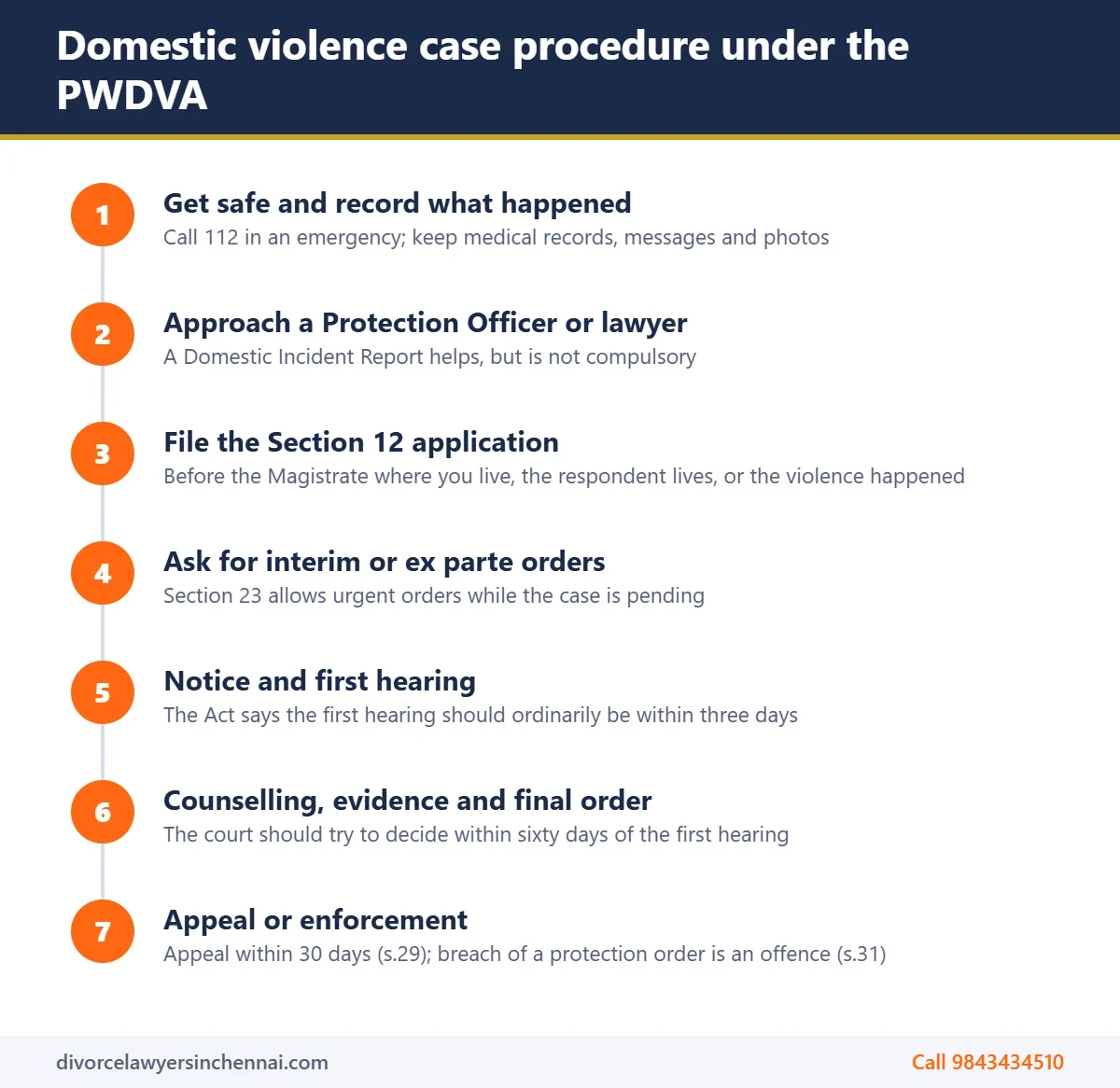
Step 1: Get safe and record what happened
Your safety comes first. Call 112 in an emergency, or the women’s helpline 181. If you are hurt, get medical treatment and keep the records.
Write down dates, what was said and done, and who saw it. Save messages, photos and audio. These details matter later.
Step 2: Approach a Protection Officer, service provider or lawyer
Each district has Protection Officers appointed under the Act. They can help you prepare a Domestic Incident Report (DIR), arrange medical help or a shelter, and forward the report to the Magistrate and the police.
You can also go directly to a lawyer, or to a registered service provider such as an NGO. A DIR is helpful but you can file without one.
Step 3: File the application under Section 12
The application is filed before the Judicial Magistrate of the First Class or the Metropolitan Magistrate. Under Section 27, you can file where you live (even temporarily), where the respondent lives, or where the violence took place.
In the application, list the incidents and ask for the specific orders you need: protection, residence, money, custody, compensation, or several of these together.
Step 4: Ask for interim and ex parte orders
Under Section 23, the Magistrate can pass interim orders while the case is pending. If there is urgency, the court can even pass an order ex parte, before hearing the respondent, based on your affidavit.
This is often the most important stage. An interim protection or residence order can stop the abuse and keep you in the home quickly.
Step 5: Notice and first hearing
The court issues notice to the respondent, usually served through the Protection Officer. The Act says the first hearing should ordinarily be within three days of the court receiving the application, though actual dates depend on the court’s workload.
Step 6: Counselling, evidence and final order
The Magistrate may direct counselling under Section 14 if it is appropriate and safe. If the matter is not resolved, both sides present their evidence.
The Act asks the court to try to dispose of the application within sixty days of the first hearing. In practice, many cases take longer. The court then passes a final order.
Step 7: Appeal or enforcement
Either side can appeal to the Court of Session within thirty days of the order being served on them, under Section 29. If the respondent breaks a protection order, that breach is itself an offence under Section 31, and you can report it to the police.
Orders the court can pass
- Protection order (Section 18): stops the respondent from committing violence, contacting you, entering your workplace, or operating joint bank accounts.
- Residence order (Section 19): stops you from being thrown out of the shared household, or directs the respondent to provide alternative housing.
- Monetary relief (Section 20): covers expenses and losses, including medical costs, lost earnings and maintenance for you and your children.
- Custody order (Section 21): temporary custody of your children, with visiting arrangements for the respondent only if safe.
- Compensation order (Section 22): compensation for injuries, including mental torture and emotional distress.
Section 17 also gives every woman in a domestic relationship the right to reside in the shared household. In Satish Chander Ahuja v. Sneha Ahuja (2020), the Supreme Court held that a shared household can include a home owned by the husband’s relatives where the couple lived, not just a house owned by the husband. For more on how custody is decided, see our guide to child custody laws in India.
Civil remedy, criminal complaint, or both
The PWDVA is a civil remedy heard by a criminal court. It gives protection and support. It does not by itself punish the abuser.
If you want criminal action, you can file a police complaint for cruelty under Section 85 of the Bharatiya Nyaya Sanhita, 2023 (formerly Section 498A IPC), and under the Dowry Prohibition Act, 1961 where dowry demands are involved. You can pursue both routes together.
Under Section 26 of the PWDVA, the same reliefs can also be claimed in a pending divorce, maintenance or other family case, so you do not always need a separate application.
Evidence and documents to gather
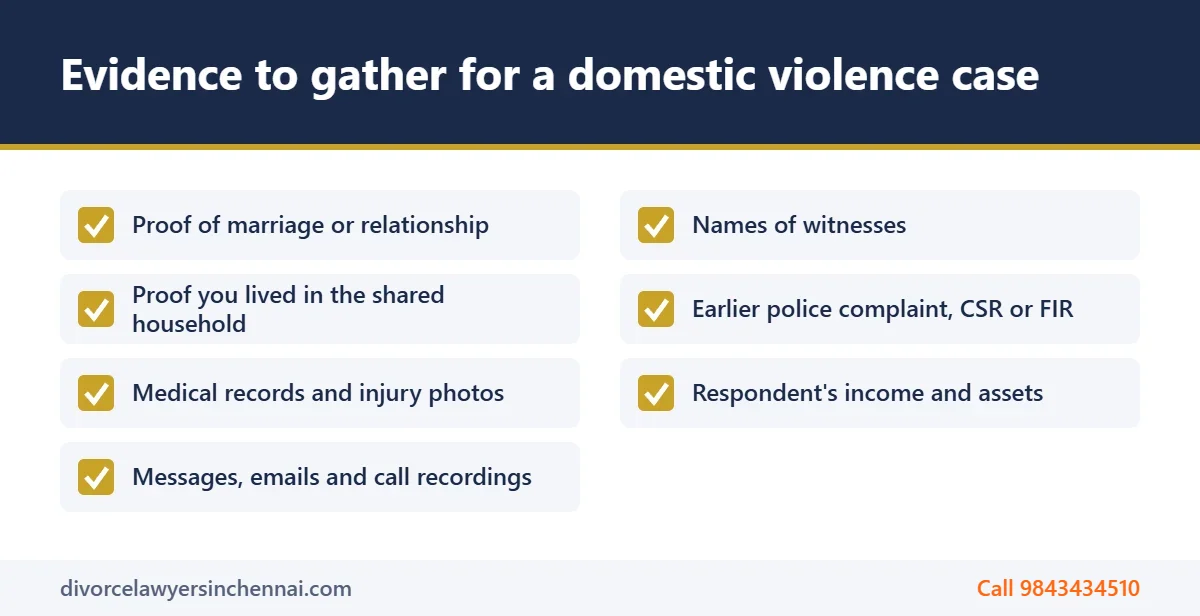
- Marriage certificate, wedding photos or proof of the relationship
- Proof that you lived in the shared household (address proof, bills, letters)
- Medical records, injury photos and hospital bills
- Messages, emails, call recordings or social media posts
- Names of neighbours, relatives or friends who saw incidents
- Any earlier police complaint, CSR receipt or FIR
- Details of the respondent’s income and assets, for monetary relief
Free legal aid in Chennai
Under Section 12 of the Legal Services Authorities Act, 1987, every woman is entitled to free legal services, whatever her income. You can approach the Tamil Nadu State Legal Services Authority or the District Legal Services Authority in Chennai for a lawyer at no cost.
Protection Officers and registered service providers can also help you file and attend hearings.
Your wider rights as a wife
A domestic violence case is often one part of a bigger picture. These are the rights women most often need to understand alongside it:
- Right to live in the shared household: Section 17 of the Domestic Violence Act protects a woman’s right to reside in the shared household, whether or not she owns it. In Satish Chander Ahuja v. Sneha Ahuja (2020) the Supreme Court held that a house belonging to the in-laws can be a shared household.
- Stridhan: jewellery, gifts and property given to a woman before, at or after the marriage are her stridhan and remain hers. The Supreme Court made this clear in Pratibha Rani v. Suraj Kumar (1985).
- Dowry harassment and cruelty: cruelty by a husband or his relatives is an offence under Section 85 of the Bharatiya Nyaya Sanhita (formerly Section 498A IPC), and demanding dowry is an offence under the Dowry Prohibition Act, 1961.
- Maintenance: a wife can seek monetary relief under the Domestic Violence Act and maintenance under Section 144 BNSS or the Hindu Marriage Act.
- Divorce: a wife can file for divorce on grounds such as cruelty or desertion, or by mutual consent, and has extra options on where to file, including the place where she lives.
Courts also expect these laws to be used fairly. In Arnesh Kumar v. State of Bihar (2014) the Supreme Court laid down safeguards against automatic arrest, so it is important to put your complaint and evidence together carefully with an advocate.
All guides in this section
Frequently asked questions
Do I need to file for divorce to file a domestic violence case?
No. A domestic violence case is separate. Many women use it to get safety and maintenance while they decide what to do about the marriage.
Can I file a case if I have already left the husband’s house?
Yes. The Act covers women who have lived in a shared household in the past. You can file where you are currently staying.
Is a Domestic Incident Report compulsory?
No. A DIR helps the court, but you can file the Section 12 application directly through a lawyer.
How long does a domestic violence case take?
It varies. The Act aims for a quick first hearing and disposal within sixty days, but contested cases often take longer. Interim orders give protection in the meantime.
Get help from a family lawyer
The domestic violence case procedure in India is designed to be quick, but the wording of your application and the interim relief you ask for make a real difference. A lawyer can also help you decide whether to file a police complaint, a maintenance case or a divorce alongside it.
If you would prefer to speak to a woman advocate, our directory includes several lady divorce lawyers in Chennai you can consult. Call 9843434510 or reach us through the contact page.
This article is general information, not legal advice. Speak to an advocate about your specific case.
About this guide: Written by the Divorce Lawyers in Chennai team. Researched from the Acts and court judgments named in this guide and checked against primary sources before publishing. Last reviewed on 26 October 2026. How we research and check our guides.