
To file for divorce in Chennai, you file a petition before the family court that has jurisdiction over your case, either jointly with your spouse (mutual consent) or on your own on a legal ground such as cruelty or desertion (contested). The route you choose decides the paperwork, the time it takes and the cost. This guide walks you through how to file for divorce in Chennai, step by step.
It covers which law applies, which court to approach, the steps for both mutual and contested divorce, and the mistakes that commonly delay cases.
In this guide
- First, decide which route applies to you
- Which law applies to your marriage
- Which court to file in
- How to file for divorce in Chennai by mutual consent
- How to file a contested divorce
- Papers to keep ready
- What filing for divorce costs
- If your spouse is abroad or cannot be traced
- Common mistakes that delay a divorce
- Frequently asked questions
- Get help filing your petition
First, decide which route applies to you
There are two ways to end a marriage in India. Before you file anything, you need to know which one fits your situation.
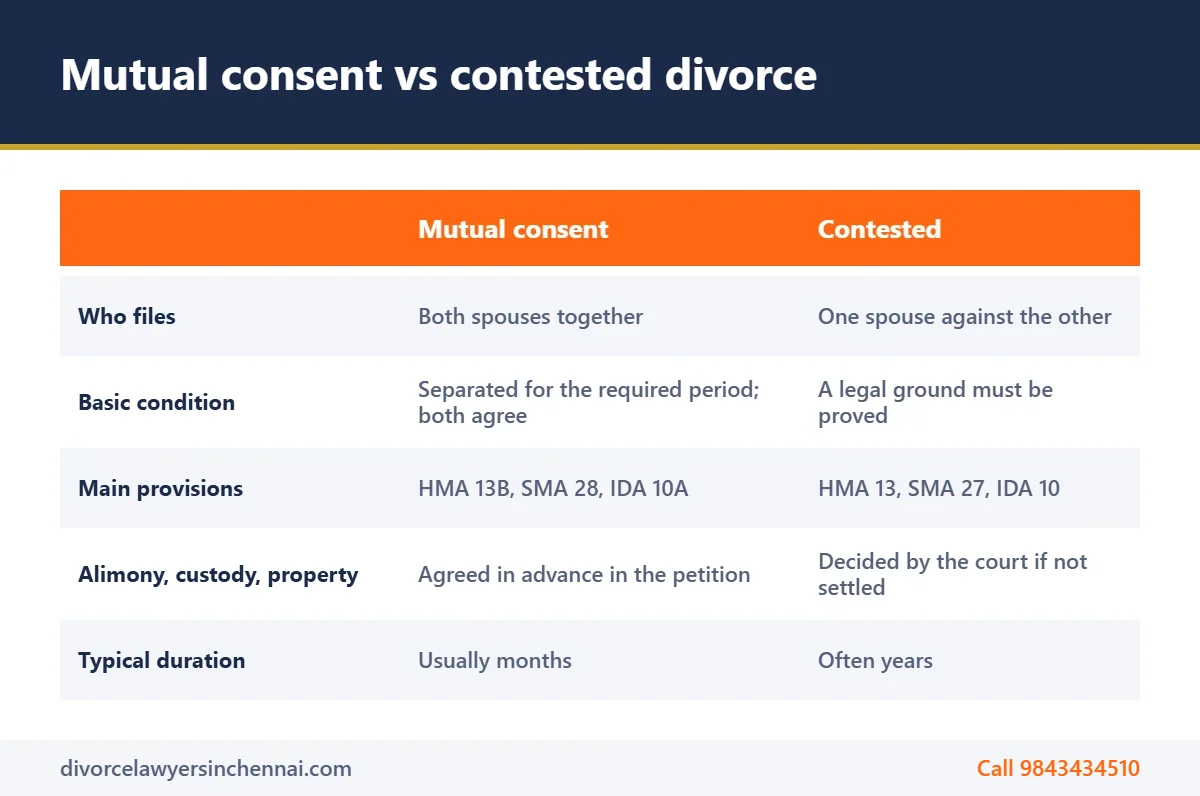
| Mutual consent divorce | Contested divorce | |
|---|---|---|
| Who files | Both spouses together | One spouse against the other |
| Basic condition | Living separately for the period the law requires, and both agree to divorce | A legal ground must be proved |
| Main provisions | HMA s.13B, SMA s.28, Indian Divorce Act s.10A | HMA s.13, SMA s.27, Indian Divorce Act s.10 |
| Settlement of alimony, custody, property | Agreed in advance and recorded in the petition | Decided by the court if not settled |
| Typical duration | Usually months | Often years |
If you and your spouse can agree on the terms, mutual consent is almost always faster and cheaper. If your spouse will not agree, or cannot be found, you will need a contested petition.
Which law applies to your marriage
- Hindu Marriage Act, 1955: Hindus, Buddhists, Jains and Sikhs married under Hindu rites.
- Special Marriage Act, 1954: marriages solemnised or registered under this Act, a route often used for inter-faith marriages.
- Indian Divorce Act, 1869: where either spouse is Christian.
- Muslim law: talaq, khula and mubarat, and the Dissolution of Muslim Marriages Act, 1939 for a wife seeking divorce through court. Instant triple talaq is void and an offence under the Muslim Women (Protection of Rights on Marriage) Act, 2019.
The law matters because the grounds, waiting periods and separation requirements differ. For example, mutual consent under the HMA needs one year of separation, while under the Indian Divorce Act it needs two years.
Which court to file in
Divorce cases in Chennai are heard by the Family Court. Under Section 19 of the Hindu Marriage Act, you can file in the court within whose limits:
- the marriage was solemnised, or
- the respondent lives at the time of filing, or
- the couple last lived together, or
- the wife lives on the date of filing, if she is the one filing.
The Special Marriage Act and Indian Divorce Act have similar rules. If you married elsewhere but now live in Chennai, you may still be able to file here. Your lawyer will confirm the right court before drafting.
How to file for divorce in Chennai by mutual consent
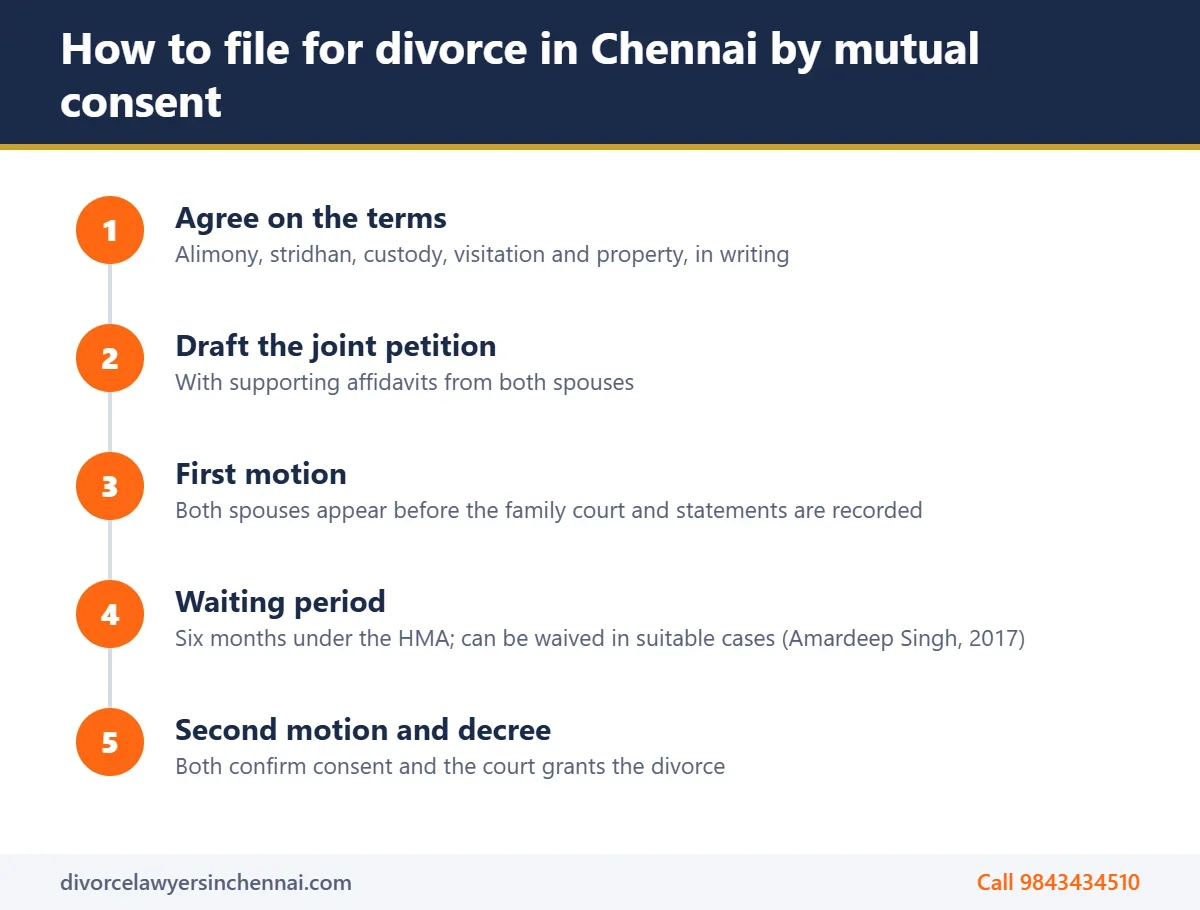
- Agree on the terms. Settle alimony or a one-time payment, return of jewellery and stridhan, child custody and visitation, and any property. Put this in a written settlement.
- Draft the joint petition. Your lawyer prepares the petition under the applicable section, with supporting affidavits from both spouses.
- File and appear for the first motion. Both spouses appear before the family court, the petition is filed, and statements are recorded.
- Waiting period. Under the HMA there is a six-month period before the second motion. In Amardeep Singh v. Harveen Kaur (2017), the Supreme Court held this period can be waived in suitable cases.
- Second motion and decree. Both spouses confirm they still want the divorce. If the court is satisfied, it grants the decree.
For more detail, read our guide to the mutual divorce process and our explainer on how many days a mutual divorce takes. If one spouse lives abroad or outside Chennai, see how the mutual divorce process online works.
How to file a contested divorce
- Identify your ground. Under Section 13 of the HMA, grounds include cruelty, desertion for at least two years, adultery, conversion to another religion, and unsound mind. Your facts must fit a recognised ground.
- Collect evidence. Messages, medical records, police complaints and witnesses that support your ground.
- Consider a legal notice. A legal notice is not compulsory before divorce, but it sometimes opens settlement talks.
- Draft and file the petition. The petition sets out the facts, the ground and the reliefs you seek, such as divorce, custody or return of stridhan. It is filed with a vakalatnama authorising your lawyer.
- Summons and appearance. The court issues notice to your spouse, who files a reply (counter).
- Counselling and mediation. Family courts usually refer the couple for counselling or mediation. Many contested cases settle and convert to mutual consent at this stage.
- Interim applications. Either spouse can seek interim maintenance and litigation expenses under Section 24 of the HMA, and interim custody of children.
- Evidence and arguments. Both sides file evidence, are cross-examined, and argue the case.
- Judgment and decree. The court grants or refuses divorce. The losing side can appeal to the High Court within the time the law allows.
Note that under Section 14 of the HMA, a divorce petition generally cannot be filed within one year of the marriage, unless the court allows it on grounds of exceptional hardship or depravity.
Papers to keep ready
You will need your marriage certificate or proof of marriage, address and identity proof for both spouses, wedding photographs, and details of children, income and assets. For a contested case, add the evidence supporting your ground. Your lawyer will give you a full list for your situation.
What filing for divorce costs
Lawyer fees vary with the type of case and its complexity. A mutual consent divorce usually costs much less than a contested case, which runs longer and needs more hearings. Court fees are separate and modest. Our divorce lawyer fees guide explains what affects the cost.
If you cannot afford a lawyer, women and children are entitled to free legal services under Section 12 of the Legal Services Authorities Act, 1987, through the District Legal Services Authority in Chennai.
If your spouse is abroad or cannot be traced
If your spouse lives outside India, a contested petition can still be filed in Chennai where the court has jurisdiction, and notice is sent to the overseas address. In mutual cases, a spouse abroad may be able to act through a power of attorney holder or join hearings by video, subject to the court’s permission.
If your spouse has disappeared and notice cannot be served normally, the court can allow substituted service, such as publication in a newspaper, under Order V Rule 20 of the Code of Civil Procedure. If the spouse still does not appear, the case can proceed ex parte.
Keep a record of every address and contact detail you have. It helps the court accept that genuine efforts were made to inform your spouse.
Common mistakes that delay a divorce
- Filing in a court that lacks jurisdiction, which leads to the petition being returned.
- Filing for mutual consent before the required separation period is complete.
- Leaving alimony, jewellery or custody unsettled in a mutual petition, so one spouse withdraws at the second motion.
- Choosing a ground you cannot prove, instead of one supported by evidence.
- Missing hearings, which can lead to dismissal or an ex parte order.
Frequently asked questions
Can I file for divorce in Chennai if we married in another state?
Often yes. If your spouse lives in Chennai, you last lived together here, or (for a wife filing under the HMA) you now live here, the court in Chennai can usually hear the case.
Do both spouses need to come to court?
In mutual consent cases, both are normally required for the motions. In Amardeep Singh v. Harveen Kaur (2017), the Supreme Court said courts can use video conferencing, or allow genuine representation through close relatives, where a spouse cannot attend in person.
What if my spouse refuses to divorce?
You can file a contested petition on a legal ground. Your spouse’s refusal does not stop the case, but you must prove the ground.
When can I remarry?
After the decree, once the time to appeal has passed without an appeal, or the appeal is dismissed.
Get help filing your petition
Knowing how to file for divorce in Chennai is the first step. Getting the jurisdiction, the ground and the settlement terms right from the start saves months later.
If you would like an experienced divorce advocate in Chennai to review your situation, call the appointment desk on 9843434510 or book through our contact page.
This article is general information, not legal advice. Speak to an advocate about your specific case.
About this guide: Written by the Divorce Lawyers in Chennai team. Researched from the Acts and court judgments named in this guide and checked against primary sources before publishing. Last reviewed on 24 October 2026. How we research and check our guides.