
How many days does the mutual divorce process take in India? When the paperwork is complete, most couples get their decree in about 7 to 8 months from filing, because the law sets a six-month gap between the first and second motion. If the court waives that gap, it can be much quicker; if documents are missing or hearings are adjourned, it can stretch towards the 18-month limit. If you are not sure mutual consent suits your situation, compare mutual vs contested divorce first.
The six-month period comes from Section 13B(2) of the Hindu Marriage Act, and the Supreme Court has held that it is not absolute. This guide explains each stage, where the days actually go, when a waiver is realistic, and how to avoid the delays that push cases past a year.
In this guide
The two legal clocks in a mutual divorce
The law runs two clocks. First, you must have lived apart for a minimum period before you can file. Second, after the petition is presented, the second motion can be made no earlier than six months and no later than eighteen months later. The separation requirement depends on the law that governs your marriage.
| Law | Applies to | Separation before filing | Gap before second motion |
|---|---|---|---|
| Hindu Marriage Act, Section 13B | Hindus, Buddhists, Jains, Sikhs | 1 year | 6 months minimum, 18 months maximum |
| Special Marriage Act, Section 28 | Civil and interfaith marriages | 1 year | 6 months minimum, 18 months maximum |
| Indian Divorce Act, Section 10A | Christians | 2 years | 6 months minimum, 18 months maximum |
Section 14 of the Hindu Marriage Act also bars divorce petitions within the first year of marriage, except in cases of exceptional hardship, so the earliest filing date depends on both your wedding date and your separation date.
A mutual divorce moves only as fast as its slowest requirement: the separation period, the six-month gap, or your paperwork.
Stage by stage: where the days go
Every mutual consent divorce follows the same four stages; our mutual divorce process guide explains each one in detail. Here is how they affect the timeline.
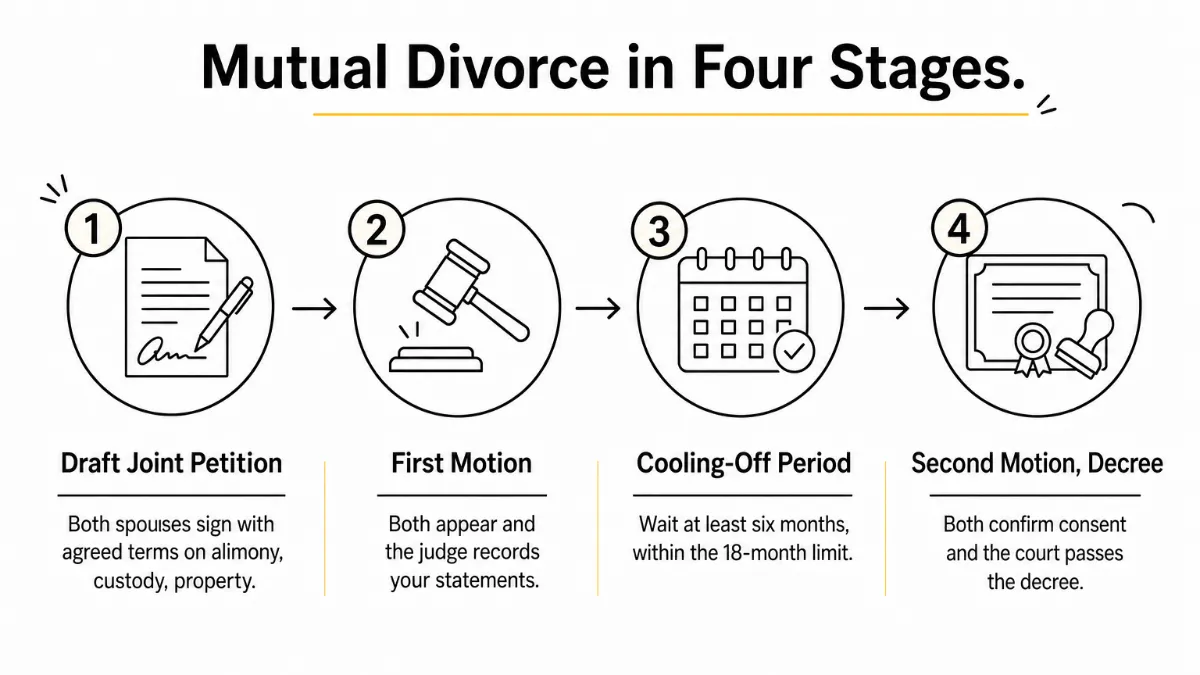
- Joint petition. Both of you sign it, with agreed terms on alimony, custody and property, and your advocate files it in the court with jurisdiction. Drafting and registry scrutiny commonly take a few weeks, longer if defects have to be corrected.
- First motion. You both appear, the judge records your statements and the court passes an order. This often comes within a few weeks of filing, depending on the court’s list, and may be preceded by counselling or mediation.
- Waiting period. At least six months from the date the petition was presented, unless waived. No court attendance is needed.
- Second motion and decree. You both appear again and confirm consent. The court then passes the decree, often the same day or within a short time.
Stage three takes up at least 180 days, so it sets the floor. Everything else is variable. Couples who file complete papers and turn up on hearing dates together usually finish close to the 7 to 8 month mark. Couples who need re-filing or fresh dates often drift towards a year or more.
The six-month wait is the only stage you cannot speed up by working harder, only by asking the court to waive it.
Can the six-month period be waived?
What the Supreme Court requires
In Amardeep Singh v. Harveen Kaur (2017), the Supreme Court held that the six-month period is directory, not mandatory. The court hearing the case can waive it if it is satisfied that:
- the one-year separation and the six-month period together, about 18 months in all, had already passed before the first motion;
- mediation and conciliation efforts have failed and there is no real chance of reunion;
- you have genuinely settled alimony, custody and all other issues;
- waiting longer would only prolong your distress.
How to apply
Your advocate files a waiver application, with reasons, which can be made one week after the first motion. Attach the signed settlement, proof of separation such as separate address records, and details of the failed mediation.
Judges decide case by case, so a waiver is never guaranteed. Courts are more comfortable when the settlement is complete and any agreed payment has already been made, and more cautious when one spouse seems pressured or the children’s arrangements are vague. If a waiver is granted, the second motion can be heard soon after, and the whole case may finish within a few months of filing instead of seven or more.
A waiver is something the court grants for a finished settlement, not something you can claim for a rushed one.
Sample timelines: fast, typical and delayed
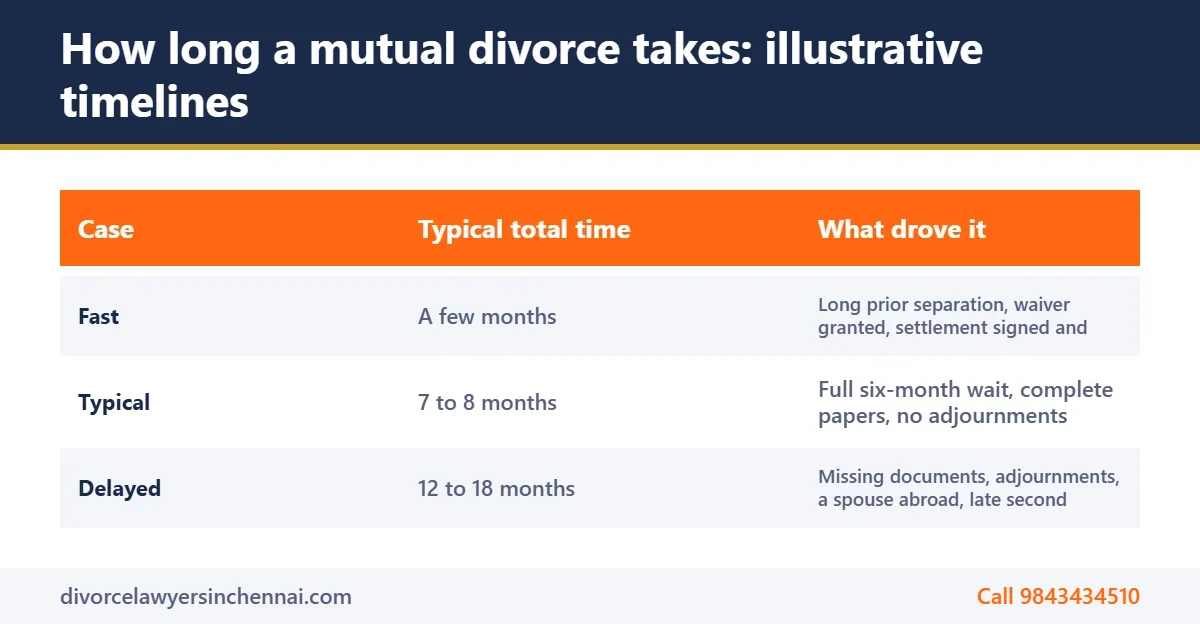
These are illustrative examples, not guaranteed outcomes. Your court’s list and your paperwork decide where you land.
| Case | Typical total time | What drove it |
|---|---|---|
| Fast | A few months | Long prior separation, waiver granted, settlement signed and paid, both spouses present |
| Typical | 7 to 8 months | Full six-month wait, complete papers, no adjournments |
| Delayed | 12 to 18 months | Missing documents, adjourned dates, a spouse abroad, late second motion |
What pushes a case from fast to delayed
Imagine a couple who had lived apart for about two years, signed a full settlement and paid the agreed alimony before the first motion. They meet the waiver conditions, so the court may hear the second motion within weeks.
Now imagine a couple who file with missing address proof and no written custody terms. The court gives fresh dates twice, one spouse then moves abroad, and the second motion slips past month 14. They are still inside the 18-month window, but only just.
Do not let the 18-month limit pass. A petition that runs beyond it can face difficulty and may have to be filed afresh, which restarts the clock.
How to keep your divorce from being delayed
Most delays come from paperwork and scheduling, not from the court. You control both.
Gather your documents first
One missing paper usually means a fresh date. Ask your advocate to check this list before you file:

- Marriage certificate and wedding photographs
- Address proof for both spouses
- Proof of separation, such as rent agreements or utility bills
- Recent income tax returns and salary slips
- Property papers and bank statements, where relevant to the settlement
- Children’s birth certificates
- Passport and visa copies, if either spouse lives abroad
Keep scanned copies and a printed set, and carry originals to each hearing.
Settle the terms and fix your dates
Disputes over money and children cause most second-motion delays. Write alimony, custody, visitation and property terms into the settlement and agree payment dates before you file. Both of you must also be free on hearing dates. If one spouse lives abroad, ask your advocate early whether the court will permit a video appearance; our NRI divorce guide explains the options. If much of your preparation will happen remotely, see how the mutual divorce process online works.
Complete papers and a written settlement save more days than any hearing strategy.
Why the timeline matters
Until the decree is passed, you are still legally married. That affects remarriage, joint accounts, property sales and nominee rights, and for a spouse abroad, how many trips to India are needed.
Delay also costs money and goodwill. Every adjourned hearing means another day off work and more advocate fees. And consent must last until the decree: either spouse can withdraw it before then, as the Supreme Court confirmed in Hitesh Bhatnagar v. Deepa Bhatnagar (2011).
Knowing the normal range also helps you spot a problem. If your case has crossed 12 months with no second motion date, ask your advocate why: it may be a missing document, an adjournment or a spouse who has stopped cooperating.
Frequently asked questions
What is the minimum time for a mutual divorce in India?
With the full six-month period, a little over six months from filing. If the court waives the period under the conditions set in Amardeep Singh, it can be shorter, but you must already have been separated for about 18 months before the first motion.
Can a mutual divorce be completed in one month?
It is unlikely. Even with a waiver, the application can only be made one week after the first motion, and the court still needs time to list and hear the second motion. Treat any promise of a fixed one-month divorce with caution.
What happens if the second motion is not filed within 18 months?
Section 13B(2) expects the second motion within 18 months of presenting the petition. If that window passes, the petition can run into difficulty and you may need to file a fresh one, so keep track of the date.
Does the six months start from filing or from the first motion?
The Act counts it from the date the petition is presented. In practice the first motion is usually recorded around then, so many people describe it as six months after the first motion.
Plan your timeline with an advocate
How many days the mutual divorce process takes comes down to three things: the six-month period sets the floor, a waiver can shorten it when you qualify, and your paperwork decides whether you finish in about 7 months or closer to 18. Start with complete documents, a written settlement and hearing dates both of you can attend.
An advocate can check your petition before you file and tell you whether a waiver is realistic for you. Our directory lists some of the best lawyers for divorce in Chennai. Call the appointment desk on 9843434510 (available 24/7, first consultation free) or send a request through our contact page.
This article is general information, not legal advice. Speak to an advocate about your specific case.
About this guide: Written by the Divorce Lawyers in Chennai team. Researched from the Acts and court judgments named in this guide and checked against primary sources before publishing. Last reviewed on 18 October 2026. How we research and check our guides.