

If you and your spouse are separating, you need to settle who keeps what before a court does it for you. A divorce property division agreement is the written document that does this. It lists your assets and debts, says who takes each one, and removes room for disputes later. A vague or badly drafted version can leave you fighting over the same flat or bank account years after the decree.
Here is the short answer. A workable agreement must name both parties and list every asset and liability with clear identifiers, such as survey numbers, account numbers, and loan details. It must state the exact split and be signed by both spouses, preferably before two witnesses. Stamp duty and registration apply where immovable property changes hands. In India, a court can then record it in the divorce decree, which gives it real force.
Below, you will find the key clauses every agreement needs, a simple format you can follow, and the steps to make it legally binding. We also flag the mistakes that commonly cause trouble in family courts.
In this guide
Why a property division agreement matters in an Indian divorce
India has no default formula
Indian law has no single rule that splits marital property equally on divorce. Under the Hindu Marriage Act, a court mainly decides maintenance and alimony, and under Section 27 it can make provision for property presented at or about the time of marriage that belongs jointly to both spouses. Ownership of a house, car, or bank account usually follows whose name is on the title. Our guide to divorce and division of property explains how each type of asset is treated.
That gap hurts people. A wife who paid the EMIs on a flat registered in her husband’s name may struggle to prove any claim. A husband who co-signed a loan can stay liable for it long after the decree. Without a written split, the outcome depends on papers and proof, not on what feels fair.
A written agreement lets you decide the split yourselves, instead of leaving it to title deeds and a judge’s discretion.
What a written agreement protects
A divorce property division agreement closes these gaps. In a mutual consent divorce under Section 13B, the court wants to see that you agree on money and property. A signed, detailed settlement shows that, and it helps the case move with fewer hearings and fewer surprises.

It also covers items people forget until a fight starts:
- Stridhan and gifts: jewelry, cash, and wedding gifts the wife received stay with her.
- Joint assets: flats, plots, fixed deposits, and vehicles, with the name of the spouse who keeps each.
- Debts: home loans, personal loans, and credit cards, with who repays and by when.
- Maintenance and child support: the amount, the schedule, and what each of you agrees not to claim later.
How to draft a divorce property division agreement
Drafting a divorce property division agreement is mostly organized paperwork. Follow this order and you will avoid most disputes later.
Build the inventory
Start by gathering proof for every asset and debt you both hold. Then agree on a value for each, using a registered valuer’s report for land or flats. Our divorce property division checklist helps you make sure nothing is left out.
- Property: sale deed, patta, encumbrance certificate
- Money: bank statements, fixed deposits, PF, shares
- Debts: loan statements, credit card dues
If you are unsure how to value or balance the shares, see how to calculate property division in a divorce.
Draft, review, and sign
Next, write each term in plain language, one asset per line, naming the spouse who keeps it. Ask your own advocate to review the draft before you sign, ideally with separate counsel for each spouse.
Disclosure matters most at this stage. If one spouse hides an asset, the other can challenge the agreement later for fraud or concealment.
Full disclosure is what keeps a settlement from being reopened after the decree.
Key clauses every agreement should include
Every divorce property division agreement rests on a handful of core clauses. Leave one out and you invite a second dispute, so check each clause before you sign. They fall into two groups.
Clauses that define the split
Start with the terms that say what moves and to whom. They must be specific enough that you can act on them without further negotiation.
- Schedule of assets: each item, its identifier, and the spouse who receives it.
- Transfer terms: who signs the sale deed or gift deed, and by what date.
- Debt allocation: who repays each loan, plus an indemnity if the lender pursues the other spouse.
Clauses that stop future claims
Then add the terms that close the file. A full and final settlement clause states that neither of you will claim the listed property again, and a disclosure warranty confirms that nothing was hidden.
A clause you skip today becomes a hearing you attend next year.
- Default clause: the remedy if a payment or transfer is missed.
- Dispute resolution: mediation first, then the family court.
A sample format you can adapt
Use the layout below as a starting skeleton for your divorce property division agreement. It follows the clauses above, in the order a family court expects to read them.
Template
Replace each bracket with your details. Your advocate will confirm the stamp paper value and tailor the wording to your case.
SETTLEMENT AGREEMENT, dated [date], Chennai
1. Parties: [Husband] and [Wife], with addresses
2. Recital: Married on [date]; living apart since [date]; settling voluntarily
3. Assets to Husband: [item, identifier]
4. Assets to Wife: [item, identifier]
5. Debts: [loan, lender, account no.], repaid by [party]
6. Transfers: [deed type] executed by [date]
7. Maintenance: Rs. [amount], [lump sum/monthly]
8. Full and final settlement; no further claims
9. Disclosure: both parties confirm full disclosure
10. Disputes: mediation, then Family Court
Signed: [Party 1] [Party 2]
Witnesses: [Name, address] [Name, address]
Adapting it to your case
Write one line per item. "Flat in Velachery" is too vague, while a flat number with its survey number and registration details is something a court can enforce.
Every asset needs an identifier, a named owner, and a transfer date.
Keep the wording exact. Replace phrases like "reasonable amount" with rupee figures and calendar dates.
How to make the agreement legally binding in India
Stamp, sign, and register
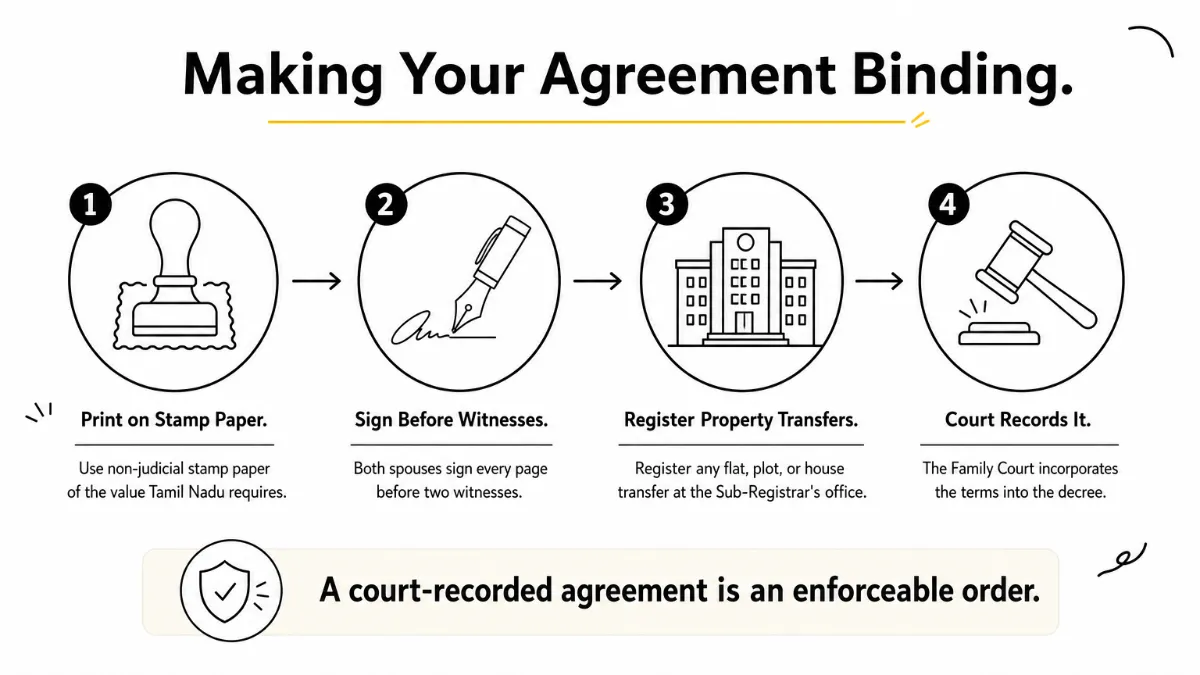
A divorce property division agreement gains force only after a few formal steps. Follow them in this order:
- Print the agreement on non-judicial stamp paper of the value Tamil Nadu requires.
- Have both spouses sign every page, ideally before two witnesses.
- Register any transfer of a flat, plot, or house at the Sub-Registrar’s office, as the Registration Act requires for immovable property.
Have the court record it
Next, file the agreement with your mutual consent petition under Section 13B. The Family Court checks that both of you consent freely and can record the terms in the decree. If the settlement transfers immovable property that is not itself the subject of the case, the decree may still need registration, so ask your advocate to check this. A decree is enforceable as a court order, so a spouse who defaults can face execution proceedings.
A signed agreement is a contract, but a court-recorded one is an order you can enforce.
Finally, keep certified copies of the decree and the registered deeds. Banks, lenders, and the Sub-Registrar will ask for them when you transfer titles or close joint accounts.
Frequently asked questions
Is a divorce settlement agreement legally binding in India?
A signed agreement binds the parties as a contract, but it carries the most weight once the Family Court records its terms in the decree. A decree can be enforced through execution proceedings if one spouse defaults.
Does the agreement need to be registered?
A document that transfers a flat, plot or house generally needs stamp duty and registration at the Sub-Registrar’s office. Ask your advocate whether your settlement or decree needs to be registered and what stamp duty applies in Tamil Nadu.
Can a property settlement be challenged after the divorce?
It is difficult. A settlement recorded by the court is rarely reopened, but it can be challenged if it was obtained by fraud, coercion or concealment of assets. That is why full disclosure matters.
Can we agree on child custody in the same agreement?
You can include custody and visitation terms, but the court is not bound by them. It will approve custody arrangements only if they serve the welfare of the child.
Putting your agreement on solid ground
A strong divorce property division agreement does three things. It lists every asset and debt with exact identifiers, it states who gets what and by when, and it closes the file with a full and final settlement clause. Full disclosure, stamp paper, two witnesses, and registration turn that draft into a document a court can act on.
The last step matters most. Once the Family Court records your terms in the decree, the agreement becomes an enforceable order, not just a promise between two people who are no longer speaking. Keep certified copies of the decree and every registered deed.
If you want an advocate to draft or review your settlement, talk to one of the leading divorce lawyers in Chennai and book a free consultation. Call the appointment desk on 9843434510 (24/7, first consultation free) or send your details through our contact page.
This article is general information, not legal advice. Speak to an advocate about your specific case.
About this guide: Written by the Divorce Lawyers in Chennai team. Researched from the Acts and court judgments named in this guide and checked against primary sources before publishing. Last reviewed on 15 October 2026. How we research and check our guides.