

To work out how to calculate property division in divorce, list every asset and debt, give each a current market value, subtract the loans, and compare the net value each spouse holds. Half the difference between the two totals is the equalisation payment one spouse could pay the other. In India, though, there is no fixed 50/50 rule, so treat that figure as a negotiating baseline, not an entitlement.
Indian courts start from who owns what, then look at contribution, need and the personal law that governs your marriage. That is why the method below matters: a clean, documented calculation tells you what is realistic before you negotiate a settlement or file an affidavit of assets.
This guide takes you through the steps in order: sorting marital from separate property, valuing a flat, gold and accounts, handling loans, and working out the final payment. For the bigger picture on how divorce and division of property work in India, see our main guide.
In this guide
How property division works in India
There is no fixed 50/50 rule
India has no single matrimonial property law. Many countries split everything earned during the marriage, but Indian courts generally start from who holds title. A flat registered only in your husband’s name is his on paper, even if you paid part of the EMI. That is the starting point, not always the final word.
Courts still have ways to balance things. When they fix maintenance and permanent alimony, they weigh each spouse’s income and property, the children’s needs, conduct and the length of the marriage. In Rajnesh v. Neha (2020), the Supreme Court required both parties in maintenance proceedings to file an affidavit disclosing their assets and liabilities, so your list must be complete and honest.
In India, property division is worked out from title, contribution and need, not from a fixed percentage.
Which law applies to you
Your personal law, or the Act you married under, sets the rules. Check this first, because it changes which claims you can make.
| Marriage under | Main law | Money and property points |
|---|---|---|
| Hindu, Sikh, Jain, Buddhist | Hindu Marriage Act, 1955 | Section 27 lets the court deal with property presented at or about the time of marriage that may belong jointly to both spouses. Section 24 covers interim maintenance and Section 25 permanent alimony. |
| Civil or interfaith | Special Marriage Act, 1954 | Section 36 covers interim alimony and Section 37 permanent alimony and maintenance. There is no separate section on wedding gifts. |
| Christian | Indian Divorce Act, 1869 | Alimony, plus the court’s power to deal with marriage settlements for the spouses or children after the decree. |
| Muslim | Muslim Women (Protection of Rights on Divorce) Act, 1986 | Mahr, a reasonable and fair provision and maintenance, and return of properties given to the wife. |
| Parsi | Parsi Marriage and Divorce Act, 1936 | Alimony and maintenance. |
Stridhan (gifts a woman receives before, at or after her marriage) is her own property. Keep records of it, because it stays out of the pool you divide.
What this means for your calculation
Because courts have discretion, your maths produces a negotiating baseline, not a guaranteed result. Use the steps below to build a realistic figure, then have a family law advocate review it before you sign a settlement or file your affidavit.
Step 1. List every asset and debt
Open a spreadsheet and record everything either of you owns or owes, whichever name it sits under. The affidavit of assets and liabilities needs this anyway, so build the list once and reuse it in every later step. Our divorce property division checklist lists the five categories to cover.

What to include
Sort items into six groups. For each one, note the owner’s name, date acquired and how it was paid for, because Step 2 depends on those facts.
| Category | Examples | Documents to collect |
|---|---|---|
| Immovable property | Flat, plot, farmland | Sale deed, patta, encumbrance certificate |
| Bank and investments | Savings, FDs, shares, mutual funds | Statements, demat holdings |
| Gold and valuables | Jewellery, watches | Purchase bills, bank locker list |
| Vehicles | Car, two-wheeler | RC book, insurance |
| Retirement and insurance | EPF, PPF, LIC policies | Passbooks, surrender value letters |
| Debts | Home loan, personal loan, credit cards | Loan account statements |
Where people miss items
Gaps usually hide in EPF and PPF balances, insurance policies, deposits in a parent’s name and gold in a locker. Three years of bank statements and your Form 26AS (from the income tax portal) help you spot them.
Debts need the same care. Ask each lender for a foreclosure statement showing the outstanding principal today, not the amount originally sanctioned.
One missing asset or hidden loan throws off every number that follows.
Step 2. Sort marital from separate property
Add a column and tag every item as separate, marital or mixed. India has no formal marital pool, but this sorting shows what each side can fairly claim when you calculate property division in a divorce.
Three tags to use
| Tag | What belongs here |
|---|---|
| Separate | Owned before marriage, inherited, personal gifts, stridhan |
| Marital | Bought during the marriage from joint income or savings, or jointly titled |
| Mixed | A separate asset improved or paid off with marital money |
Mixed items need the most care. A flat bought before the wedding but paid off through a joint account is the classic case. Record who paid what and when, because contribution is often argued alongside the name on the deed.
Tag first, argue later: every item needs a label and a document behind it.
Proof that settles disputes
Evidence beats memory. For separate claims, collect gift deeds, wills and pre-marriage bank statements. For marital claims, pull salary slips and transfer records that show where the money came from.
Gifts from the bride’s family are often contested. Photos, purchase bills and a jewellery list prepared at the time of the wedding make stridhan far easier to establish. If your spouse disputes a tag, mark it as contested and move on; your advocate can help you resolve it. If relatives also claim a share, see our guide to family property dispute lawyers in Chennai.
Step 3. Value each asset and subtract debts
Now put a current market value next to every item. To keep the calculation fair, pick one valuation date for everything, such as the date you separated or filed. That stops either side from choosing flattering numbers.

How to value each type
| Asset | Where to get the value |
|---|---|
| Flat or plot | Registered valuer’s report, checked against recent sales nearby |
| Gold | Today’s rate per gram for the purity, from a bank or jeweller |
| Vehicle | Used-vehicle quote from a dealer |
| Bank accounts and FDs | Balance on the valuation date |
| Shares and mutual funds | Closing price or NAV on that date |
| EPF, PPF | Latest passbook balance |
| LIC policy | Surrender value letter |
Guideline value is not market value. The government guideline value in Tamil Nadu is often lower than the real selling price, so use it only as a floor. For property worth lakhs, a valuer’s written report carries far more weight in negotiation.
Subtract the debts
Subtract each loan from the asset it financed, using the outstanding principal from the foreclosure statement. Deduct unsecured debts, like personal loans and credit cards, from the total.
Net value = Market value - Outstanding loan

Flat: Rs 80,00,000 - Home loan Rs 30,00,000 = Rs 50,00,000
Divide net values, not sticker prices: a flat is worth only what is left after its loan.
Total the net values for each tag from Step 2. Keep contested items in a separate column so you can see how much they move the result.
Step 4. Work out the split and settlement payment
The equalisation formula
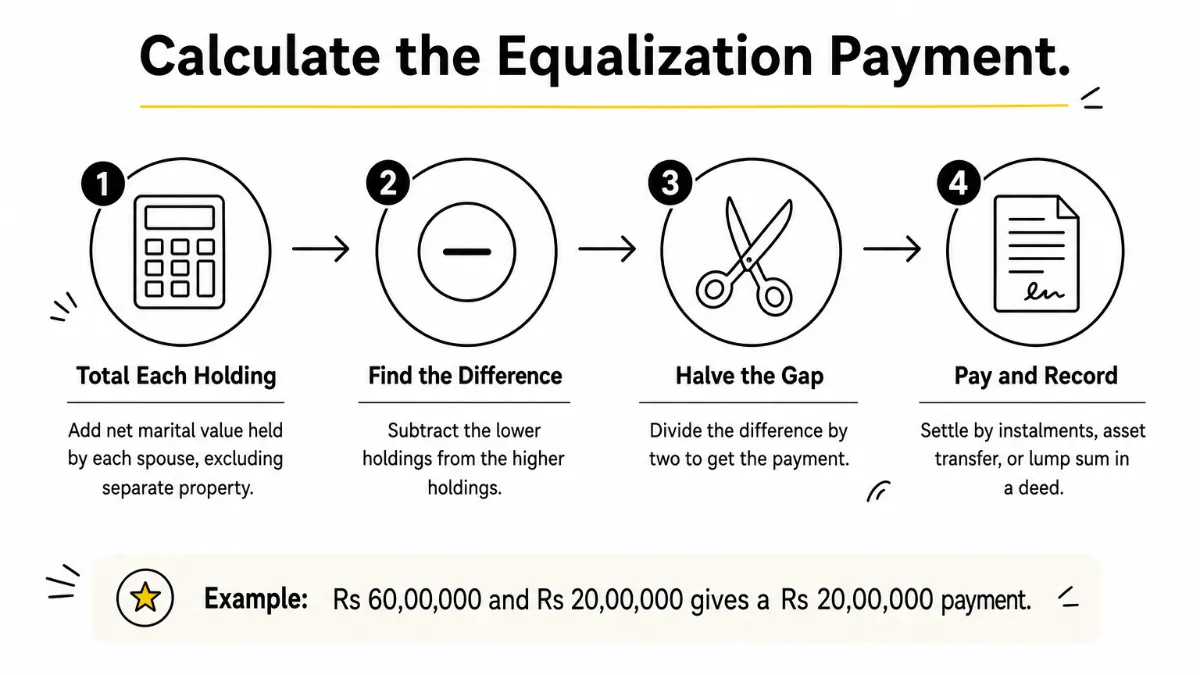
Add up the net marital value each spouse holds, including their share of mixed items. Leave separate property out. Then apply this formula. The figures are an illustration only.
Equalisation payment = (Higher net holdings - Lower net holdings) / 2

Spouse A holds Rs 60,00,000. Spouse B holds Rs 20,00,000.
(60,00,000 - 20,00,000) / 2 = Rs 20,00,000
A pays B Rs 20,00,000, so each ends with Rs 40,00,000.
Adjust the share for your case
Equal is only a baseline. If one spouse contributed more, or keeps the children, you may agree on a different split. Multiply the combined total by each person’s share, then subtract what each already holds. On Rs 80,00,000 split 60/40, A’s share is Rs 48,00,000. A holds Rs 60,00,000, so A pays B Rs 12,00,000.
Subtract what each spouse already holds from what each should receive; the gap is the payment.
Decide how the payment is made
Few people have lakhs sitting in cash. You can agree on instalments, a transfer of one asset, or a lump sum from a sale. Put the terms in a written property division agreement, and in a mutual consent divorce make sure the terms are recorded before the court. Courts are not bound by your maths in a contested case and may order something different.
Frequently asked questions
Is property divided 50/50 in a divorce in India?
No. Indian law has no automatic equal-split rule. Property generally stays with the person who holds title, and the other spouse’s financial needs are mostly met through maintenance and alimony. Couples can still agree on an equal or other split in a settlement.
Does a wife get a share of a flat in her husband’s name?
Not automatically as an owner. She can claim maintenance and permanent alimony, which take the husband’s property and income into account, and under the Domestic Violence Act a woman has a right to reside in the shared household. If she paid towards the flat, she should keep proof of those payments.
Is stridhan included when dividing property?
No. Stridhan belongs to the woman. It is kept out of the calculation and can be claimed back in full, so list it separately with whatever proof you have.
What happens to a joint home loan after divorce?
The bank is not bound by your settlement. Both co-borrowers stay liable until the loan is closed or the lender releases one of them, so a settlement should say who pays the EMIs and how the other will be released.
Putting your numbers to use
You now have a method for how to calculate property division in divorce: list everything, tag it, value it on one date, subtract debts and apply the equalisation formula. Your spreadsheet is a negotiating baseline, not a verdict. It shows where a fair settlement could land and where you may need to push back.
Before you share a number with your spouse, have an advocate check it against your personal law and your documents. Bring your list, valuations and loan statements to the first meeting; it saves time and fees. You can speak with an experienced divorce advocate in Chennai from our directory about your calculation.
Call the appointment desk on 9843434510 (open 24/7, first consultation free) or use our contact page to book a time.
This article is general information, not legal advice. Speak to an advocate about your specific case.
About this guide: Written by the Divorce Lawyers in Chennai team. Researched from the Acts and court judgments named in this guide and checked against primary sources before publishing. Last reviewed on 26 October 2026. How we research and check our guides.