

If your property dispute is tied to a marriage or a family, such as a flat bought together before a divorce, stridhan that has not been returned, or ancestral land relatives will not divide, you need family property dispute lawyers who handle both sides of the problem: the family case and the property claim. This page explains which family property disputes our directory’s advocates can help with, introduces the advocates you can speak to, and tells you what to gather before you call.
Be clear on one point first. Divorce Lawyers in Chennai is a directory of divorce and family law advocates. If your dispute has nothing to do with a marriage or family, for example a builder delay, a tenancy fight or a boundary problem with a neighbour, speak to the appointment desk and they will tell you honestly whether one of the listed advocates can help.
In this guide
- Property disputes connected to marriage and family
- Advocates for family property disputes
- How property is handled when a marriage ends
- Partition of family and ancestral property
- Disputes outside family law
- Documents to gather before your consultation
- Questions to ask before you hire a lawyer
- Frequently asked questions
- Book a consultation
Property disputes connected to marriage and family
Many property fights start inside a household, not in a sale transaction. When they do, the property claim usually runs alongside maintenance, custody or a divorce petition, and a lawyer who sees only the property side can miss how those pieces affect each other.
The table below shows the situations where a family law advocate is a natural fit.
| Situation | Why it belongs with a family law advocate |
|---|---|
| Matrimonial home or a jointly owned flat during a divorce | Claims over the home are usually settled together with alimony and custody |
| Stridhan, jewellery and wedding gifts being withheld | Stridhan is the wife’s own property, and its return is usually sought in the matrimonial or domestic violence proceedings |
| Being pushed out of the shared household | The Protection of Women from Domestic Violence Act, 2005 gives a woman a right to reside in the shared household |
| A spouse trying to sell or mortgage property while the case is pending | The court hearing the matrimonial case can be asked for an order restraining the sale |
| Ancestral or family property that becomes an issue in a divorce | The family’s personal law decides who has a share, and marriage alone does not create one |
| Partition among siblings or heirs within a family | Shares turn on succession law and family documents, often with a settlement possible |
Advocates for family property disputes
The advocates listed on this site are below. Advocate Harish’s stated practice includes property-related disputes and Advocate Mohan’s includes wider family disputes, so they are the closest fit for property questions arising inside a marriage or family. The appointment desk can also suggest another advocate from the directory if your matter is mainly about divorce, custody or maintenance.

Advocate Mohan
- Experience: 33+ years
- Specialisation: Divorce, child custody, maintenance, family disputes, police station matters
- Why consider: 33+ years in divorce, child custody and maintenance cases, including wider family disputes.

Advocate Gabriel
- Experience: 10+ years
- Specialisation: Divorce and family law litigation
- Why consider: 10+ years in divorce and family law litigation, useful if your case is likely to be contested.

Advocate Pavithra
- Experience: 5+ years
- Specialisation: Divorce, child custody, maintenance
- Why consider: A woman advocate who handles divorce, child custody and maintenance.

Advocate Anushya
- Experience: 5+ years
- Specialisation: Divorce and family court matters
- Why consider: A woman advocate with 5+ years in divorce and family court matters.

Advocate Saleem
- Experience: 13+ years
- Specialisation: Divorce, child custody, maintenance, domestic disputes
- Why consider: 13+ years in divorce, custody and maintenance, including domestic disputes.

Advocate Harish
- Experience: 5+ years
- Specialisation: Divorce, domestic violence, family law, property-related disputes
- Why consider: Handles divorce, domestic violence and property-related disputes, with practice in the Madras High Court and Chennai courts.

Advocate Dhibankar
- Experience: 5+ years
- Specialisation: Divorce, child custody, maintenance
- Why consider: 5+ years in divorce, child custody and maintenance cases.
Each advocate decides whether to take your matter and on what terms. Ask for the fee and the likely next steps in writing before you engage anyone.
How property is handled when a marriage ends
India has no general law that splits a couple’s assets equally on divorce. What each spouse can claim depends mostly on whose name is on the title, who paid, and what was gifted. Our guide to divorce and division of property explains the rules in detail; here is what matters most in a dispute.
- Jointly owned property: if both names are on the sale deed, you are co-owners. Couples usually agree on a buyout or a sale, and the split often follows what each person paid.
- Property in one spouse’s name: the other spouse may still have a claim if they can prove payments towards the price or the EMIs, so bank statements matter.
- Property given at the wedding: under Section 27 of the Hindu Marriage Act, the court can make provision for property presented at or about the time of marriage that belongs jointly to both spouses.
- Stridhan: the Supreme Court has repeatedly held that stridhan is the wife’s absolute property, even when the husband or in-laws hold it.
- The shared household: under Section 17 of the Domestic Violence Act a woman in a domestic relationship has a right to reside in the shared household, whether or not she owns it, and a Magistrate can pass residence orders under Section 19.
Where a Family Court has been set up, as in Chennai, it can hear disputes between spouses about their property under the Family Courts Act, 1984. That means the property question can often be raised in the same forum as the divorce. If your spouse is trying to sell or mortgage a disputed property, ask your advocate about an interim order restraining the transfer while the case is pending.
Most couples settle rather than fight every asset in court. If you are heading towards a settlement, read our guides on how to calculate property division in a divorce and on drafting a divorce property division agreement.
Partition of family and ancestral property
Partition disputes between siblings, cousins or other heirs are family disputes too. A spouse does not get a share in the other spouse’s ancestral property merely because of the marriage, but the children of the marriage may have rights of their own under the family’s succession law.
A partition usually moves in this order:
- The advocate checks which personal law governs the family, because Hindu, Muslim and Christian succession rules give different shares.
- They build the family tree and collect the title papers, legal heir certificate, any will and the revenue records.
- They try a family settlement or a registered partition deed, which is far quicker and cheaper than a suit.
- If relatives refuse, a partition suit is filed in the civil court. The court first passes a preliminary decree declaring each person’s share, and a final decree later divides the property by metes and bounds or orders a sale.
Daughters deserve a special mention. Since the 2005 amendment to the Hindu Succession Act, a daughter is a coparcener in a Hindu joint family by birth, with the same rights as a son. In Vineeta Sharma v. Rakesh Sharma (2020), the Supreme Court held that this right does not depend on whether the father was alive when the amendment came into force.
Treat any timeline as a rough range. A settlement deed can be done in weeks, while a contested partition suit and appeals can take several years.
Disputes outside family law
Some property problems have nothing to do with a marriage or a family relationship. These usually need a civil, revenue or consumer-law practice rather than a family law one:
- Builder delays, refunds and complaints under the Real Estate (Regulation and Development) Act, 2016
- Landlord and tenant disputes, eviction and rent deposits
- Encroachment or boundary disputes with neighbours or strangers
- Patta, chitta and other revenue record corrections, or title disputes with an unrelated buyer
The advocates in this directory do not advertise these as their practice areas. If your matter falls here, call the appointment desk and explain it briefly; they can tell you whether a listed advocate can assist or whether you should look for a civil practitioner.
Documents to gather before your consultation
Your papers decide most property disputes, so bring copies to the first meeting. The divorce property division checklist has a fuller list, but start with these:
- Sale deeds, gift deeds, any will, and the parent documents for the property
- Encumbrance certificate, patta and property tax receipts
- Home loan statements and bank statements showing who paid the EMIs or the down payment
- A list of jewellery and gifts, with bills or wedding photographs if you have them
- Legal heir certificate and death certificate in an inheritance matter
- Copies of any petition, notice or court order already received
Questions to ask before you hire a lawyer
A good first conversation tells you a lot. The advocate should read your papers, explain your options in plain language and point out the weak spots in your case. Be wary of anyone who guarantees a result.
- Have you handled property claims inside divorce or family cases before?
- Should this go to the Family Court, the civil court or the Magistrate under the Domestic Violence Act?
- Can we try a settlement or a partition deed before filing anything?
- Can we ask for an order stopping a sale while the case runs?
- How do you charge for each stage, and which costs are extra?
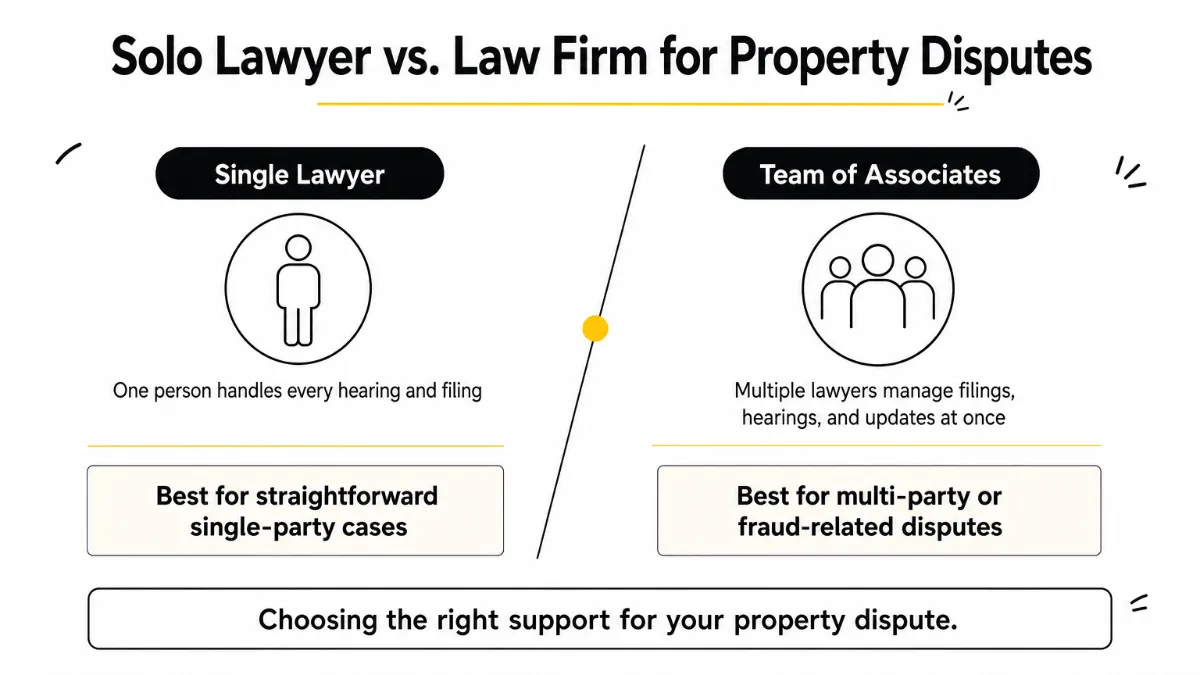
- Will you attend hearings yourself, and how will you update me?
Frequently asked questions
Does a wife get half of her husband’s property after divorce in India?
No. There is no automatic equal split. A wife can claim what she owns or paid for, her stridhan and her alimony, and the court can consider the husband’s income and property when it fixes alimony.
Can a family court decide a property dispute between husband and wife?
Yes. Under the Family Courts Act, 1984, a Family Court can hear suits and proceedings between the parties to a marriage about the property of either or both of them.
Can my spouse sell our flat while the divorce case is pending?
If the flat is in your spouse’s name, nothing stops a sale automatically. You can ask the court for an interim order restraining the sale, and a woman facing domestic violence can also seek a residence order covering the shared household.
Can I file a property dispute case without a lawyer?
You can appear in person, but property disputes turn on documents, limitation and procedure. A short consultation before you file can save you from mistakes that are hard to undo later.
Book a consultation
If your property dispute is linked to a marriage, a separation or a family partition, a family law advocate can tell you quickly where you stand. You can reach Advocate Harish or Advocate Mohan through the numbers above, or speak to one of the divorce case lawyers in Chennai listed on our homepage.
Call the appointment desk on 9843434510 (24/7, first consultation free) or send your details through our contact page. For land, builder or tenancy disputes, tell the desk what the matter is about and they will advise you on the next step.
This article is general information, not legal advice. Speak to an advocate about your specific case.
About this guide: Written by the Divorce Lawyers in Chennai team. Researched from the Acts and court judgments named in this guide and checked against primary sources before publishing. Last reviewed on 15 October 2026. How we research and check our guides.