

A good divorce property division checklist covers five groups: immovable property, money and investments, gold and household goods, business and job benefits, and debts. For every item, record who holds the title, when and how it was acquired, what it is worth, and what proof you have. Once you have that, you can sort each item as marital or separate and divide it with your advocate.
Indian law has no single community property rule. How assets are divided depends on the personal law that governs your marriage, whose name is on the title, and what each spouse contributed. Courts also look at property facts when deciding maintenance. A missing item or a vague valuation can cost real money, so the list below is built around assets common in India, such as patta land, PPF accounts, and stridhan.
This article walks through the five categories. Each one tells you what to list, how to judge whether it is marital or separate, and which documents to collect. Copy the headings into a notebook or spreadsheet and take it to your advocate; it is usually the first thing a family lawyer asks for.
In this guide
1. Immovable property: land, house, and flats
Start with real estate, because it is usually the largest asset and the one that triggers the most disputes. Your divorce property division checklist should include every property regardless of whose name is on the title, along with shares in family land.

What to list
Write one line per property and fill in the same details each time.
- Marital home or rented-out flat
- Plots, agricultural land, and farmhouses
- Under-construction flat with a builder agreement
- Your share in ancestral or joint family property
- Shop or office space
For each one, note the survey number, registered owner, purchase date, price, and source of funds.
Marital or separate
Indian law does not split property 50:50 by default. Inherited and ancestral property generally stays with the person who inherited it. Property bought during the marriage usually follows the title, but contribution and need are argued case by case, and both feed into maintenance and alimony. If you paid the down payment or the EMIs on a flat in your spouse’s name, keep proof, because it strengthens your position in a settlement.
Whose name is on the deed matters, but who paid for the property matters just as much.
Proof to collect
Gather the sale deed, patta and chitta extracts, an encumbrance certificate, property tax receipts, and home loan statements. Together they show ownership and the payment trail.
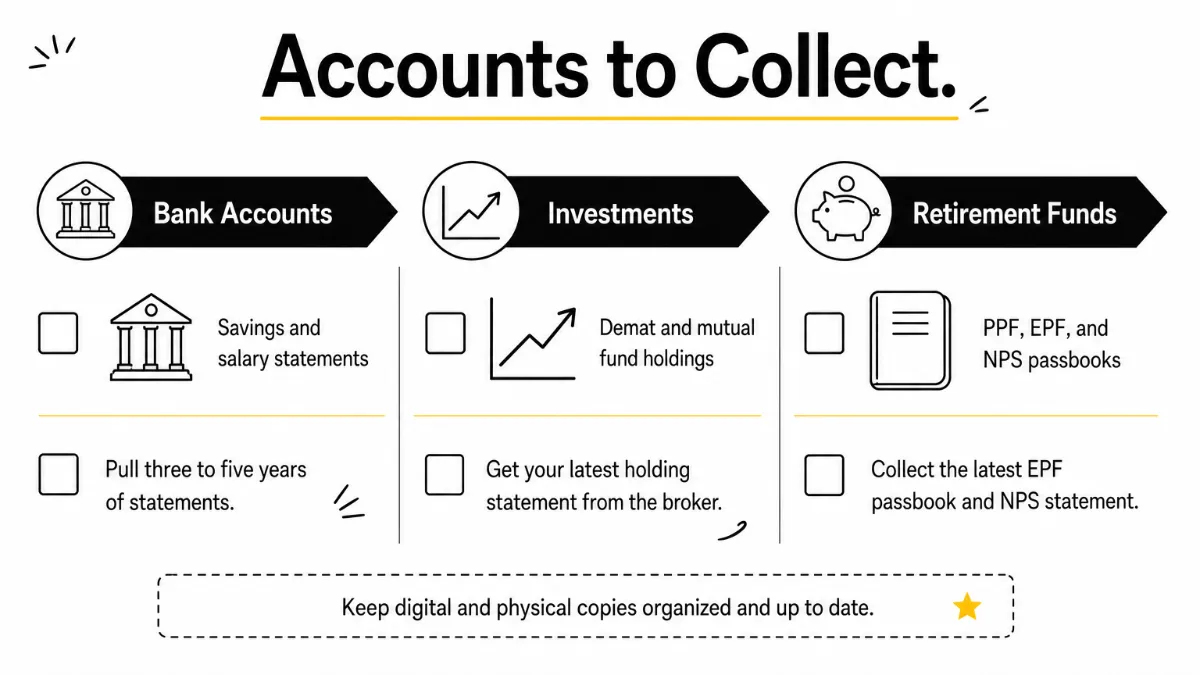
2. Bank accounts, investments, and retirement funds
Money in accounts is the easiest asset to value and the easiest to move, so list it early and in full. This part of the divorce property division checklist should cover joint accounts, individual accounts, and anything held in a parent’s or child’s name on your behalf.
What to list
- Savings, current, and salary accounts
- Fixed and recurring deposits
- Mutual funds, shares, and demat holdings
- PPF, EPF, and NPS balances
- LIC and other insurance policies, with surrender value
- Cash, bank lockers, and cryptocurrency wallets
Marital or separate
Savings built from salary during the marriage are usually treated as family resources, even when held in one name. Balances that existed before the wedding, gifts from your own parents, and inheritances are easier to defend as separate. You still need to show where the money came from. Mixing that money into a joint account weakens your claim.
Separate money stays separate only while you can prove where it came from.
Proof to collect
Pull statements for the last three to five years, the latest EPF passbook, your demat holding statement, and policy schedules. Do not drain joint accounts in a panic. Sudden withdrawals can look like concealment and may be held against you when maintenance is decided.
3. Gold, stridhan, vehicles, and household goods
Movable goods cause the sharpest emotional fights, mostly over wedding gold and gifts. Your divorce property division checklist should record each item, who gave it, and who holds it now.

What to list
- Gold, diamond, and silver jewellery
- Cash and goods gifted at the wedding by both families
- Cars and two-wheelers
- Furniture, appliances, and electronics
- Artwork, collectibles, and musical instruments
Add the weight or description, an approximate value, and a photograph for each.
Marital or separate
Gifts change status depending on who received them and why. The table shows the usual starting position, though the final answer depends on the facts and your personal law.
| Item | Usual position |
|---|---|
| Stridhan, meaning gifts to the wife | Her own property; she can claim it back in full |
| Items presented jointly at the wedding | The court can deal with property presented at or about the time of marriage that may belong jointly to both spouses (Section 27, Hindu Marriage Act) |
| Gifts to one spouse from their own family | Generally that spouse’s |
| Vehicles and appliances bought during the marriage | Argued by who paid and whose name is on the papers |
Section 27 applies to marriages under the Hindu Marriage Act. Marriages under the Special Marriage Act, Christian law or Muslim personal law follow their own rules, so ask your advocate how gifts are treated for you.
Wedding gifts are not one pool, so sort each item by who received it.
Proof to collect
Use jeweller bills, wedding invoices, gift lists, photographs and videos, and vehicle registration certificates. A wedding album often settles who gave and who wore what.
4. Business interests and employment benefits
Business stakes and job benefits are easy to forget because you cannot hold them. In any divorce property division checklist, they deserve their own category, since they often outweigh the house.
What to list
- Sole proprietorship, partnership share, or company shares
- Clinic, professional practice, or consultancy
- ESOPs, stock grants, and unpaid bonuses
- Gratuity, provident fund, and pension entitlements
- Rental, royalty, or commission income
- Online stores, domain names, and digital assets
Marital or separate
A business started before the marriage usually stays with its owner. Its income and value still shape maintenance. A business built during the marriage with both spouses’ effort, money, or guarantees is much harder to keep out of the discussion. Ask a chartered accountant for a written valuation instead of relying on the owner’s estimate.
A business you keep out of the property split can still raise the maintenance you pay.
Proof to collect
Collect three years of income tax returns, balance sheets, GST returns, the partnership deed or company incorporation papers, Form 16, and ESOP grant letters. Missing records are the usual reason a valuation drags on.
5. Debts, loans, and other liabilities
Debts belong on the checklist because a fair split is calculated on net worth, not gross assets. List everything owed, including informal borrowing from relatives, as part of your divorce property division checklist.
What to list
- Home loan and loan against property
- Car, personal, education, and business loans
- Credit card dues and EMI plans
- Loans where either of you is a guarantor
- Money borrowed from friends or family
- Unpaid mehr, if your marriage is under Muslim personal law
Marital or separate
Debts taken for family needs, such as the house, children’s fees, or medical bills, are generally treated as shared. Debts for one spouse’s personal spending or business are more often assigned to that spouse. Keep in mind that a divorce decree does not bind your lender. A co-borrower or guarantor stays liable to the bank until the loan is closed or the lender releases them.
A court can divide the debt between you, but the bank still collects from both names.
Proof to collect
Gather loan statements, sanction letters, credit card bills, and a current credit report from a credit bureau such as TransUnion CIBIL. Then subtract total debts from total assets. That net figure is what you and your advocate will use to negotiate, and the final terms belong in a written property division agreement.
Frequently asked questions
What assets are not divided in a divorce in India?
Property you owned before the marriage, inherited property, personal gifts from your own family and a wife’s stridhan are generally treated as separate. You still need documents to prove where each came from.
Do I need to list assets in my spouse’s name?
Yes. List everything you know about, whoever holds it. In maintenance proceedings, the Supreme Court in Rajnesh v. Neha (2020) required both parties to file an affidavit disclosing assets and liabilities, so a complete list helps you check your spouse’s disclosure.
Is stridhan part of the property division?
No. Stridhan is the woman’s own property. Keep it on a separate list with bills, photos and gift records so it is not mixed into the shared pool.
How far back should my bank records go?
Three to five years of statements is a practical range. It shows regular income, large transfers and any money moved shortly before or after separation.
Take your checklist to an advocate
A complete inventory comes down to five habits: list every item, note who holds the title, sort each as marital or separate, attach the paperwork, and subtract your debts. Do this before negotiations begin and you will argue from documents instead of memory.
Nobody should work through this alone while a marriage is ending. If you want an experienced family law advocate to review your list, book a consultation with one of the divorce case lawyers in Chennai in our directory and bring this checklist with you.
Call the appointment desk on 9843434510 (open 24/7, first consultation free) or use our contact page.
This article is general information, not legal advice. Speak to an advocate about your specific case.
About this guide: Written by the Divorce Lawyers in Chennai team. Researched from the Acts and court judgments named in this guide and checked against primary sources before publishing. Last reviewed on 26 October 2026. How we research and check our guides.